Nails, lashes, brows, facials, waxing, massage and tanning: the beauty industry is full of services that customers book again and again. That repeat demand makes a beauty salon a strong business to own. It also comes with responsibilities that many new owners underestimate: licensing in some areas, patch tests and consultation records, treatment insurance, hygiene and a stock list that can quietly eat your profit.
This guide explains how to open a beauty salon in the UK, whether you are a therapist going solo from a room or opening a multi-room salon with a team. It covers your treatment menu, licensing, insurance, pricing, records, stock, VAT, cash flow and safety.
1. Decide your treatment menu
Most successful salons are known for something. Options include:
- Nails: gel, acrylic, nail art. High volume, low product cost per appointment.
- Lashes and brows: lash lifts, extensions, brow lamination, waxing and tinting. Fast appointments, strong repeat cycles.
- Facials and skin: higher price points and retail opportunities.
- Waxing: quick, frequent, good margins.
- Massage and holistic: longer appointments, relaxed premium positioning.
- Spray tanning: seasonal peaks before holidays and events.
Start with the services you are best trained in, then add others. Every new treatment needs training, insurance cover and stock, so add them deliberately.
2. Write a beauty salon business plan
Your beauty salon business plan should answer:
- What does it cost to open? Fit-out, couches, trolleys, autoclave, lighting, initial stock, deposit and legal fees.
- What are monthly fixed costs? Rent, rates, utilities, insurance, booking software, laundry.
- How many treatments a week can you realistically deliver?
- What is your average treatment price and product cost?
- What is your break-even number of treatments a month?
Revisit it after three months with real numbers.
3. Licensing: check your council
In some areas, including London boroughs and certain other councils, many beauty treatments such as massage, nail treatments, electrolysis and tattooing need a special treatment licence from the local council, renewed regularly. Elsewhere, certain treatments involving skin piercing need registration. Rules differ between councils and between England, Wales and Scotland, so check with your local authority before you open and log the renewal date in your compliance register.
4. Qualifications and insurance
Insurers usually require proof that therapists are qualified for each treatment they perform. Keep a record of every therapist's qualifications and training certificates, with refresher dates.
Most beauty salons carry:
- Treatment liability insurance: covers claims arising from treatments, such as reactions or burns.
- Public liability insurance.
- Employers' liability insurance: a legal requirement once you employ anyone.
- Contents and equipment insurance.
If you rent rooms to self-employed therapists, make sure they have their own treatment insurance.
5. Patch tests and consultation records
Records protect your clients and your business. Before many treatments (lash and brow tints, lash lifts, some waxing and skin treatments) you should carry out a patch test in advance and record the result. Every new client should complete a consultation form covering allergies, medical conditions and medication, signed and dated.
Make these daily checks, not afterthoughts: patch tests done before treatments, consultation forms signed, allergy records updated. If a client ever has a reaction, those records are your first line of defence.
6. Beauty salon pricing
Beauty salon pricing needs to cover therapist time, product cost and overheads, and leave profit.
For each treatment, know:
- Time in the room
- Product cost (gel polish, lash lift kits, hot wax, couch roll, cotton pads, facial products, tan solution)
- Therapist cost for that time
- Price
Calculate profit per hour, not just per treatment. A 20-minute brow wax and tint can earn more per hour than a 60-minute massage. Use that to shape your menu and your diary. A pricing calculator that works back from your target margin helps you set prices with confidence.
7. Stock control
Beauty products have expiry dates, come in many variants and walk out of the door if nobody counts them. Beauty salon stock control means tracking, for each line:
- Unit cost
- Opening stock
- Deliveries
- Closing count
- Reorder level
Usage and stock value calculate automatically, and anything below its reorder level gets flagged before you run out mid-treatment. Track retail skincare separately. It is pure profit when it sells, and dead money when it sits past its date.
8. Track treatments by therapist
Record treatments done, price, product cost, therapist and other costs, revenue and gross profit, by therapist and treatment. From that you can see:
- Treatments done per month
- Average treatment price
- Product cost as a percentage of sales
- Gross margin
These four numbers tell you which therapists, treatments and days are making money.
9. Hygiene and health and safety
Your beauty salon risk assessment should cover:
- Allergic reactions: patch tests, consultation forms, allergy records and first aid.
- Dermatitis: gloves, moisturising and skin checks for therapists.
- Burns: hot wax temperature checks.
- Slips, hazardous chemicals (with a COSHH assessment), electrical equipment and fire.
Daily hygiene checks: tools sterilised and autoclave cycle logged, couch roll changed between clients, wax pots cleaned and temperature checked, toilets cleaned, opening and closing checks done. Weekly: fire exits clear. Monthly: first aid kit stocked, chemicals stored and labelled.
Your compliance register should include treatment liability insurance, special treatment licence (if required), therapist qualifications, public and employers' liability, fire risk assessment, extinguisher service, PAT testing, COSHH assessment and data protection registration.
10. VAT
Beauty salons often grow close to the VAT threshold. Once you pass it, you must register and charge VAT, which can mean raising prices or taking a big cut in margin. Room rental models affect your turnover calculation. Speak to an accountant early.
Once registered, keep a quarterly VAT summary of VAT charged, reclaimable and net to pay.
11. Cash flow
Beauty is seasonal: busy before Christmas, prom season, weddings and summer holidays, and quieter in January. A 12-week cash flow forecast shows money in from treatments and retail, money out for wages, rent, stock and tax, and warns you of weeks where the balance dips. Build reserves in peak months.
12. Staff rota
A therapist rota with shifts, hours and wage cost helps you match staff to bookings and spot when you are overstaffed on quiet days.
13. Beauty salon software: app or spreadsheet?
Booking apps handle appointments well, but most beauty salon software charges monthly and does little for your profit, stock, compliance, licensing or cash flow. A common setup is a booking app for the diary and a spreadsheet for the business.
Common mistakes new beauty salon owners make
Adding too many treatments too soon. Every treatment needs training, insurance cover, stock and space. A huge menu ties up cash in products that rarely sell. Start with your strongest treatments and add new ones when customers ask for them.
Pricing by copying competitors. The salon down the road may have lower rent, no staff or a different treatment mix. Price from your own time, product and overhead costs, then check the market.
Skipping patch tests when busy. A reaction from a missed patch test can mean an insurance claim, a bad review and an unhappy client. Keep patch tests as a non-negotiable daily check.
Not tracking product cost per treatment. Gel polish, lash kits and wax are small items that add up. If you do not know the product cost of each treatment, you cannot know which treatments make money.
Letting retail stock expire. Skincare sitting on a shelf past its date is lost cash. Order retail little and often, and track it separately.
Ignoring room utilisation. An empty treatment room still costs rent. Track treatments done per room per day and fill gaps with offers, courses or room rental.
The numbers to check every month
Set aside one hour a month to review:
1. Treatments done compared with last month and the same month last year. 2. Average treatment price: is it rising as you upsell and adjust prices? 3. Product cost as a percentage of sales: a sudden rise means waste, theft or underpricing. 4. Gross margin and net profit: after wages, rent and overheads. 5. Retail sales: as a share of total income. 6. Unpaid and overdue invoices for any corporate or event work. 7. Lowest cash balance over the next 12 weeks. 8. Compliance score: checks up to date, certificates and licences in date, high risks and stock to reorder.
Those eight numbers tell you more about the health of your salon than a full diary ever will.
Growing your beauty business
Once the salon is running smoothly, growth usually comes from four places: courses and packages that lock in repeat visits, retail recommendations at the end of each treatment, room rental to self-employed therapists on quiet days, and new treatments that your existing clients already ask about. Each one is easier to judge when you already track treatments, product costs and margins month by month.
How to market your beauty salon business
Marketing a beauty business is about being found, being trusted and being rebooked. Before and after photos of lashes, brows and nails sell your work, so post them regularly with client permission. Reply to every review and keep your treatment menu and prices current online. Rebook clients before they leave and reward referrals. Partnerships with hairdressers, wedding planners and gyms can bring in new clients. Track where every new client comes from so you spend your marketing time wisely.
The most effective marketing for most small beauty businesses is free: excellent work, prompt replies, honest prices and asking every happy customer for a review. Paid advertising works best once your pricing, capacity and customer records are in place, because you will know exactly what a new customer is worth to you over a year.
The Beauty Salon Management System
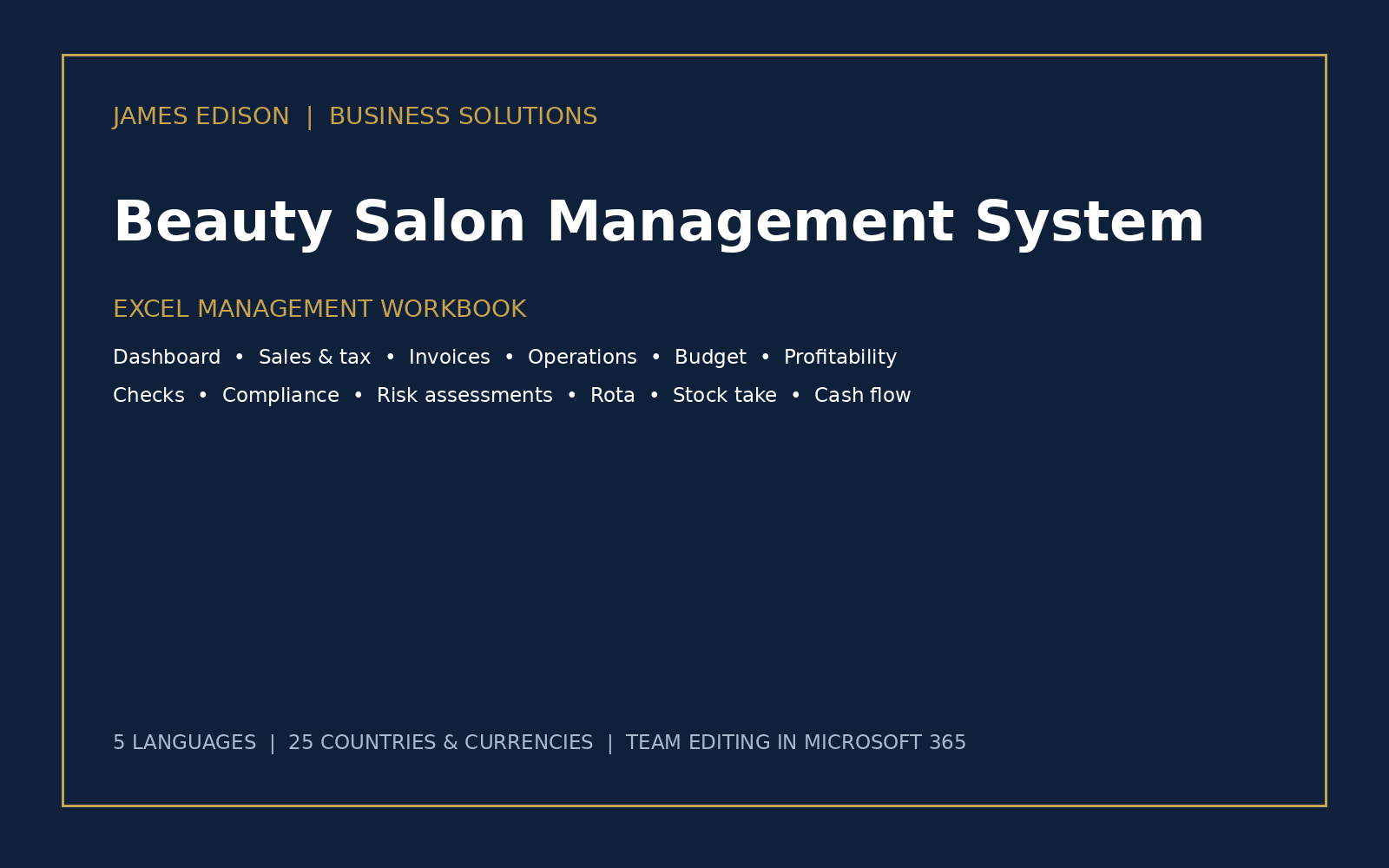
The Beauty Salon Management System is a beauty salon spreadsheet in Excel covering everything in this guide:
- Treatments tracker by therapist and treatment: treatments done, price, product cost, staff and other costs, revenue and gross profit
- Sales and VAT, invoices and aged debtors
- 12-week cash flow forecast with shortfall warnings
- Quarterly VAT summary, profit and loss, budget vs actual and a pricing calculator
- Daily checks: tools sterilised and autoclave logged, couch roll, consultation forms, patch tests, wax pots, toilets and cash
- Compliance register pre-filled with treatment liability insurance, special treatment licence, therapist qualifications, fire risk assessment, PAT testing, COSHH and data protection
- Risk assessments pre-filled for allergic reactions, dermatitis, burns, slips, chemicals, electrical equipment and fire
- Stock take pre-loaded with gel polish, lash lift kits, hot wax, couch roll, cotton pads, facial products, tan solution and retail skincare
- Staff rota with wage cost
- Dashboard with income, profit, margin, treatments done, average price, product cost % of sales, gross margin and a compliance score
It costs £15 once, with no subscription. Works alongside your booking app in Excel 2016 or later, Microsoft 365, Excel for Mac and Excel online, in 5 languages and 25 currencies.
**Get the beauty salon spreadsheet →**
Your beauty salon opening checklist
1. Choose your core treatments. 2. Write a business plan with start-up costs and break-even. 3. Check whether your council requires a special treatment licence. 4. Collect and log every therapist's qualifications. 5. Arrange treatment liability, public liability and employers' liability insurance. 6. Set up patch test and consultation form procedures. 7. Complete fire risk, COSHH and PAT testing. 8. Price every treatment by time, product and staff cost. 9. Set up stock control with reorder levels. 10. Plan for VAT before you reach the threshold. 11. Run a rota and a 12-week cash flow forecast. 12. Keep daily hygiene checks and an autoclave log.
Frequently asked questions
How much does it cost to open a beauty salon? It depends on location and size. The main costs are the premises deposit and fit-out, couches and equipment, initial stock, licensing, insurance and marketing. Many therapists start from a rented room to keep costs low.
Do I need a licence to open a beauty salon? In some areas, including London boroughs, many treatments require a special treatment licence from the council. Check with your local authority before opening.
Do I need qualifications to be a beauty therapist? Insurers usually require proof of qualification for each treatment you offer, so recognised training is effectively essential.
Why are patch tests important? They help identify allergic reactions before a treatment and give you a record that you followed safe practice.
What software do beauty salons use? Most use a booking app for appointments and many use a spreadsheet for profit, stock, compliance and cash flow to avoid extra monthly fees.
A beauty salon is built on trust, hygiene and repeat bookings. Get your licensing, records, pricing and stock under control and the business takes care of itself. The beauty salon spreadsheet gives you all of it in one Excel file for £15.