Day nurseries provide care and early education for babies and young children while parents work. Demand is strong in many parts of the UK, waiting lists are common in good settings, and a well-run nursery can be a stable business with loyal families.
It is also one of the most demanding small businesses to run. Registration and inspection, staffing ratios and qualifications, safeguarding, food safety, safe sleep, funded hours and wage costs all need tight control. This guide explains how to open a day nursery in the UK and run it profitably.
1. Plan your nursery
Decide on your age range, number of places, opening hours and approach. Many nurseries have a baby room, a toddler room and a pre-school room, each with its own ratios and space requirements. Your number of places determines your staffing, and staffing is usually by far your biggest cost.
2. Registration and inspection
Nurseries must be registered with the regulator for their nation: Ofsted in England, Care Inspectorate Wales, the Care Inspectorate in Scotland, or the local Health and Social Care Trust in Northern Ireland. Registration involves checks on the provider and manager, premises, policies and an inspection. Your inspection outcome is one of the first things parents look at.
3. Premises
Premises must meet space requirements per child by age, have suitable toilets and nappy-changing areas, a kitchen that meets food safety standards, secure entry and outdoor play space where possible. Check planning permission, parking and drop-off safety. Fit-out costs can be significant, so get quotes before you commit to a lease.
4. Staffing, ratios and qualifications
Staff-to-child ratios are set by age and must be met at all times, including breaks. A proportion of staff need relevant early years qualifications, and managers need appropriate qualifications and experience. Every staff member needs criminal record checks, paediatric first aid where required, and safeguarding training.
Build your staff rota around ratios and opening hours. An audit of staff qualifications and ratios at least yearly, and spot checks in between, protects you at inspection.
5. Fees and funded hours
Nursery income usually comes from:
- Private fees per full day or half day
- Government-funded hours paid through the local authority
- Extras: meals, consumables, breakfast club, late fees
Funded hours have expanded in recent years in England, and funding rates do not always cover the full cost of a place. Understand your local authority's rules for charging for extras and when payments arrive. Track sessions booked, average fee per session, food and consumables as a percentage of sales and gross margin, and record a next funding claim or review date.
6. Daily routines
Daily records and checks are the backbone of a safe nursery:
- Ratios met in every room
- Attendance register with arrival and collection times
- Only authorised adults collect children
- Room safety checks before children arrive
- Food prepared safely and allergies checked
- Sleep checks recorded
- Accident and incident records completed
- Nappy changes and hygiene recorded
- Fridge temperatures logged
Weekly: fire exits clear. Monthly: fire drill practised and recorded, first aid kits stocked.
Your nursery risk assessment should cover choking and allergies, safe sleep for babies, trips and falls, a lost or uncollected child, illness spreading, slips and fire.
7. Food safety
If you prepare food, register as a food business and follow a food safety management system. Keep an allergen list for every child, label food clearly and train staff. Choking risk should shape how food is prepared for each age group.
Occupancy is everything
A nursery's profit depends on occupancy: how many of your available places are filled, session by session and room by room. An empty baby room still needs staff to meet ratios for the children who are there. Track occupancy weekly by room and session, and manage it actively:
- Offer flexible sessions to fill quiet days.
- Keep a waiting list and contact families early when places open.
- Plan room moves as children age so transitions do not leave gaps.
- Watch for September and January changes when children leave for school or join.
Staff costs rise in steps as occupancy grows, so model the point where adding a child requires another member of staff.
Staff recruitment and retention
Recruiting and keeping qualified early years staff is one of the biggest challenges for nurseries. Offer training and progression, recognise good work, plan rotas fairly and keep paperwork light where you can. Track sickness, turnover and agency use each month. High turnover affects children, parents and inspection outcomes, and it costs money in recruitment and training.
Parent partnership
Regular updates on meals, sleep, nappies and learning, parents' evenings and an open-door approach build trust and help children settle. Families who feel involved stay longer and recommend you.
Inspection readiness
Keep policies, registers, training records and risk assessments up to date all year rather than preparing at the last minute. Inspections can come with little notice.
VAT and tax
Most small businesses register with HMRC for Self Assessment as sole traders, or run as a limited company once profits grow. You must register for VAT once taxable turnover passes the HMRC threshold, and some services in this sector have specific VAT treatment, so take advice from an accountant before you set prices. Once registered, a quarterly VAT summary of VAT charged, VAT reclaimable and net to pay keeps you ready for every return.
Cash flow: the number that keeps you open
Profitable businesses still run out of money when payments arrive later than bills. A 12-week cash flow forecast shows money in from customers and money out for wages, rent, supplies, insurance and tax, week by week, with a warning for any week the balance goes negative. Review it every week in your first year. It gives you time to chase payments, delay a purchase or arrange finance before a shortfall becomes a crisis.
Your first 90 days
Month one: complete registration, staffing, policies and daily routines before the first child starts. Month two: track occupancy by room and session each week, and fill gaps with flexible sessions or a breakfast club. Month three: compare staff cost against fee income by room and adjust sessions, prices or rotas so every room covers its costs.
How to work out your break-even
Break-even is the number of full-day sessions you need each month to cover all your costs.
1. Add up your monthly fixed costs: rent, insurance, software, marketing, loan payments and your own minimum drawings. 2. Work out your contribution per full-day session: your price minus the variable cost of delivering it. 3. Divide fixed costs by contribution.
For example, with fixed costs of £45,000 a month, a price of £65 per full-day session and a variable cost of £4, each full-day session contributes £61, so you would need about 738 full-day sessions a month to break even. These figures are illustrations only: use your own. A price rise lowers your break-even straight away, which is why pricing is usually the fastest lever you have.
When to raise your prices
Costs rise every year. If your prices stay still, your margin shrinks. Signs you are undercharging include being fully booked weeks ahead, customers rarely questioning your price and a gross margin that falls month by month. Review private fees each year with written notice to parents, and review extras charges alongside your local authority's funded hours rules.
Common mistakes
Underestimating staff costs. Ratios mean staff costs rise in steps as numbers grow. Model every room.
Relying on funded hours alone. Funding rates may not cover the full cost of care.
Weak records. Inspectors look closely at registers, accident records and safeguarding.
Opening with too few bookings. Pre-sell places before opening so cash flow starts quickly.
The numbers to check every month
Review sessions booked, average fee per session, food & consumables % of sales, gross margin, plus overdue invoices and your lowest cash balance in the next 12 weeks. Those numbers tell you whether the business is profitable, not just busy.
How to market your day nursery
Parents choose nurseries on trust: inspection outcome, reputation, staff and environment. A clear website with photos of rooms and outdoor space, open days, reviews from parents and partnerships with local employers and antenatal groups all help. Keep a waiting list and contact families early as places open.
The Day Nursery Management System
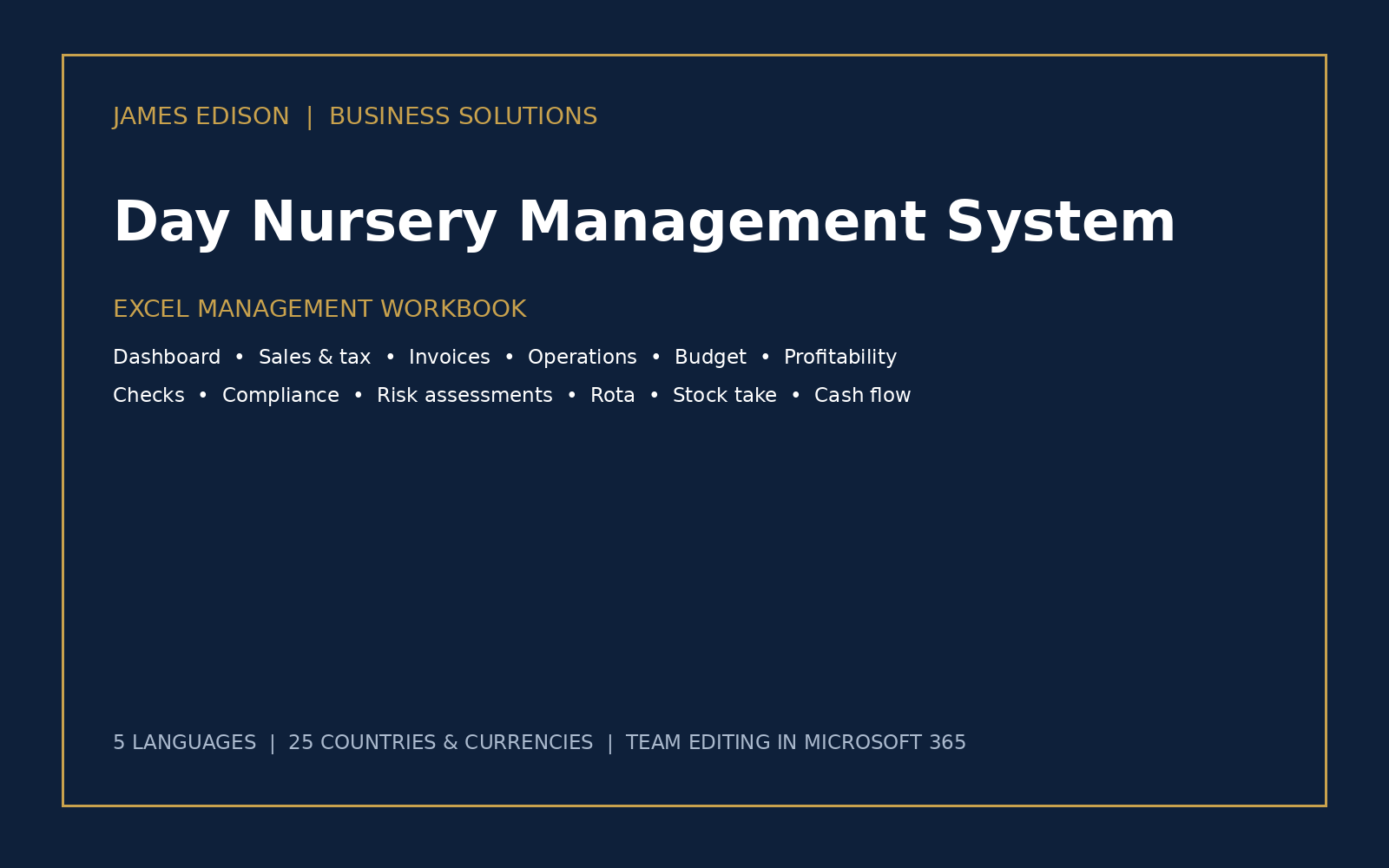
The Day Nursery Management System is a nursery management spreadsheet in Excel built around this guide:
- Session tracker with sessions booked, fee per session, food & consumables per session, staff & other costs, revenue, gross profit and a next funding claim / review reminder
- Sales and VAT, invoices and aged debtors with a "chase these first" list
- 12-week cash flow forecast with shortfall warnings
- Quarterly VAT summary, profit and loss, budget vs actual and a pricing calculator
- Daily, weekly and monthly checks including adult to child ratios within registration, attendance register with arrival and collection times, only authorised adults collect children, room safety checks before children arrive, food prepared safely and allergies checked and more
- Compliance register pre-filled with registration with the childcare regulator, paediatric first aid certificate, safeguarding training, staff background checks, food hygiene inspection / registration, public liability insurance and more, with renewal reminders
- Risk assessments pre-filled for choking and food allergies, safe sleep for babies, trips and falls, lost or uncollected child, illness spreading between children, slips, trips and falls, fire
- Stock take pre-loaded with nappies and wipes, snacks and meals, fresh milk, craft and activity supplies, cleaning chemicals, disposable gloves, first aid refills, toilet roll
- Staff rota with wage cost
- Dashboard with income, profit, margin, sessions booked, average fee per session, food & consumables % of sales, gross margin and a compliance score
It costs £15 once, with no subscription and no app. It works in Excel 2016 or later, Microsoft 365, Excel for Mac and Excel online, in 5 languages and 25 currencies.
**Get the nursery management spreadsheet →**
Your start-up checklist
1. Plan age range, places, hours and rooms. 2. Write a business plan with occupancy and staffing costs. 3. Find premises and check planning, space and fit-out costs. 4. Register with the regulator for your nation. 5. Recruit qualified staff and complete criminal record checks. 6. Arrange paediatric first aid and safeguarding training. 7. Arrange public and employers' liability insurance. 8. Register as a food business and set up food safety. 9. Complete fire risk assessment and extinguisher servicing. 10. Set private fees and understand funded hours rules. 11. Build a rota that meets ratios at all times. 12. Run a 12-week cash flow forecast.
Frequently asked questions
How much does it cost to open a day nursery? Costs depend heavily on premises. The main items are the lease, fit-out, equipment and resources, registration, insurance, staff recruitment and working capital while places fill.
Do I need to register a day nursery? Yes. Nurseries must register with the regulator for their nation and will be inspected.
What are nursery staff ratios? Ratios are set by law according to children's ages and staff qualifications. Check the current rules for your nation and meet them at all times.
Are funded hours profitable? It depends on your local funding rate and your costs. Many nurseries rely on private fees and permitted extras to cover the gap.
What software do nurseries use? Many use a nursery app for registers and parent communication, and a spreadsheet for fees, occupancy, staffing costs, compliance and cash flow.
How full does a nursery need to be to make money? It depends on your fees, funding rates and staff costs. Track occupancy by room and session and find the level at which each room covers its staff and overheads.
Getting the systems right from day one is what turns a good day nursery into a lasting one. The nursery management spreadsheet puts it all in one Excel file for £15.