Every small business needs its books kept, and many owners would rather pay someone than do it themselves. Bookkeeping can be run from home with low start-up costs and builds recurring monthly income from loyal clients.
It also carries real responsibility. Anti-money laundering supervision, data security, deadlines and accuracy all matter, and pricing badly can leave you working long hours for little. This guide explains how to start a bookkeeping business in the UK.
1. Skills and qualifications
There is no legal requirement to hold a bookkeeping qualification in the UK, but recognised qualifications and professional body membership build trust and often come with supervision, insurance options and support. Keep your CPD up to date and log it monthly.
2. Anti-money laundering supervision
Bookkeepers providing services to businesses must be supervised for anti-money laundering (AML), either by HMRC or by a professional body. Before taking on clients, carry out client ID and AML checks, assess risk and keep records. Make these weekly checks for new clients.
3. Insurance, data and security
You will need professional indemnity insurance, and many bookkeepers also take cyber insurance. Register with the ICO for data protection. Back up data, use two-factor login on every system, encrypt devices and check passwords monthly. A data breach can end a practice.
4. Services
- Monthly bookkeeping and bank reconciliations
- VAT returns
- Payroll
- Year-end preparation for the accountant
- Self Assessment records
- Credit control
- Software setup and training
- Catch-up work for neglected records
Making Tax Digital for Income Tax is being phased in for sole traders and landlords above income thresholds from April 2026, which is creating demand for help with digital records and quarterly updates.
5. Bookkeeping prices
Hourly rates are simple but cap your income. Many bookkeepers move to fixed monthly fees based on transaction volume, number of bank accounts, VAT and payroll. Track hours, rate per hour, staff cost, software and other costs, revenue per client and gross margin. Record time against every client so you can see which fixed fees are really profitable.
6. Engagement letters and deadlines
Every client needs an engagement letter setting out scope, fees, responsibilities and timelines. Keep a client deadline calendar for VAT, payroll and year ends and review it daily. Chase records early so deadlines do not become emergencies.
7. Daily routine
- Daily: deadlines reviewed, bank feeds reconciled, data backed up and secure, time recorded, work reviewed before submission
- Weekly: engagement letters for new clients, ID and AML checks, client records chased, invoices sent and fees chased
- Monthly: passwords and two-factor access checked, CPD logged, complaints reviewed
Your risk assessment should cover cyber attack and data breach, errors in filings, deadline overload, screen use and posture, lone working, electrical equipment and fire.
Onboarding new clients
A structured onboarding process saves time later. Carry out ID and AML checks, sign the engagement letter, collect logins and bank access, agree the monthly routine and deadlines, and set expectations on how and when the client sends records. Clean up historic records before starting regular work, and price catch-up work separately. Clients who start well usually stay well.
Growing beyond yourself
A solo bookkeeper's income is limited by their hours. Growth options include fixed monthly packages that reward efficiency, automation through bank feeds and receipt capture, a part-time assistant for data entry, and partnerships with accountants who refer clients. Track revenue per client and per hour every month. If a client consistently takes far longer than their fee covers, reprice or let them go.
Plan capacity around busy periods such as VAT quarters, payroll year end and Self Assessment deadlines. Spreading work evenly through the year keeps quality high and stress manageable.
A typical week in a bookkeeping practice
Monday: review the deadline calendar for the next 30 days, reconcile bank feeds for monthly clients and chase any missing records. Tuesday and Wednesday: process bookkeeping, payroll and VAT work in deadline order, recording time against each client as you go. Thursday: review completed work before submission, send VAT returns and payroll reports for approval, and answer client queries. Friday: invoice clients, chase unpaid fees, run onboarding checks for new clients, back up data and plan next week.
Batch similar tasks together, such as all bank reconciliations, then all payroll, because switching between clients wastes time. Set a regular day by which clients must send records each month, and stick to it. Clients who send everything at the last minute should pay a rush fee or move to a more structured service.
Choosing your target clients
Specialising in a sector, such as trades, hospitality, landlords or online sellers, lets you build templates, learn the common problems and market directly to those businesses. Sector bookkeepers often charge more because they understand the work. Look at which of your existing clients are easiest to serve and most profitable, and find more like them.
Data security basics
Use a password manager, two-factor login on every client system, encrypted laptops and phones, and automatic backups. Never send client data by unencrypted email, and remove access when a client leaves.
VAT and tax
Most small businesses register with HMRC for Self Assessment as sole traders, or run as a limited company once profits grow. You must register for VAT once taxable turnover passes the HMRC threshold, and some services in this sector have specific VAT treatment, so take advice from an accountant before you set prices. Once registered, a quarterly VAT summary of VAT charged, VAT reclaimable and net to pay keeps you ready for every return.
Cash flow: the number that keeps you open
Profitable businesses still run out of money when payments arrive later than bills. A 12-week cash flow forecast shows money in from customers and money out for wages, rent, supplies, insurance and tax, week by week, with a warning for any week the balance goes negative. Review it every week in your first year. It gives you time to chase payments, delay a purchase or arrange finance before a shortfall becomes a crisis.
Your first 90 days
Month one: complete AML supervision, insurance, data protection and engagement letter templates. Month two: take on your first clients and record time on every task. Month three: compare time spent with fees charged for each client and move underpriced clients to proper fixed fees.
How to work out your break-even
Break-even is the number of client months you need each month to cover all your costs.
1. Add up your monthly fixed costs: rent, insurance, software, marketing, loan payments and your own minimum drawings. 2. Work out your contribution per client month: your price minus the variable cost of delivering it. 3. Divide fixed costs by contribution.
For example, with fixed costs of £600 a month, a price of £250 per client month and a variable cost of £30, each client month contributes £220, so you would need about 3 client months a month to break even. These figures are illustrations only: use your own. A price rise lowers your break-even straight away, which is why pricing is usually the fastest lever you have.
When to raise your prices
Costs rise every year. If your prices stay still, your margin shrinks. Signs you are undercharging include being fully booked weeks ahead, customers rarely questioning your price and a gross margin that falls month by month. Review fixed fees at each client's anniversary, and reprice when transaction volume or scope grows.
Common mistakes
Charging by the hour forever. Fixed fees reward efficiency and are easier for clients to budget.
No engagement letters. Scope creep follows when expectations are not written down.
Weak security. Client data is valuable to criminals. Protect it.
Taking every client. Disorganised, slow-paying clients cost more than they pay.
The numbers to check every month
Review average revenue per client, hours worked, revenue per hour, software & other % of revenue, plus overdue invoices and your lowest cash balance in the next 12 weeks. Those numbers tell you whether the business is profitable, not just busy.
How to market your bookkeeping business
Referrals from accountants, business networks and happy clients bring most bookkeeping work. Partner with local accountants who need bookkeepers for their clients, publish clear service packages and get listed with accounting software partner directories. Track where each client came from.
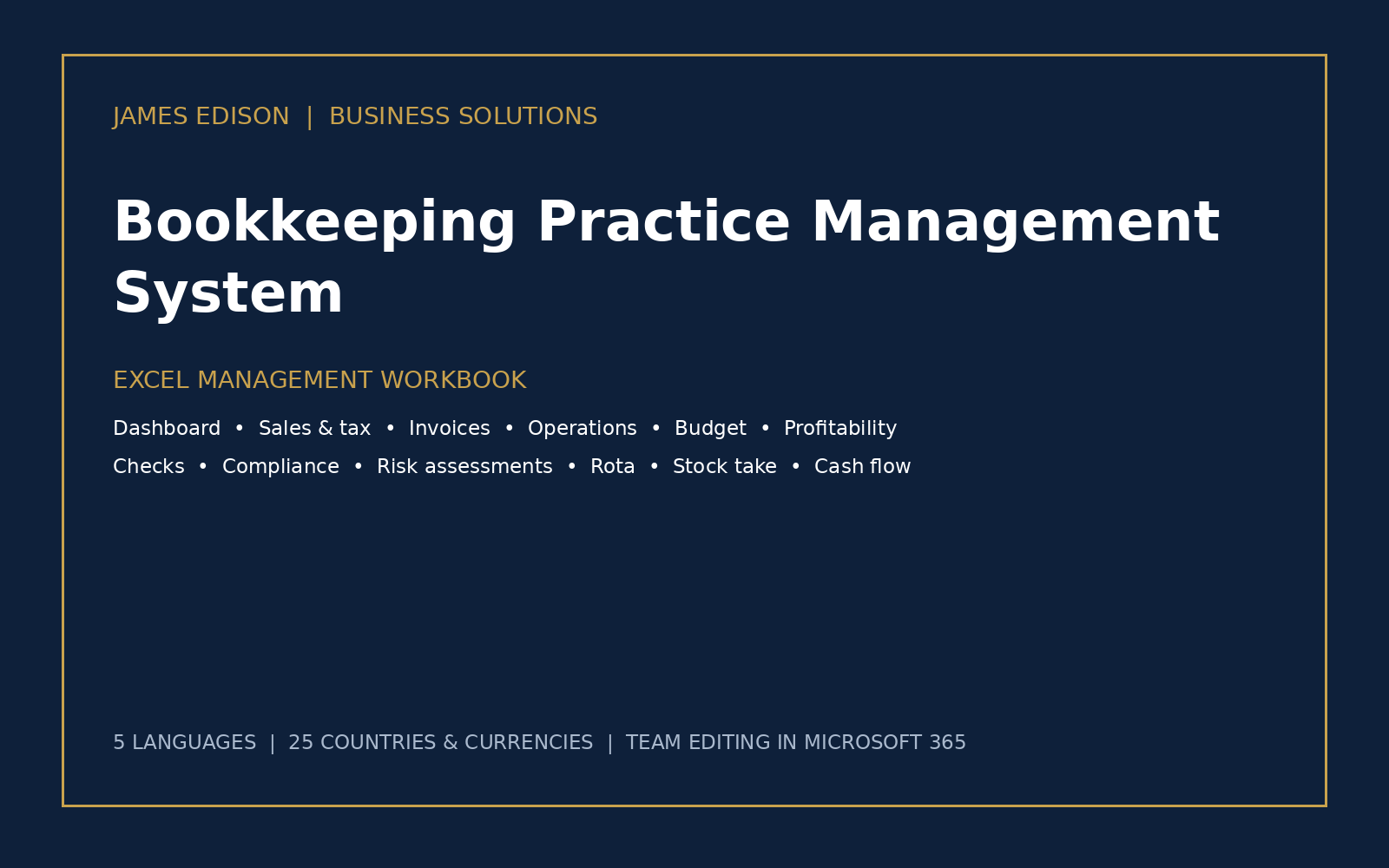
The Bookkeeping Practice Management System
The Bookkeeping Practice Management System is a bookkeeping practice spreadsheet in Excel built around this guide:
- Service tracker with hours, rate per hour, staff cost per hour, software & other costs, revenue, gross profit and a next deadline (VAT, payroll, year end) reminder
- Sales and VAT, invoices and aged debtors with a "chase these first" list
- 12-week cash flow forecast with shortfall warnings
- Quarterly VAT summary, profit and loss, budget vs actual and a pricing calculator
- Daily, weekly and monthly checks including client deadlines calendar reviewed, bank feeds reconciled, data backed up and access secure, time recorded against clients, work reviewed before submission and more
- Compliance register pre-filled with anti-money laundering supervision, professional body membership, professional indemnity insurance, data protection registration, tax authority agent services account, accounting software partner licences and more, with renewal reminders
- Risk assessments pre-filled for cyber attack and data breach, errors in client filings, deadline stress and overload, screen use and posture, lone working, electrical equipment, fire
- Stock take pre-loaded with printer paper, printer ink, files and folders, envelopes and postage, encrypted USB drives, office stationery, receipt scanning supplies, cleaning chemicals
- Staff rota with wage cost
- Dashboard with income, profit, margin, average revenue per client, hours worked, revenue per hour, software & other % of revenue and a compliance score
It costs £15 once, with no subscription and no app. It works in Excel 2016 or later, Microsoft 365, Excel for Mac and Excel online, in 5 languages and 25 currencies.
**Get the bookkeeping practice spreadsheet →**
Your start-up checklist
1. Decide your services and target clients. 2. Get qualified or join a professional body. 3. Register for AML supervision. 4. Register for data protection. 5. Arrange professional indemnity and cyber insurance. 6. Set up an agent services account if acting for clients with HMRC. 7. Choose accounting software partnerships. 8. Write engagement letters. 9. Set fixed monthly fees or hourly rates. 10. Build a client deadline calendar. 11. Record time against every client. 12. Run a 12-week cash flow forecast.
Frequently asked questions
Do I need a qualification to be a bookkeeper? Not legally, but recognised qualifications and professional body membership build credibility.
Do bookkeepers need AML supervision? Yes, bookkeepers providing services to businesses must be supervised for anti-money laundering by HMRC or a professional body.
How much do bookkeepers charge? Rates vary. Many move from hourly rates to fixed monthly fees based on the work involved.
What insurance does a bookkeeper need? Professional indemnity insurance is essential, and cyber insurance is increasingly common.
What software do bookkeepers use? Cloud accounting software for client books, and often a spreadsheet for client profitability, deadlines, compliance and cash flow.
Should I charge fixed fees or hourly rates? Fixed monthly fees are easier for clients to budget and reward you for working efficiently. Base them on transaction volume, bank accounts, VAT and payroll, and record your time so you can check each fee stays profitable.
How many clients can one bookkeeper handle? It depends on the size and complexity of each client. Track hours per client each month; your real capacity is the number of clients whose work fits your available hours with time to spare for deadlines.
Can I work for clients anywhere in the UK? Yes. Cloud accounting software lets you work remotely, which widens your market beyond your local area.
Getting the systems right from day one is what turns a good bookkeeping business into a lasting one. The bookkeeping practice spreadsheet puts it all in one Excel file for £15.