Plenty of good bricklayers and builders go it alone every year. Extensions, garden walls, garage conversions, porches and repairs keep demand strong in most areas. Yet construction has one of the highest business failure rates of any sector, and it is rarely down to poor workmanship. It is down to job costing, cash flow and paperwork.
This guide covers how to start a building business in the UK, whether you are a bricklayer going self-employed or a small builder taking on bigger projects. It covers structure, CIS, insurance, pricing and job costing, materials, subcontractors, site safety, VAT and the cash flow habits that keep you trading.
1. Decide what you build
"Builder" covers everything from a garden wall to a two-storey extension. Narrowing your focus makes pricing, marketing and planning easier:
- Brickwork and blockwork: walls, extensions, chimneys and repointing, often as a subcontractor to main builders.
- Small domestic builds: porches, garage conversions, single-storey extensions.
- Landscaping construction: patios, steps and boundary walls.
- Repairs and maintenance: lintels, wall repairs, chimney work for homeowners and letting agents.
- Main contracting: running whole projects with your own subcontractors.
Subcontracting to other builders gives steadier work and less admin; main contracting gives bigger margins and bigger risks. Many start as subcontractors and move up.
2. Business structure and the Construction Industry Scheme (CIS)
Most new builders start as sole traders registered for Self Assessment, then consider a limited company as profits grow. An accountant can model the difference for you.
The Construction Industry Scheme (CIS) is central to construction finance in the UK. If you work as a subcontractor for a contractor, they may deduct tax from your payments and pass it to HMRC. If you pay subcontractors yourself, you must register as a contractor, verify each subcontractor with HMRC and make the right deductions and monthly returns. Getting CIS wrong leads to penalties, so log your registration and verify every subcontractor before you pay them.
Open a separate business bank account from day one. Construction involves large material purchases and stage payments, and mixing them with personal money hides your real profit.
3. Insurance and cards
Most building businesses need:
- Public liability insurance: essential, and often required by customers and main contractors.
- Employers' liability insurance: a legal requirement once you employ anyone.
- Contract works insurance: covers the work in progress against damage or theft.
- Tools and plant insurance.
- Van and vehicle insurance for business use.
Many sites require CSCS cards for everyone working on them. If you offer warranties, an insurance-backed guarantee can reassure homeowners on bigger jobs. Log every policy, card and scheme in a compliance register with expiry dates and reminders.
4. Job costing: where builders win or lose
Builder job costing is the single most important skill in the business. For every job you need to know:
- Labour hours for each trade, at your charge rate and your real cost per hour
- Materials: bricks, blocks, cement, sand, ties, lintels, DPC, plasticiser, skips and deliveries
- Plant and equipment hire: mixers, saws, scaffold
- Overheads: van, fuel, insurance, phone, accountant
- Contingency: for the problems you find once you start digging or opening up walls
Underestimate labour by a day or materials by a pallet on a fixed-price job and your profit disappears. Track actual hours and materials on every job and compare them to your estimate. After a few jobs you will know your real productivity, and your quotes get sharper.
5. How to price building work
Start with your true hourly or daily cost: yearly overheads divided by realistic billable days. Weather, quoting, collecting materials, snagging and admin all reduce billable time.
Pricing options:
- Day rate for subcontract brickwork and uncertain repair work.
- Price per thousand bricks or per square metre, common for bricklaying.
- Fixed price for defined jobs like garden walls, patios and porches.
- Fixed price with stage payments for extensions and conversions.
Always decide how materials are charged: at cost, at cost plus a mark-up, or included in a fixed price. A pricing calculator that works back from your target margin removes the guesswork.
6. Stage payments protect your cash
On bigger jobs, never fund the whole build yourself. Agree stage payments in writing: a deposit to cover materials, then payments at clear milestones such as foundations, wall plate, roof on and completion. Record the next stage or payment due for every job, and get a reminder before it arrives so you invoice on time.
7. Materials and stock control
Materials are the biggest cost on most building jobs and the easiest place to lose money: over-ordering, theft from site, waste and items bought twice.
A builder materials tracker lists each item (facing bricks, concrete blocks, cement, building sand, wall ties, steel lintels, DPC, mortar plasticiser) with unit cost, opening stock, deliveries, closing count and reorder level. Usage and stock value calculate automatically. Check deliveries against the order every time; short deliveries are common and easy to miss.
8. Managing subcontractors
As you grow you will use subcontractors: groundworkers, roofers, plasterers, electricians, plumbers. For each one:
- Verify them for CIS before paying.
- Check their insurance and cards.
- Agree price and scope in writing.
- Track what you owe and when.
Subcontractor costs go into your job costing so you can see true job profit.
9. Invoices, debtors and retentions
Invoice promptly at each stage. Track every invoice as Paid, Open or Overdue, and use an aged debtors report to see who is late. Main contractors sometimes pay slowly or hold retentions, so agree terms clearly and chase consistently. A "chase these first" list keeps your effort on the biggest, oldest debts.
10. VAT
Register for VAT once taxable turnover passes the HMRC threshold. Construction VAT can be complex: the domestic reverse charge applies to some work between VAT-registered construction businesses, and some types of building work carry different VAT rates. Take advice from an accountant who knows construction.
A quarterly VAT summary of VAT charged, VAT reclaimable and net to pay helps you set money aside. Check with your accountant before filing.
11. Cash flow: the number one killer
Construction cash flow is brutal. You buy materials, pay wages and subcontractors weekly, and get paid in stages, sometimes late. A profitable builder with two slow-paying jobs can run out of money in weeks.
A 12-week cash flow forecast maps expected money in from stage payments and money out for wages, materials, plant hire, rent and tax, showing the bank balance each week and warning you of shortfalls. Review it weekly. It tells you when to chase a payment, ask for a deposit or delay a purchase.
12. Site safety and risk assessments
Construction is one of the highest-risk industries. Your builder risk assessment should cover:
- Working at height: scaffolds, ladders and roofs.
- Falling materials and collapse: propping, correct lintels, exclusion zones and hard hats.
- Silica dust: cutting bricks, blocks and concrete creates harmful dust. Use water suppression or extraction and fitted FFP3 masks.
- Asbestos in older buildings: check before drilling or demolishing.
- Manual handling: blocks, bags and lintels are heavy.
- Machinery and power tools.
- Members of the public on site.
Back it up with daily and weekly checks: site fenced and secure at end of day, dust controls in place, asbestos checked, deliveries checked, scaffold inspected and tagged every seven days, mixer and saws checked, PPE in good condition. Records like these protect you if something goes wrong.
13. Builder business software: app or spreadsheet?
Construction management software is often built for large contractors and priced to match, with monthly per-user fees. A small builder or bricklayer usually needs something simpler: one place for jobs, costs, materials, invoices, VAT, cash flow, compliance and site checks, with a dashboard. A good spreadsheet does that with no monthly fee, and your data stays yours.
Common mistakes new builders make
Quoting without a site visit. Ground conditions, access and existing structures change everything. Always visit and measure.
No written variations. Customers change their minds mid-job. Agree every change and its price in writing before you do it, or it becomes free work.
Funding the job yourself. Without deposits and stage payments, one slow payer can stall the whole business.
Not checking deliveries. Short deliveries and wrong materials are common. Check every delivery against the order before the driver leaves.
The numbers to check every month
Review your job profit against estimate, average job value, labour margin, materials billed, overdue invoices and your lowest cash balance in the next 12 weeks. These tell you whether you are pricing properly and whether the business can fund the next big job.
How to market your building business
Marketing a building business is about being found, being trusted and being rebooked. Photos of finished work, reviews and word of mouth win most building jobs. Relationships with architects, letting agents and other trades bring a steady pipeline. Track each enquiry's source and conversion rate.
The most effective marketing for most small building businesses is free: excellent work, prompt replies, honest prices and asking every happy customer for a review. Paid advertising works best once your pricing, capacity and customer records are in place, because you will know exactly what a new customer is worth to you over a year.
The Builder & Bricklayer Business Management System
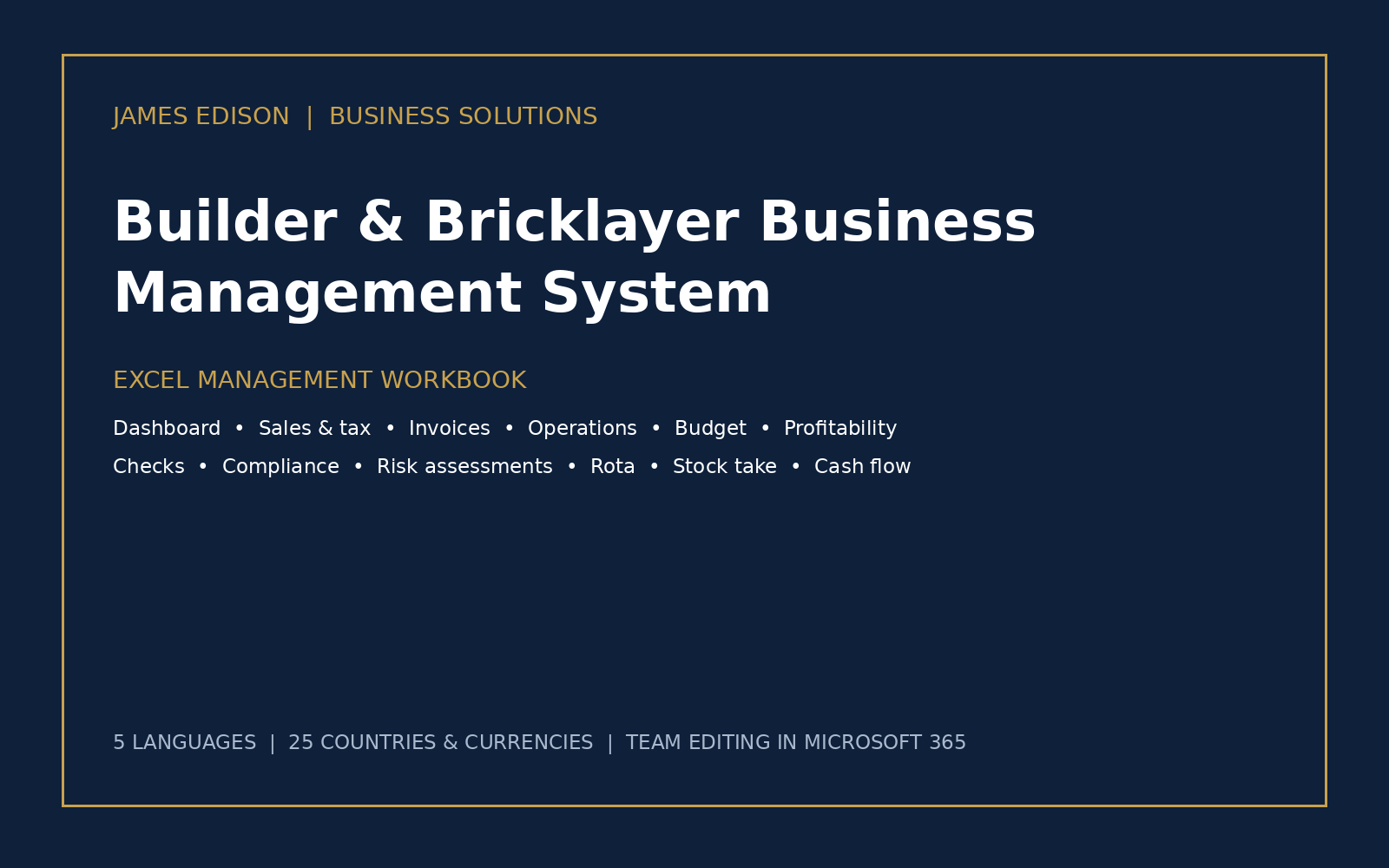
The Builder & Bricklayer Business Management System is a builder business spreadsheet in Excel covering everything above:
- Job tracker with labour hours, charge and cost per hour, materials, revenue, gross profit and a next stage / payment due reminder
- Sales and VAT, invoices and aged debtors with a "chase these first" list
- 12-week cash flow forecast with shortfall warnings
- Quarterly VAT summary, profit and loss, budget vs actual and a pricing calculator
- Site checks: site secure, dust controls, asbestos, deliveries, scaffold inspections, power tools, PPE and trailer
- Compliance register pre-filled with skills cards, subcontractor tax verification, guarantee scheme, contract works insurance, public and employers' liability, vehicle, waste carrier and tools insurance
- Risk assessments pre-filled for working at height, collapse, silica dust, asbestos, manual handling, machinery and the public
- Materials stock take pre-loaded with bricks, blocks, cement, sand, ties, lintels, DPC and plasticiser
- Staff rota with wage cost
- Dashboard with income, profit, margin, average job value, labour hours sold, materials billed, labour margin and a compliance score
It costs £15 once. No subscription, no app. It works in Excel 2016 or later, Microsoft 365, Excel for Mac and Excel online, in 5 languages and 25 currencies.
**Get the builder business spreadsheet →**
Your building business start-up checklist
1. Decide your focus: brickwork, small builds, repairs, landscaping construction or main contracting. 2. Register as a sole trader or limited company and open a business account. 3. Register for CIS and verify every subcontractor before paying. 4. Arrange public liability, employers' liability, contract works and tools insurance. 5. Get CSCS cards for anyone who needs them. 6. Cost every job: labour, materials, plant, overheads and contingency. 7. Agree stage payments in writing on larger jobs. 8. Track materials and check every delivery. 9. Invoice each stage on time and chase debtors weekly. 10. Get construction VAT advice and keep a quarterly VAT summary. 11. Run a 12-week cash flow forecast. 12. Write site risk assessments and keep daily and weekly safety checks.
Frequently asked questions
How much does it cost to start a building business? It depends on the tools, van and plant you already own. Key costs are a van, tools, insurance, CSCS cards, initial materials and marketing. Hiring plant rather than buying it keeps start-up costs down.
Do bricklayers need to register for CIS? If you work as a subcontractor for a contractor in construction, you should register so deductions are made at the right rate. If you pay subcontractors, you must register as a contractor.
How do builders price a job? Estimate labour, materials, plant, overheads and contingency, then add your profit margin. Track actual costs on every job to improve future quotes.
Why do so many building businesses fail? Most fail on cash flow and underpricing rather than workmanship. Stage payments, accurate job costing and a weekly cash flow forecast reduce the risk.
What software should a small builder use? Many small builders use a spreadsheet for job costing, invoices, materials, VAT and cash flow before moving to construction software as the business grows.
The difference between a builder and a building business is control of the numbers. Cost every job, get paid in stages and watch your cash weekly. The builder business spreadsheet puts it all in one Excel file for £15.