Skilled carpenters and joiners are in constant demand. Kitchens, wardrobes, doors, staircases, decking, extensions, sash windows and fire doors all need someone who can measure accurately and build properly. Many carpenters have more enquiries than they can handle.
Yet plenty of talented joiners still earn less than they should. The reason is rarely the work itself. It is underpricing, materials that are not tracked, quotes that miss half the job and cash tied up in timber. This guide explains how to start a carpentry business in the UK and run it profitably: choosing your work, setting up, insurance, pricing, job costing, timber stock, safety, VAT and cash flow.
1. Choose your carpentry niche
"Carpenter" covers very different businesses:
- First fix: structural timber, stud walls, floors and roofs on building sites. Often CIS subcontract work.
- Second fix: doors, skirting, architrave, staircases and finishing. Skilled, visible work.
- Kitchen fitting: high-value, repeatable jobs, often through kitchen showrooms.
- Bespoke furniture and fitted wardrobes: premium pricing, workshop time and design skills.
- Joinery workshop: windows, doors and staircases made to order.
- Fire doors: a specialist and regulated niche with strong commercial demand.
- Decking and garden structures: seasonal and materials-heavy.
- Property maintenance: letting agent repairs and small jobs.
Specialising lets you charge more, market more precisely and become efficient at the work you do most.
2. Setting up the business
Most carpenters start as sole traders registered with HMRC for Self Assessment, moving to a limited company as profits grow. If you do construction work as a subcontractor or pay subcontractors, the Construction Industry Scheme (CIS) applies, so register and verify subcontractors before paying them.
Open a business bank account straight away. Timber and fixings are large, frequent purchases and need to be kept separate from personal spending.
3. Insurance and credentials
Most carpentry businesses carry:
- Public liability insurance: covers damage to customers' property or injury to others.
- Employers' liability insurance: a legal requirement once you employ anyone, including apprentices.
- Tools insurance: power tools and hand tools are expensive and frequently stolen.
- Van insurance for business use.
Credentials help win work: CSCS cards for site work, trade association membership and, for fire doors, fire door installer certification through a recognised third-party scheme. Fire doors are life-safety products, and commercial clients and landlords increasingly require certified installers. Log every policy, card and certificate in a compliance register with expiry dates.
4. Carpenter pricing
Carpenter pricing starts with your true daily cost: yearly overheads (van, fuel, tools, insurance, workshop rent, phone, marketing, accountant) divided by realistic billable days. Quoting visits, collecting timber, workshop prep and admin all reduce billable time.
Then choose a structure:
- Day rate for site work and uncertain jobs.
- Fixed price for defined jobs: hanging doors, skirting a room, fitting a kitchen, building a wardrobe.
- Fixed price plus materials for bespoke work, where timber prices can move.
Always price materials clearly, at cost, with a mark-up or within a fixed price. A pricing calculator that works back from your target margin makes every quote consistent.
5. How to quote carpentry jobs
A good joinery quote covers:
- Measurements and drawings, especially for bespoke work
- Materials: timber, sheet materials, fixings, glue, hinges and door furniture, finishes
- Labour: site time plus workshop time
- Access and protection: dust sheets, floor protection, furniture moving
- Waste removal
- What is excluded: decorating, plastering, electrics and plumbing
Put inclusions and exclusions in writing and agree any variations before doing the extra work.
6. Job costing
Joinery job costing shows whether each job made money. For every job record:
- Client and address
- Job type (doors, kitchen, staircase, wardrobes, skirting, repairs, decking, sash windows)
- Labour hours, charge per hour and labour cost per hour
- Materials
- Revenue, total cost and gross profit
- Job date and a follow-up date
After a few months you will see which job types earn the most per hour. Many joiners find that fixed-price door hanging and kitchen fitting beat bespoke work once design and workshop time are counted. That insight should shape your pricing and marketing.
7. Timber and stock control
Timber is expensive, bulky and easy to over-order. A timber stock spreadsheet lists each item (wood screws, MDF sheets, plywood, planed timber, wood glue, hinges and door furniture, skirting board and sanding sheets) with unit cost, opening stock, deliveries, closing count and reorder level. Usage and stock value work themselves out and low items are flagged.
Check every timber delivery and store it dry and flat. Warped or damp timber costs you twice: once to buy, again to replace.
8. Health and safety for carpenters
Your carpenter risk assessment should cover:
- Machinery: saws, routers and planers with guards checked daily.
- Wood dust: hardwood and MDF dust are harmful to breathe. Use extraction, vacuum rather than sweep and wear FFP3 masks.
- Manual handling of sheet materials and doors.
- Working at height on ladders and towers.
- Asbestos in older buildings before cutting or drilling.
- Hidden cables and pipes when fixing into walls and floors.
- Slips and trips on site.
Daily checks: saws and guards checked, dust extraction on, hidden pipes and cables detected before fixing, asbestos checked, protection in place. Weekly: timber deliveries checked, tools and PPE inspected.
9. Invoices and getting paid
Take a deposit for materials on larger and bespoke jobs, invoice promptly on completion and track every invoice as Paid, Open or Overdue. An aged debtors report shows who to chase first. Main contractors can pay slowly, so agree terms in writing.
10. VAT
Register for VAT once taxable turnover passes the HMRC threshold. Construction VAT includes the domestic reverse charge for some work between VAT-registered businesses, so get advice from an accountant. A quarterly VAT summary keeps you ready for each return.
11. Cash flow
Bespoke jobs and kitchens can tie up cash in materials for weeks. A 12-week cash flow forecast shows money in from deposits and invoices and money out for timber, wages, van costs and tax, with warnings for any week the balance goes negative.
Common mistakes new carpenters make
Forgetting workshop time. Bespoke work involves hours of making before you set foot on site. Price it.
Vague quotes. "Fit kitchen" without stating what is included leads to disputes. Spell it out.
Buying timber for every job separately. Small orders cost more and waste time. Keep core stock with reorder levels.
Ignoring dust. Wood dust causes long-term lung damage. Extraction and masks are not optional.
The numbers to check every month
Review average job value, labour hours sold, materials billed, labour margin, overdue invoices and your lowest cash balance in the next 12 weeks. They show whether your quotes are right and whether you can afford the next big materials order.
How to market your joinery business
Carpentry sells on photos. Show finished kitchens, staircases and fitted furniture on your website and social media, with before and after shots. Ask every happy client for a review. Build relationships with kitchen showrooms, builders, letting agents and architects who need reliable joiners. Fire door certification opens commercial work with landlords and facilities managers. Track where enquiries come from and focus on what wins jobs.
Your first 90 days as a joinery business
Month one: set up insurance, your job tracker and a standard price list for common jobs such as hanging a door, fitting skirting per room and building a standard wardrobe. Month two: compare actual hours with your quotes on every job and adjust. Month three: look at which job types earn the most per hour and focus your marketing there. Start collecting photos of every finished job from day one, because your portfolio is your best sales tool.
Hiring your first employee or apprentice
Taking on an apprentice or labourer doubles what you can quote for, but adds wages, employer's National Insurance, pension contributions and employers' liability insurance. Before you hire, check your job tracker: do you have enough booked work to keep two people busy for three months? Use the rota to plan hours and the cash flow forecast to make sure wages are covered in quiet weeks.
How to work out your break-even
Break-even is the number of labour days you need each month to cover all your costs. It is the single most useful number for a new joinery business.
1. Add up your monthly fixed costs: everything you pay whether you are busy or not, such as rent, insurance, vehicle finance, phone, software, marketing and your own minimum drawings. 2. Work out your contribution per labour day: your price per labour day minus the variable cost of delivering it (staff time, materials, fuel, products or fees). 3. Divide fixed costs by contribution.
For example, if your fixed costs were £2,500 a month, your average price per labour day was £300 and your variable cost per labour day was £140, each labour day would contribute £160 towards fixed costs. You would need about 16 labour days a month just to break even. Everything above that is profit. These figures are illustrations only: use your own.
Knowing your break-even tells you how busy you need to be, whether a quiet month is a problem, and what happens if you raise prices or cut costs. A price rise lowers your break-even straight away, which is why pricing is usually the fastest lever you have.
When and how to raise your prices
Costs rise every year: fuel, insurance, materials, wages and rent. If your prices stay still, your margin shrinks. Review prices at least once a year, and sooner if a major cost jumps.
Signs you are undercharging:
- You are fully booked weeks ahead
- Customers rarely question your price
- Your gross margin is falling month by month
- You are busy but your bank balance is not growing
Raise prices on new quotes first. Customers comparing quotes care most about quality, reliability and clear paperwork. Track your average price and gross margin monthly after any change, so you can see the effect in your own numbers rather than guessing.
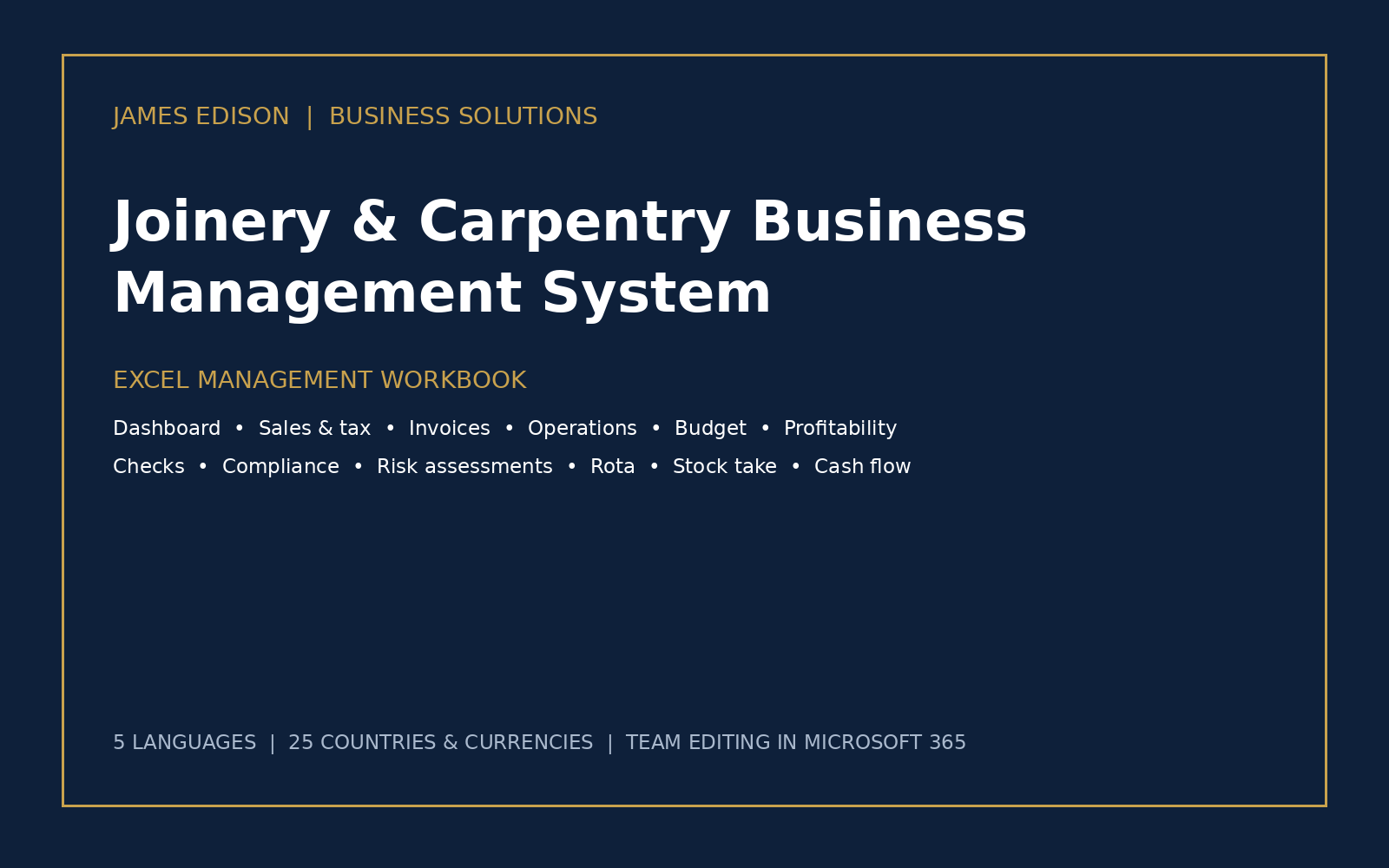
The Joinery & Carpentry Business Management System
The Joinery & Carpentry Business Management System is a joinery business spreadsheet in Excel covering this guide:
- Job tracker with labour hours, charge and cost per hour, materials, revenue, gross profit and a follow-up due reminder
- Sales and VAT, invoices and aged debtors with a "chase these first" list
- 12-week cash flow forecast with shortfall warnings
- Quarterly VAT summary, profit and loss, budget vs actual and a pricing calculator
- Daily and weekly checks: saws and guards, dust extraction, hidden cables and pipes, asbestos, protection, timber deliveries, tools and PPE
- Compliance register pre-filled with fire door installer certification, trade association, CSCS cards, CIS, insurance, vehicle, waste carrier, tools and PAT testing
- Risk assessments pre-filled for machinery, wood dust, manual handling, working at height, asbestos, electrics and slips
- Stock take pre-loaded with screws, MDF, plywood, planed timber, glue, hinges, skirting and sanding sheets
- Staff rota with wage cost
- Dashboard with income, profit, margin, average job value, labour hours, materials billed, labour margin and a compliance score
It costs £15 once, with no subscription. Works in Excel 2016 or later, Microsoft 365, Excel for Mac and Excel online, in 5 languages and 25 currencies.
**Get the joinery business spreadsheet →**
Your carpentry business start-up checklist
1. Choose your niche: first fix, second fix, kitchens, bespoke, fire doors or maintenance. 2. Register the business and open a business account. 3. Register for CIS if you do construction work. 4. Arrange public liability, employers' liability, tools and van insurance. 5. Get CSCS cards and, for fire doors, installer certification. 6. Work out your daily cost and set fixed prices for standard jobs. 7. Write detailed quotes with inclusions and exclusions. 8. Cost every job and compare against your estimate. 9. Keep core timber and fixings stock with reorder levels. 10. Take deposits for materials on bigger jobs. 11. Run a VAT summary and a 12-week cash flow forecast. 12. Write risk assessments for machinery and dust and keep daily checks.
Frequently asked questions
How much does it cost to start a carpentry business? Costs depend on the tools and van you already have. The main items are a van, power tools, hand tools, insurance and marketing, plus workshop space if you make bespoke pieces.
How much should a carpenter charge per day? Work out your daily cost from overheads and billable days, add your profit, and compare with local rates. Specialist work such as bespoke joinery and fire doors usually commands more.
Do carpenters need CIS? If you do construction work as a subcontractor or pay subcontractors, CIS applies.
Do I need certification to fit fire doors? It is not always a legal requirement, but third-party certification is increasingly expected by commercial clients and landlords because fire doors are life-safety products.
What software do carpenters use? Many sole traders use a spreadsheet for quotes, job costing, materials, invoices and cash flow, avoiding monthly app fees.
A carpentry business rewards craftsmanship, but it is the numbers that keep it running. Quote fully, cost every job, control timber and stay safe. The joinery business spreadsheet gives you all of it in one Excel file for £15.