Demand for driving lessons is strong across the UK, with long waits for tests in many areas and learners keen to book good instructors. Being a self-employed driving instructor offers flexible hours, a steady stream of new pupils every year and the chance to grow into a multi-car driving school.
But many instructors find their income is lower than expected once car costs, fuel, franchise fees, cancellations and quiet weeks are counted. This guide explains how to start a driving school business in the UK: qualifying, choosing franchise or independent, pricing, insurance, pupil records, costs and cash flow.
1. Qualifying as an approved driving instructor
In Great Britain you must be on the approved driving instructor (ADI) register, run by the DVSA, to charge for driving lessons. The route involves a theory test, a driving ability test and an instructional ability test, with a trainee licence option that lets you give paid lessons while you complete training under conditions. Applicants need a criminal record check.
Once qualified, you display your ADI certificate in the car. Your registration lasts for a fixed period and must be renewed, and you must take periodic standards checks to stay on the register. Log both dates in your compliance register so they never slip.
2. Franchise or independent?
This is the biggest early decision.
Franchise. You pay a weekly fee to a driving school. In return you may get a car, insurance, branding and pupils. It is a quick start with less marketing, but the fee is paid every week whether you are busy or not.
Independent. You provide your own dual-controlled car, insurance, marketing and booking system. You keep all the lesson income, but you must find your own pupils.
Many instructors start on a franchise and go independent once they have a reputation and a waiting list. Whichever you choose, track the franchise fee or your car and marketing costs as a share of revenue so you know what each lesson really earns.
3. Car, dual controls and insurance
Your car is your workplace. You need:
- A reliable, economical car with dual controls professionally fitted and checked
- Driving school insurance that covers tuition and pupils, not standard car insurance
- Public liability insurance, worth having for when pupils are in your care
- Regular servicing, tyre checks and a valid MOT
Downtime is lost income. Many instructors have an arrangement for a replacement car if theirs is off the road.
4. Driving lesson prices
Driving lesson prices in the UK vary by region. Set yours from your costs, not just the competition:
- Car costs: finance or lease, insurance, servicing, tyres, dual controls, depreciation
- Fuel per hour of tuition
- Franchise fee if you have one
- Marketing, phone, booking software and accountant
- Unpaid time: travel between pupils, admin, cancellations
Work out your car and fuel cost per lesson hour and your overheads per hour, then add your profit. Offer block bookings paid in advance to secure income and reduce cancellations, and charge for late cancellations.
5. Pupil records and progress
Every pupil should have a record: contact details, provisional licence checked, eyesight checked on the first lesson, lessons taken, progress against the syllabus, payments and block balances, and test dates. Good records help pupils pass, make your teaching consistent and protect you in any dispute.
Track for each pupil: lesson type, lesson hours, price per hour, car and fuel cost per hour, franchise and other costs, revenue and gross profit, plus the next lesson or test due.
6. Daily and weekly checks
A professional instructor runs a routine:
- Daily: vehicle walk-around (tyres, lights, mirrors), dual controls checked, car cleaned and touch points wiped between pupils, pupil progress records updated, roof sign and L-plates fitted, breaks planned between lessons
- Weekly: new pupil licences and eyesight checked, lesson diary and test dates confirmed, lesson payments and block balances reconciled, phone mount and dashcam working
- Monthly: car service and tyre tread checked, first aid kit stocked
7. Driving instructor risk assessment
Your risk assessment should cover:
- Road collisions during lessons: dual controls, graded routes, clear instructions and assessing each pupil's ability
- Fatigue from long days driving: planned breaks and realistic diaries
- Lone working with pupils
- Aggression from pupils or other road users
- Back and neck strain from sitting all day
- Infections passed on in a shared car: ventilation, cleaning and hand sanitiser
- Ice, fog and poor visibility: cancel or change routes in severe weather
8. Tax, expenses and VAT
As a self-employed instructor you register with HMRC for Self Assessment and pay tax on profit. Keep records of every allowable expense: car costs, fuel, insurance, franchise fees, phone, training and marketing. A driving instructor expenses spreadsheet makes your tax return much easier.
Most solo instructors stay below the VAT threshold. If you grow into a multi-car school, you may pass it, so plan ahead with an accountant.
9. Cash flow
Lesson income dips in some months and peaks before summer and after Christmas. Car finance, insurance and franchise fees do not dip. A 12-week cash flow forecast shows lesson income expected, car costs, franchise fees and tax, and warns of any week where the balance goes negative.
Common mistakes new driving instructors make
Pricing from the competition. Your car and fuel costs may be very different. Know your own cost per hour.
Gaps in the diary. Travel time between distant pupils is unpaid. Group pupils by area.
No cancellation policy. Last-minute cancellations are lost income. Set and enforce a policy.
Letting standards checks or registration dates sneak up. Missing them can put your income at risk.
The numbers to check every month
Review average revenue per pupil, lesson hours sold, revenue per hour, franchise and other costs as a percentage of revenue, unpaid balances and your lowest cash balance over the next 12 weeks.
How to market your driving school
Pass photos (with permission), reviews and word of mouth bring most pupils. A simple website with areas covered, prices and availability, plus local search listings, makes you easy to find. Partner with schools, colleges and local employers. Referral discounts reward pupils who recommend friends. Track where every pupil came from.
Your first 90 days as an instructor
Month one: set your prices, cancellation policy and block booking offers, and set up pupil records and a lesson tracker. Track every car and fuel cost from day one. Month two: look at your diary for travel time between pupils and start grouping lessons by area. Month three: calculate your real revenue per hour after car, fuel and franchise costs. If it is lower than expected, adjust prices, reduce dead time or reconsider your franchise.
Going independent
If you are on a franchise, track the fee as a percentage of revenue every month. When you have a steady flow of pupils from referrals and reviews, compare that fee with the cost of your own car lease, insurance and marketing. Many instructors find independence pays once their diary fills without franchise leads, but the cash flow forecast should show you can cover the gap during the switch.
How to work out your break-even
Break-even is the number of lesson hours you need each month to cover all your costs. It is the single most useful number for a new driving school.
1. Add up your monthly fixed costs: everything you pay whether you are busy or not, such as rent, insurance, vehicle finance, phone, software, marketing and your own minimum drawings. 2. Work out your contribution per lesson hour: your price per lesson hour minus the variable cost of delivering it (staff time, materials, fuel, products or fees). 3. Divide fixed costs by contribution.
For example, if your fixed costs were £1,500 a month, your average price per lesson hour was £38 and your variable cost per lesson hour was £9, each lesson hour would contribute £29 towards fixed costs. You would need about 52 lesson hours a month just to break even. Everything above that is profit. These figures are illustrations only: use your own.
Knowing your break-even tells you how busy you need to be, whether a quiet month is a problem, and what happens if you raise prices or cut costs. A price rise lowers your break-even straight away, which is why pricing is usually the fastest lever you have.
When and how to raise your prices
Costs rise every year: fuel, insurance, materials, wages and rent. If your prices stay still, your margin shrinks. Review prices at least once a year, and sooner if a major cost jumps.
Signs you are undercharging:
- You are fully booked weeks ahead
- Customers rarely question your price
- Your gross margin is falling month by month
- You are busy but your bank balance is not growing
Raise prices for new pupils first, honour existing block bookings, and give current pupils notice of the new rate for future blocks. Track your average price and gross margin monthly after any change, so you can see the effect in your own numbers rather than guessing.
The Driving Instructor Business Management System
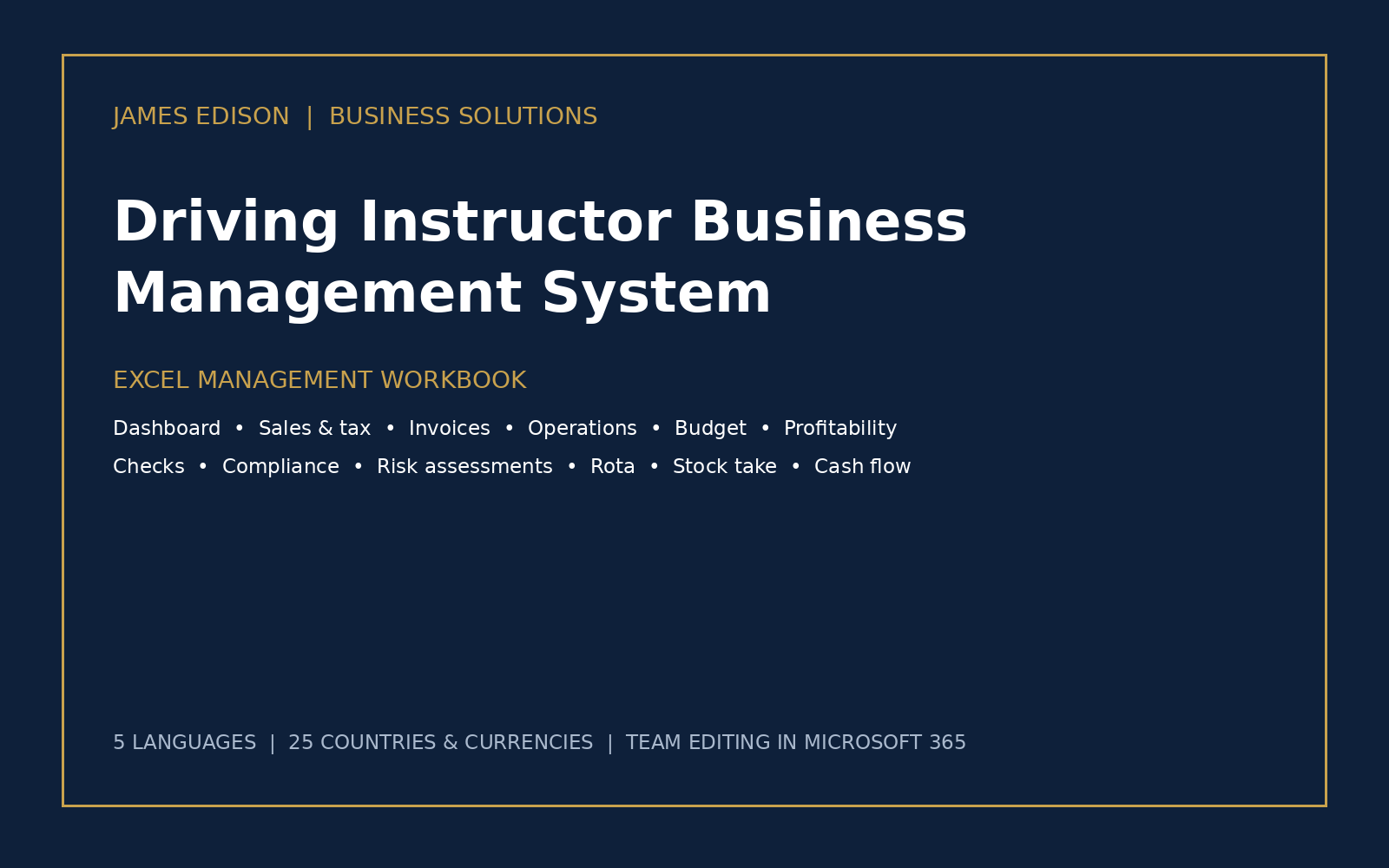
The Driving Instructor Business Management System is a driving instructor spreadsheet in Excel built for ADIs and small driving schools:
- Pupil and lesson tracker with lesson type, hours, price per hour, car and fuel cost, franchise and other costs, revenue, gross profit and a next lesson / test due reminder
- Sales and VAT, invoices and aged debtors for unpaid lessons
- 12-week cash flow forecast with shortfall warnings
- Quarterly VAT summary, profit and loss, budget vs actual and a pricing calculator
- Daily and weekly checks: car, dual controls, cleaning, pupil records, signs, breaks, licences, diary, payments and dashcam
- Compliance register pre-filled with instructor registration, standards check, vehicle insurance, criminal record check, public liability, franchise review, dual control inspection, licence check and data protection
- Risk assessments pre-filled for collisions, fatigue, lone working, aggression, posture, infection and bad weather
- Stock take pre-loaded with sanitiser, wipes, L-plates, screenwash, bulbs, lesson cards, cones and tissues
- Rota for multi-car schools
- Dashboard with income, profit, margin, average revenue per pupil, lesson hours, revenue per hour, franchise and other costs % and a compliance score
It costs £15 once, with no subscription. Works in Excel 2016 or later, Microsoft 365, Excel for Mac and Excel online, in 5 languages and 25 currencies.
**Get the driving instructor spreadsheet →**
Your driving school start-up checklist
1. Qualify and join the ADI register. 2. Decide franchise or independent. 3. Arrange a dual-controlled car and driving school insurance. 4. Register as self-employed with HMRC and open a business account. 5. Work out your car and fuel cost per lesson hour. 6. Set prices, block booking offers and a cancellation policy. 7. Keep a record for every pupil, with licence and eyesight checks. 8. Log registration renewal and standards check dates. 9. Run daily car and dual control checks. 10. Track every expense for your tax return. 11. Run a 12-week cash flow forecast. 12. Write your risk assessment.
Frequently asked questions
How do I become a self-employed driving instructor? Qualify through the DVSA's ADI tests, join the register, then either join a franchise or set up independently with your own dual-controlled car and insurance.
Is a driving instructor franchise worth it? It can be a fast start with pupils and a car provided, but the weekly fee is fixed. Many instructors go independent once they have a steady flow of pupils.
How much should I charge for driving lessons? Base your price on your car, fuel, franchise and overhead costs per lesson hour, add your profit and compare with local instructors.
What insurance does a driving instructor need? Driving school insurance that covers tuition, plus public liability cover.
What software do driving instructors use? Many use a diary app for bookings and a spreadsheet for income, costs, pupil records and cash flow.
Running a driving school well means knowing your real cost per lesson, keeping the diary full and staying on top of your registration. The driving instructor spreadsheet puts it all in one Excel file for £15.