An ageing population and a strong preference for care at home mean demand for home care is high across the UK. A well-run domiciliary care agency helps people stay independent and can grow into a substantial business with private clients and local authority contracts.
It is also one of the most heavily regulated small businesses. Registration, a registered manager, recruitment checks, mandatory training, medication safety, rotas, travel time and tight margins all need careful control. This guide explains how to start a home care agency in the UK.
1. Registration
Providing personal care in people's homes is regulated. In England you must register with the Care Quality Commission (CQC); in Scotland with the Care Inspectorate; in Wales with Care Inspectorate Wales; and in Northern Ireland with the RQIA. Registration takes time and includes checks on the provider, the registered manager, policies and systems. Plan for months, not weeks, and budget for the period before you can deliver care.
2. The registered manager
Your agency needs a suitable registered manager with relevant experience and qualifications. They are accountable for the quality and safety of care. If you are not experienced in care yourself, recruiting the right manager is the most important decision you will make.
3. Recruitment and training
Every carer needs enhanced criminal record checks, references and right to work checks. Mandatory training typically includes moving and handling, medication, safeguarding, infection control, first aid and the relevant care induction standard. Keep a training matrix and review it monthly. Check carers' business car insurance if they drive to visits.
4. Pricing care hours
Most agencies charge per hour, with higher rates for evenings, weekends and bank holidays. Your rate must cover:
- Carer wages including holiday pay, employer's National Insurance and pension contributions
- Travel time and mileage between visits
- Training, recruitment and supervision
- Office costs, insurance and registration fees
- Profit
Private clients usually pay more than local authority contracts. Track care hours delivered, rate per hour, carer cost per hour, mileage and other costs, revenue per client and gross margin.
5. Rotas and missed calls
Rotas are the operational heart of home care. Every visit should be covered, on time, with the right carer. Daily: all visits covered with no missed or late calls, care notes completed after every visit, medication records completed, lone worker check-ins working, safeguarding concerns reported and logged, accident and incident records completed. Weekly: carer spot checks, PPE stock with every carer, key safe codes stored securely. Monthly: training matrix and complaints log reviewed.
6. Care plans
Every client needs an assessed care plan, reviewed regularly and whenever needs change. Record a next care plan review date for every client so reviews never slip.
7. Home care risk assessment
Cover moving and handling, lone working, infection control, medication errors, aggression, driving between visits and slips. Each client's home also needs its own environmental risk assessment.
Building efficient care runs
Travel time is one of the biggest hidden costs in home care. Group visits geographically, avoid long gaps between calls and plan runs so carers are not crossing town between every visit. Track travel time and mileage per run, and review runs whenever clients start or stop. A well-designed run means carers spend more of their paid time with clients, which improves both care and margins.
Private clients and local authority contracts
Many agencies combine private clients with local authority or health contracts. Contracts can bring volume, but rates are often lower and terms strict. Before bidding, calculate your true cost per hour including travel, on-costs and supervision. Private clients usually pay higher rates and expect continuity of carers and flexible scheduling. Track profitability separately for each, and do not let low-rate contracts crowd out the private work that funds your growth.
Whatever the mix, continuity matters. Clients and families value seeing the same carers, and carers value regular runs. Good continuity reduces complaints, improves care and helps you keep staff.
Quality monitoring
Spot checks, care note audits, medication record audits and client feedback calls are how you know care is good between inspections. Schedule them, record them and act on what you find. Repeated issues with a carer need supervision and training; repeated issues across the agency need a change in systems. Good quality monitoring also gives you evidence at inspection.
Managing carer turnover
Carer turnover is high across the sector. Fair pay, paid travel time, regular runs, good training, supervision and recognition all help keep staff. Track starters, leavers and reasons every month, and use exit conversations to fix problems.
Handling complaints well
Complaints are a chance to improve. Acknowledge them quickly, investigate fairly, respond in writing and record what changed as a result. Review the complaints log every month to spot patterns across carers, runs or clients.
Technology that helps
Electronic call monitoring, digital care notes and medication records reduce errors, prove visits happened and save office time. Introduce them gradually and train carers properly.
VAT and tax
Most small businesses register with HMRC for Self Assessment as sole traders, or run as a limited company once profits grow. You must register for VAT once taxable turnover passes the HMRC threshold, and some services in this sector have specific VAT treatment, so take advice from an accountant before you set prices. Once registered, a quarterly VAT summary of VAT charged, VAT reclaimable and net to pay keeps you ready for every return.
Cash flow: the number that keeps you open
Profitable businesses still run out of money when payments arrive later than bills. A 12-week cash flow forecast shows money in from customers and money out for wages, rent, supplies, insurance and tax, week by week, with a warning for any week the balance goes negative. Review it every week in your first year. It gives you time to chase payments, delay a purchase or arrange finance before a shortfall becomes a crisis.
Your first 90 days
Month one after registration: start with a small number of private clients you can staff reliably. Month two: track care hours, travel time and carer cost per hour for every client and visit run. Month three: review profitability by client and contract, and adjust rates, runs and recruitment before taking on more.
How to work out your break-even
Break-even is the number of care hours you need each month to cover all your costs.
1. Add up your monthly fixed costs: rent, insurance, software, marketing, loan payments and your own minimum drawings. 2. Work out your contribution per care hour: your price minus the variable cost of delivering it. 3. Divide fixed costs by contribution.
For example, with fixed costs of £8,000 a month, a price of £25 per care hour and a variable cost of £16, each care hour contributes £9, so you would need about 889 care hours a month to break even. These figures are illustrations only: use your own. A price rise lowers your break-even straight away, which is why pricing is usually the fastest lever you have.
When to raise your prices
Costs rise every year. If your prices stay still, your margin shrinks. Signs you are undercharging include being fully booked weeks ahead, customers rarely questioning your price and a gross margin that falls month by month. Review private rates annually with notice to clients and families, and renegotiate contract rates when wage costs rise.
Common mistakes
Ignoring travel time. Unpaid travel between visits destroys margins.
Growing faster than recruitment. Taking clients you cannot staff leads to missed calls.
Underpricing council contracts. Check that rates cover all costs before signing.
Weak medication records. Medication errors are a major risk for clients and inspection.
The numbers to check every month
Review average revenue per client, care hours delivered, revenue per hour, mileage & other % of revenue, plus overdue invoices and your lowest cash balance in the next 12 weeks. Those numbers tell you whether the business is profitable, not just busy.
How to market your home care agency
Families choose care on trust. Your inspection rating, reviews, clear information about services and responsive enquiries matter. Build relationships with GPs, hospital discharge teams, social workers, care homes and community groups. Track enquiry sources and conversion.
The Home Care Agency Management System
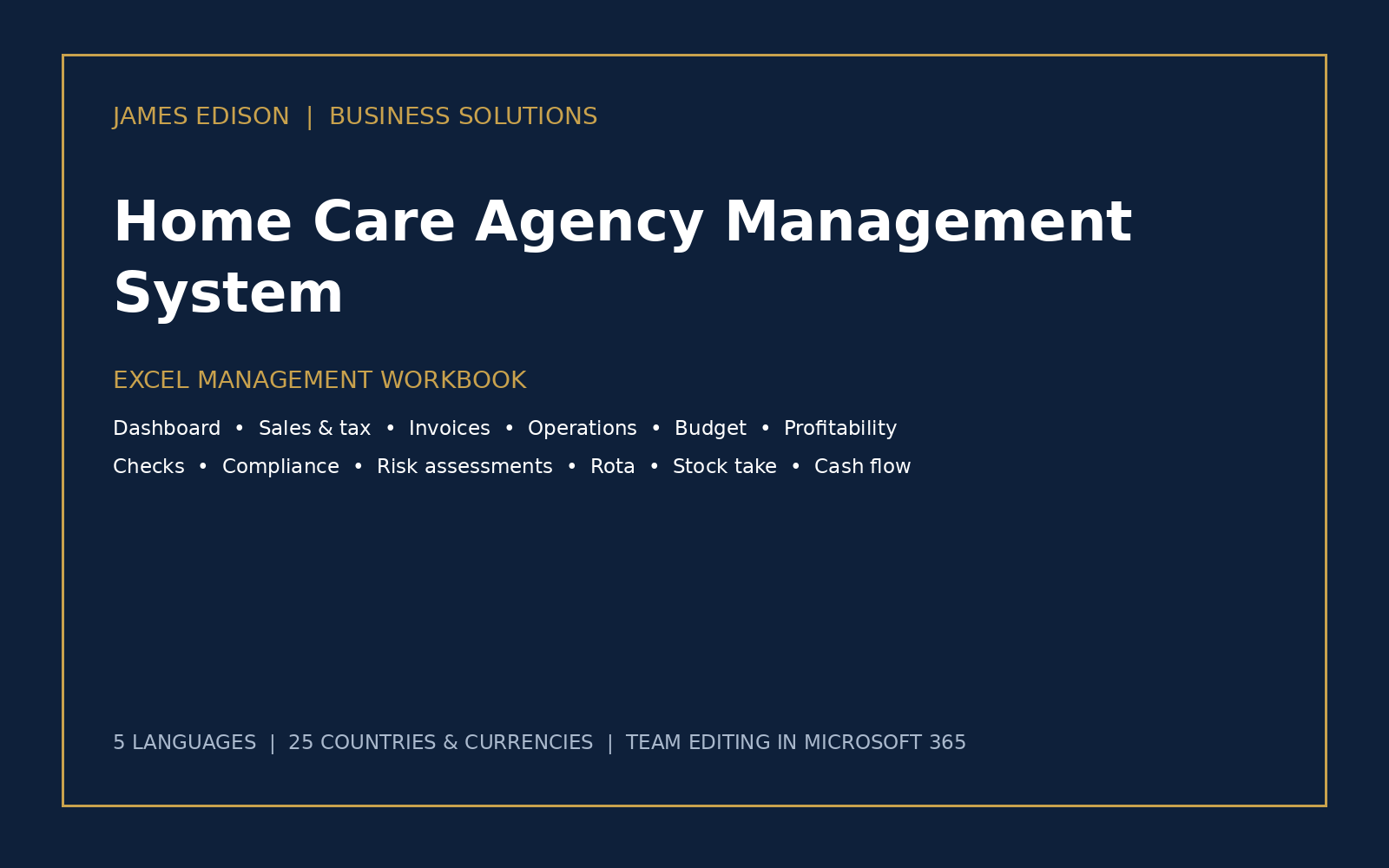
The Home Care Agency Management System is a home care agency spreadsheet in Excel built around this guide:
- Care type tracker with care hours, rate per hour, carer cost per hour, mileage & other costs, revenue, gross profit and a next care plan review reminder
- Sales and VAT, invoices and aged debtors with a "chase these first" list
- 12-week cash flow forecast with shortfall warnings
- Quarterly VAT summary, profit and loss, budget vs actual and a pricing calculator
- Daily, weekly and monthly checks including all visits covered with no missed or late calls, medication records completed, care notes completed after every visit, safeguarding concerns reported and logged, lone worker check-ins working and more
- Compliance register pre-filled with care regulator registration, registered manager in post, staff background checks, mandatory care training (moving and handling, medication, safeguarding), care liability insurance, employers’ liability insurance and more, with renewal reminders
- Risk assessments pre-filled for manual handling and lifting, lone working, infection control, medication errors, violence and aggression, long hours driving, slips, trips and falls
- Stock take pre-loaded with disposable gloves, aprons, face masks, hand sanitiser, care note and medication record booklets, continence and hygiene wipes, clinical waste bags, first aid refills
- Staff rota with wage cost
- Dashboard with income, profit, margin, average revenue per client, care hours delivered, revenue per hour, mileage & other % of revenue and a compliance score
It costs £15 once, with no subscription and no app. It works in Excel 2016 or later, Microsoft 365, Excel for Mac and Excel online, in 5 languages and 25 currencies.
**Get the home care agency spreadsheet →**
Your start-up checklist
1. Decide private, local authority or mixed clients. 2. Appoint a registered manager. 3. Prepare policies, procedures and systems. 4. Apply to the care regulator for your nation. 5. Arrange care liability and employers' liability insurance. 6. Recruit carers with enhanced criminal record checks. 7. Deliver mandatory training and keep a training matrix. 8. Set hourly rates including travel and on-costs. 9. Build rotas with no missed or late calls. 10. Create and review care plans for every client. 11. Audit medication records regularly. 12. Run a 12-week cash flow forecast.
Frequently asked questions
Do I need to register a home care agency? Yes. Providing personal care at home is regulated, and you must register with the regulator for your nation, such as the CQC in England.
How long does CQC registration take? It can take several months. Prepare policies, systems and your registered manager in advance.
How much should a home care agency charge per hour? Enough to cover carer wages and on-costs, travel time, training, office costs and profit. Private rates are usually higher than council rates.
Can I start a care agency with no care experience? You can own one, but you will need an experienced, suitable registered manager.
What software do home care agencies use? Most use rostering and care planning software, and many use a spreadsheet for profit by client, compliance, training and cash flow.
What is a registered manager? The person registered with the regulator as responsible for managing the regulated care service day to day. They must be suitable, experienced and appropriately qualified.
How do agencies reduce missed calls? With realistic rotas, efficient runs, enough carers, electronic call monitoring where possible and quick escalation when a carer cannot attend.
Getting the systems right from day one is what turns a good home care agency into a lasting one. The home care agency spreadsheet puts it all in one Excel file for £15.