Rats, mice, wasps, bed bugs, fleas and birds do not care about the economy. Homeowners need help fast, and every food business, letting agent, warehouse and school needs pest control they can rely on. Commercial contracts with regular visits give pest control one of the most predictable income streams of any service business.
Pest control is also regulated. Professional products, rodenticide rules, hazardous substances, treatment records and the safety of pets, wildlife and the public all matter. This guide explains how to start a pest control business in the UK and build it on solid ground.
1. Domestic or commercial?
- Domestic call-outs: mice, rats, wasps, fleas, bed bugs and moths. Quick jobs, good rates, seasonal peaks.
- Commercial contracts: cafés, restaurants, takeaways, shops, offices, warehouses, schools and farms. Regular scheduled visits, recurring income and higher documentation standards.
- Specialist work: bird proofing, bed bug heat treatments, moles and wildlife management.
Most firms start with domestic call-outs to build cash and experience, then grow a book of commercial contracts. Contracts are where the long-term value lies, because they renew year after year.
2. Qualifications and product rules
Recognised pest control qualifications show customers and insurers that you know what you are doing, and trade body membership often requires them.
Rodenticides are tightly controlled. In the UK, professional rodenticides are sold only to users who can show they are trained and certified under the rodenticide stewardship regime. Keep your professional rodenticide user certificate current and log its renewal date. Glue traps for rodents are restricted: in England their use requires a licence, and rules in Scotland are stricter, so check the current position wherever you work.
Other pesticides and biocides come with label conditions you must follow. Build product knowledge and record keeping into your business from day one.
3. Business structure and insurance
Most pest controllers start as sole traders. Open a business account from day one.
Insurance should include:
- Public liability insurance: covers harm to people, pets or property from your work.
- Employers' liability insurance: a legal requirement once you employ anyone.
- Tools and equipment insurance and vehicle insurance.
- Professional indemnity: worth considering for commercial contracts and surveys.
Trade association membership is a strong trust signal, particularly when bidding for commercial contracts.
4. Treatment records: your evidence
Every visit should produce a record: what you found, what you used, where you placed it, quantities, safety measures and recommendations. Commercial clients need these reports for their own audits and food hygiene inspections. Your records also protect you if a pet or child is harmed or a client complains.
Daily routine:
- Bait stations locked and labelled
- Treatment records and site reports completed
- Risk to pets and wildlife checked before placing products
- Hands and kit cleaned between sites
- Van walk-around
Weekly: pesticide store locked and stock logged, sprayers cleaned and checked, PPE inspected, client keys and access codes secured. Monthly: hazardous substances assessments reviewed, first aid kit stocked.
5. Hazardous substances (COSHH)
Pest control products are hazardous substances. You need COSHH assessments for the products you use, correct storage in a locked store, the right PPE and records of what you hold. Your van store should be secure, ventilated and separated from the cab.
6. Pest control risk assessment
Your risk assessment should cover:
- Hazardous chemicals: COSHH assessments, PPE and safe storage.
- Disease from rodents and droppings: gloves, covering cuts, hand washing and health awareness cards for staff.
- Wasp and bee stings: bee suits, asking about allergies and keeping the public away.
- Poisoning of pets and wildlife: tamper-resistant boxes, recording placements and removing products after treatment.
- Working at height in lofts and on ladders.
- Lone working and slips.
7. Pest control prices
Pest control prices need to cover your time, products, travel and follow-up visits:
- Fixed price per treatment for wasps, fleas and standard mouse or rat treatments, including follow-up visits.
- Hourly rate for surveys and complex jobs.
- Annual contract fee for commercial clients, priced per visit with an emergency call-out allowance.
- Specialist quotes for bird proofing and bed bugs.
Track revenue per hour and materials as a percentage of revenue. Bird proofing and bed bug work can be materials-heavy; wasp nests are quick and profitable. A pricing calculator that works back from your target margin keeps quotes consistent.
8. Contract visit scheduling
Commercial contracts live or die on visits happening on time. For every job or contract record customer and site, treatment, hours, rate per hour, labour cost per hour, products and materials, revenue, total cost and gross profit, visit date and next visit due. A reminder 30 days before each due date and a weekly look at what is coming up mean no client ever chases you.
9. Stock control
Track rodenticide bait blocks, bait stations, snap traps, insecticide concentrate, wasp nest powder, insect monitoring traps, bird netting and gloves with unit cost, opening stock, deliveries, closing count and reorder level. It controls cost and supports the stock records your pesticide store needs.
10. Invoices, VAT and cash flow
Invoice domestic jobs on the day. For contracts, invoice monthly or quarterly in advance where possible. Track every invoice as Paid, Open or Overdue, with an aged debtors report.
Register for VAT once taxable turnover passes the HMRC threshold and keep a quarterly VAT summary.
Domestic pest control is seasonal: wasps in summer, rodents in autumn and winter. A 12-week cash flow forecast smooths the peaks and troughs, and a growing contract base makes income steadier each year.
Common mistakes new pest controllers make
Underpricing follow-up visits. Many treatments need two or three visits. Include them in the price.
Poor records. Commercial clients and inspectors expect detailed reports. Missing records can lose you contracts.
Leaving products behind. Remove bait and monitoring after treatment to protect pets and wildlife.
Chasing only call-outs. Contracts bring recurring income. Start building them early.
The numbers to check every month
Review average job value, hours worked, revenue per hour, materials as a percentage of revenue, overdue invoices, contract visits due and your lowest cash balance in the next 12 weeks.
How to market your pest control business
Domestic customers search urgently, so a fast-loading website, local search listings, clear prices and reviews matter. For commercial work, approach food businesses, letting agents, schools and facilities managers, and highlight your trade membership, insurance and reporting. Food businesses often look for a new contractor after a poor inspection. Track every enquiry's source.
Your first 90 days in pest control
Month one: complete training and certification, set up a secure product store, insurance and COSHH assessments, and build a treatment record template you use on every visit. Month two: price domestic treatments including follow-ups and track how many visits each job really needs. Month three: approach local food businesses, letting agents and offices with a simple contract offer: scheduled visits, written reports and priority call-outs. Even five small contracts give you a base of recurring income.
Growing a contract base
Every commercial contract should have a clear visit frequency, a price per visit, a call-out allowance and a renewal date. Track each one with a next visit due date so visits are never missed, and review profitability yearly. Contracts that take longer than priced should be repriced at renewal.
How to work out your break-even
Break-even is the number of treatments you need each month to cover all your costs. It is the single most useful number for a new pest control business.
1. Add up your monthly fixed costs: everything you pay whether you are busy or not, such as rent, insurance, vehicle finance, phone, software, marketing and your own minimum drawings. 2. Work out your contribution per treatment: your price per treatment minus the variable cost of delivering it (staff time, materials, fuel, products or fees). 3. Divide fixed costs by contribution.
For example, if your fixed costs were £1,600 a month, your average price per treatment was £120 and your variable cost per treatment was £35, each treatment would contribute £85 towards fixed costs. You would need about 19 treatments a month just to break even. Everything above that is profit. These figures are illustrations only: use your own.
Knowing your break-even tells you how busy you need to be, whether a quiet month is a problem, and what happens if you raise prices or cut costs. A price rise lowers your break-even straight away, which is why pricing is usually the fastest lever you have.
When and how to raise your prices
Costs rise every year: fuel, insurance, materials, wages and rent. If your prices stay still, your margin shrinks. Review prices at least once a year, and sooner if a major cost jumps.
Signs you are undercharging:
- You are fully booked weeks ahead
- Customers rarely question your price
- Your gross margin is falling month by month
- You are busy but your bank balance is not growing
Review contract prices at each renewal and domestic prices each year. Explain the value: follow-up visits, reports and safe practice. Track your average price and gross margin monthly after any change, so you can see the effect in your own numbers rather than guessing.
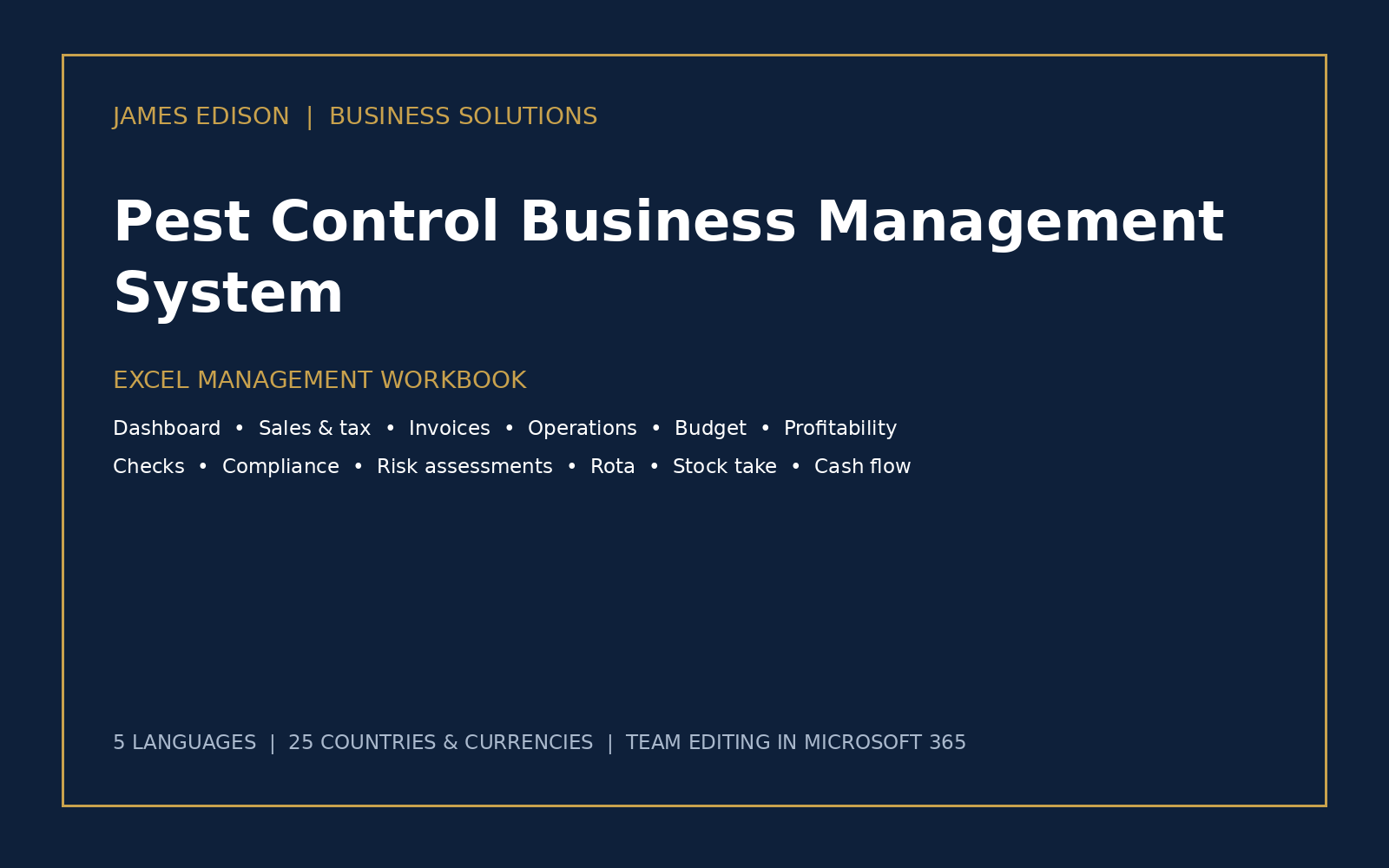
The Pest Control Business Management System
The Pest Control Business Management System is a pest control business spreadsheet in Excel built around this guide:
- Job and contract tracker with treatment, hours, rate, labour cost, products and materials, revenue, gross profit and a next visit due reminder
- Sales and VAT, invoices and aged debtors with a "chase these first" list
- 12-week cash flow forecast with shortfall warnings
- Quarterly VAT summary, profit and loss, budget vs actual and a pricing calculator
- Daily and weekly checks: bait stations, treatment records, pets and wildlife risk, decontamination, pesticide store, sprayers, PPE and keys
- Compliance register pre-filled with rodenticide user certificate, pest control qualification, trade association, COSHH, insurance, waste carrier, vehicle, tools and data protection
- Risk assessments pre-filled for chemicals, rodent-borne disease, stings, poisoning of pets and wildlife, working at height, lone working and slips
- Stock take pre-loaded with bait blocks, bait stations, traps, insecticide, wasp powder, insect monitors, bird netting and gloves
- Staff rota with wage cost
- Dashboard with income, profit, margin, average job value, hours worked, revenue per hour, materials % and a compliance score
It costs £15 once, with no subscription. Works in Excel 2016 or later, Microsoft 365, Excel for Mac and Excel online, in 5 languages and 25 currencies.
**Get the pest control business spreadsheet →**
Your pest control start-up checklist
1. Choose domestic, commercial or both. 2. Get recognised pest control training. 3. Get your professional rodenticide user certificate. 4. Register the business and open a business account. 5. Arrange public liability, employers' liability, equipment and vehicle insurance. 6. Write COSHH assessments and set up a secure product store. 7. Join a trade association. 8. Set fixed treatment prices including follow-ups, and price contracts per visit. 9. Keep a treatment record for every visit. 10. Schedule contract visits with next visit due reminders. 11. Track products and consumables with reorder levels. 12. Run a VAT summary and a 12-week cash flow forecast.
Frequently asked questions
How much does it cost to start a pest control business? The main costs are training and certification, a suitable van with a secure store, equipment and products, insurance and marketing.
Do you need qualifications to do pest control? Recognised training is expected by insurers and clients, and you need certification to buy professional rodenticides.
How do pest control contracts work? Commercial clients pay an annual or monthly fee for scheduled visits, reports and call-outs. They renew yearly and provide steady income.
What records does a pest controller need? Treatment records for every visit, COSHH assessments, product stock records and site reports for commercial clients.
What software do pest controllers use? Many small firms use a spreadsheet for visits, contracts, treatment records, stock, invoices and cash flow before moving to paid software.
Pest control rewards reliability and good records. Build contracts, keep meticulous treatment records and stay compliant. The pest control business spreadsheet puts it all in one Excel file for £15.