Thinking about how to start a plumbing business? You are in a good trade. Boilers break in every postcode, landlords need gas safety checks every year, and almost every bathroom refit needs a plumber. Demand is not the problem. The plumbers who struggle are usually the ones who are brilliant on the tools and loose on the paperwork: unpriced extras, invoices sent late, van stock that vanishes, and a Gas Safe renewal that sneaks up on them.
This guide walks you through starting a plumbing business in the UK step by step: the legal setup, registrations, insurance, pricing, van stock, job tracking, cash flow and the admin system that keeps it all under control. It is written for sole traders going self-employed for the first time and for small plumbing and heating firms that want to tighten up.
1. Decide what kind of plumbing business you are building
Before you register anything, decide what work you want to be known for. "General plumber" is a crowded search term and a hard way to win good margins. Most successful plumbing and heating businesses pick a lane:
- Heating and boilers: boiler installs, boiler servicing, power flushing, system upgrades. Higher ticket jobs and repeat annual service income, but you need gas qualifications.
- Landlord work: gas safety checks, leak repairs and quick-turnaround fixes for letting agents. Steady, predictable volume.
- Bathrooms and kitchens: refits and first-fix/second-fix plumbing. Bigger jobs, more materials, more project management.
- Emergency call-outs: premium rates, unsocial hours and a lot of phone time.
- Commercial maintenance: contracts with offices, cafés and schools. Slower to win, sticky once you have them.
Your choice affects everything that follows: the qualifications you need, the van stock you carry, how you price and what your marketing says. A heating engineer with a full book of annual boiler services has a completely different cash flow from a bathroom fitter with three big jobs a month.
2. Choose your business structure
Most new plumbers start as a sole trader. It is simple: you register with HMRC for Self Assessment, keep records and pay Income Tax and National Insurance on your profit. Many move to a limited company once profits grow, because it can be more tax-efficient and keeps business and personal liabilities separate. Speak to an accountant before you decide; the right answer depends on your profit level and plans.
Whichever you choose, open a separate business bank account from day one. Mixing personal and business spending is the fastest way to lose track of your real profit and make your tax return painful.
3. Get the registrations and qualifications right
This is where plumbing differs from many trades. Some work is legally restricted.
Gas work. In the UK it is a legal requirement to be on the Gas Safe Register to work on gas appliances and fittings. Each engineer holds qualifications (often through the ACS scheme) for the specific appliance types they work on, and these need renewing. If you plan to do boilers, cookers or gas fires, this is non-negotiable. Track every engineer's qualification expiry dates and your company registration renewal date.
Unvented hot water. Working on unvented hot water cylinders requires a specific qualification (commonly called G3). It is a valuable add-on for bathroom and heating work.
Water regulations. Joining an approved contractor scheme for water regulations lets you self-certify certain work and is a useful trust signal on your website and quotes.
Waste carrier registration. If you take away old boilers, radiators and pipework, you will usually need to register as a waste carrier with the relevant environment agency.
Put every one of these in a compliance register with the issue date, the renewal frequency and the expiry date. A lapsed Gas Safe registration does not just risk a fine; it can stop you working overnight.
4. Insurance every plumber needs
At a minimum, most self-employed plumbers carry:
- Public liability insurance: covers you if your work damages a customer's property or injures someone. A leak through a ceiling can cost thousands.
- Employers' liability insurance: a legal requirement in the UK as soon as you employ anyone, including apprentices.
- Tools and equipment insurance: vans are broken into for tools every day.
- Van insurance that covers business use, plus a valid MOT.
Add every policy to your compliance register so renewals never slip.
5. Work out your pricing properly
Underpricing is the most common reason new plumbing businesses fail. You need a plumber pricing structure that covers every cost and leaves profit.
Start with your true hourly cost. Add up your yearly costs (van, fuel, insurance, tools, phone, software, accountant, training, Gas Safe fees, advertising) and divide by the hours you can realistically bill. Most self-employed tradespeople bill far fewer hours than they work, because travel, quoting, buying materials and admin eat into the week. Plan on billing perhaps 25 to 30 hours a week, not 40.
Then decide how you charge:
- Hourly or day rate for repairs and unknown work.
- Fixed price for boiler services, gas safety checks, power flushes and standard installs. Customers love fixed prices and you profit when you are efficient.
- Materials: decide whether you charge parts at cost, at cost plus a mark-up, or bundle them into a fixed price. Whatever you choose, track parts on every job so you know your real margin.
- Call-out fees for emergency and out-of-hours work.
A pricing calculator that works backwards from your target margin is the fastest way to stop guessing. Put in your costs and the margin you want, and it tells you the price.
6. Set up your van stock system
Plumbers lose money through the van door. Fittings get used and not billed, items get bought twice because nobody knew they were already on board, and a missing compression fitting turns a one-hour job into a two-hour trip to the merchant.
A simple van stock spreadsheet fixes this. For each item (15mm copper pipe, compression fittings, push-fit fittings, PTFE tape, central heating inhibitor, radiator valves, solder and flux, silicone sealant) record:
- Unit cost
- Opening count
- What you bought
- Closing count
- Reorder level
Usage and stock value then work themselves out, and anything below its reorder level gets flagged before it runs out. Do a quick count weekly and a full count monthly.
7. Track every job from quote to payment
Plumber job management is where profit is made or lost. For every job you want to know:
- Customer and address
- Job type (boiler service, leak repair, radiator replacement, install)
- Labour hours, your charge per hour and your labour cost per hour
- Parts and materials used
- Revenue, total cost and gross profit
- Job date and the next service due date
That last column matters more than most plumbers realise. A boiler service is an annual job. If you record when the next service is due and get a reminder 30 days before, you have a ready-made stream of repeat work. The same applies to landlord gas safety checks. This is the cheapest marketing you will ever do.
Over a few months, your job log also tells you which job types make the most money per hour. Many plumbers discover that their small, fixed-price service jobs earn more per hour than their big installs once materials and travel are counted.
8. Invoicing and getting paid
Send invoices the same day the job finishes. Every day you wait reduces the chance of being paid on time. Your plumbing invoice should show your business name, the customer, a clear description of the work, labour and parts, VAT if you are registered, your payment terms and how to pay.
Then track every invoice as Paid, Open or Overdue. An aged debtors report that splits money owed into 1–30, 31–60, 61–90 and 90+ days overdue tells you exactly who to chase first. Letting agents and commercial customers are often the slowest payers, so keep a close eye on them.
9. VAT and tax
You must register for VAT once your taxable turnover passes the HMRC threshold. Some plumbers register voluntarily earlier, particularly if they mainly work for VAT-registered businesses. Once registered, you charge VAT on your work, reclaim VAT on business purchases and submit returns, usually quarterly.
Keep a running quarterly VAT summary: VAT charged on sales, VAT reclaimable on purchases and the net amount to pay. It avoids the nasty surprise of a big bill you have not set aside cash for. Always check your figures with your accountant before filing.
10. Cash flow: the thing that actually sinks plumbing businesses
Profitable plumbing businesses still run out of money. A boiler install might mean buying £1,500 or more of parts up front, then waiting weeks for payment. Combine that with a quiet month and a van repair, and the bank balance drops fast.
A 12-week cash flow forecast shows your expected bank balance week by week: money in from invoices due, money out for wages, parts, rent and tax, and a warning for any week where the balance goes negative. It turns "I hope we're okay" into "we need to chase these two invoices before week six".
11. Health and safety for plumbers
Plumbing has specific risks that should be written into your plumber risk assessment:
- Carbon monoxide and gas leaks: tightness testing, wearing a personal CO alarm, checking flues and reporting unsafe appliances.
- Asbestos in older properties: check the survey or ask the owner before drilling, cutting or lifting floorboards, and stop if you are unsure.
- Burns: hot pipes, soldering and hot water.
- Manual handling: boilers, cylinders and radiators are heavy.
- Working at height: lofts and ladders.
- Electrical equipment and lone working.
Score each hazard by likelihood and severity, list your controls and review it every 12 months. Add simple daily checks too: van walk-around, commissioning forms completed, dust sheets used and asbestos checked before drilling.
12. Plumbing business software: app or spreadsheet?
There are plenty of plumbing business software apps. Most charge a monthly subscription per user, and many lock your data inside their platform. For a busy multi-van firm with office staff, an app can make sense.
For a sole trader or small team, the honest answer is that you probably do not need one yet. What you need is one place to log jobs, invoices, stock, compliance and cash, with a dashboard that tells you how the business is doing. A well-built spreadsheet does that, costs nothing per month and keeps your data in your own file.
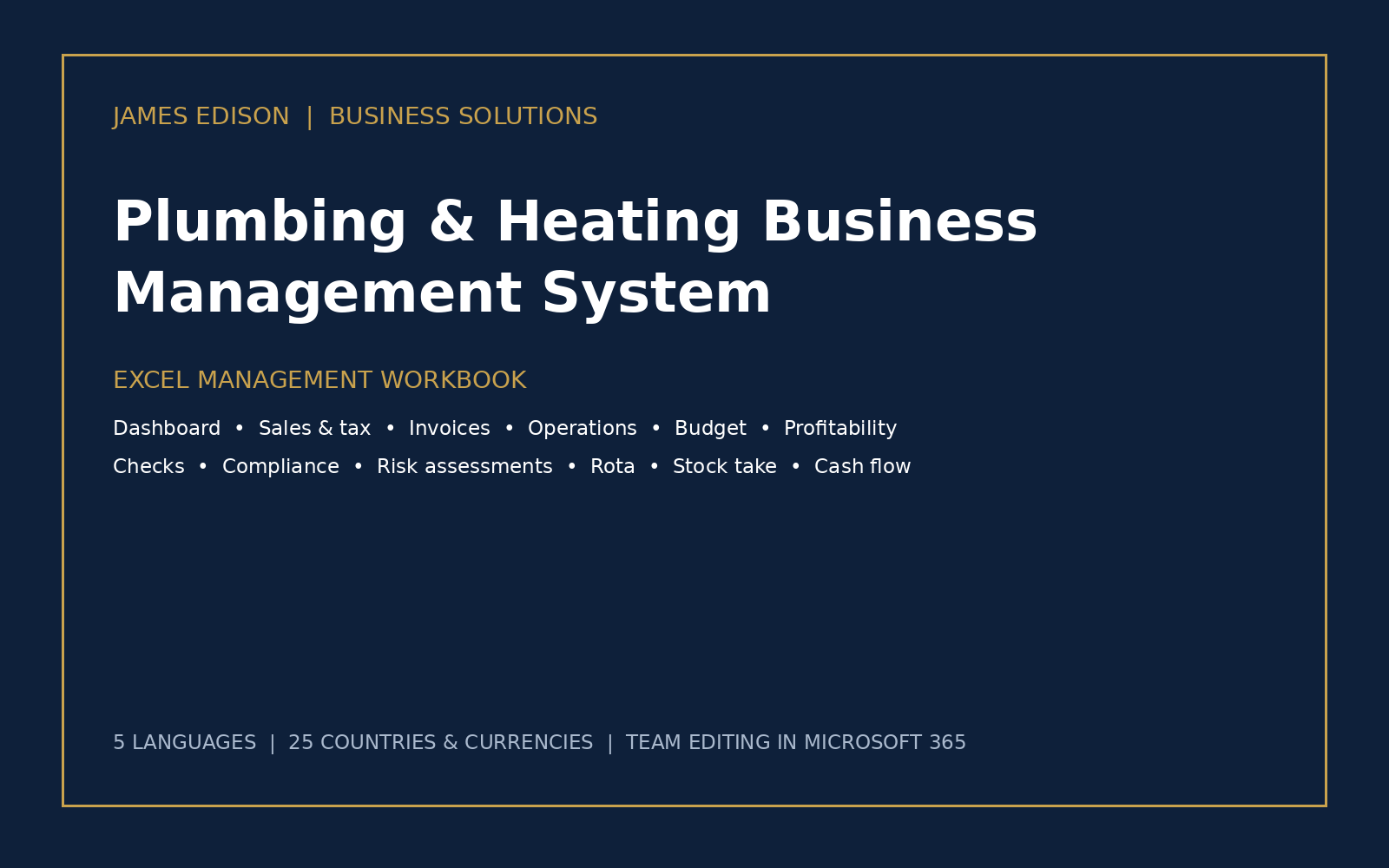
The Plumbing & Heating Business Management System
We built the Plumbing & Heating Business Management System for exactly this. It is a plumbing business spreadsheet in Excel that covers everything in this guide:
- Job tracker with labour hours, labour charge and cost, parts and materials, revenue, gross profit and a "next boiler service due" reminder that turns amber 30 days before and red when overdue
- Sales and VAT, invoices and an aged debtors report with a "chase these first" list
- 12-week cash flow forecast with shortfall warnings
- Quarterly VAT summary, profit and loss and budget vs actual
- Pricing calculator for your target margin
- Daily, weekly and monthly checks including commissioning forms, asbestos checks, van stock and flue gas analyser calibration
- Compliance register pre-filled with Gas Safe registration, gas qualifications, water regulations, unvented hot water certificate, insurance and waste carrier registration
- Risk assessments pre-filled for carbon monoxide, asbestos, burns, manual handling and more
- Van stock take pre-loaded with pipe, fittings, PTFE, inhibitor, radiator valves and sealant
- Staff rota with wage cost
- Dashboard with income, profit, margin, average job value, labour hours sold, parts billed, labour margin and a compliance score
It costs £15 once. No subscription, no app, no monthly fee. It works in Excel 2016 or later, Microsoft 365, Excel for Mac and Excel online, in 5 languages and 25 currencies.
**Get the plumbing business spreadsheet →**
Your plumbing business start-up checklist
1. Choose your niche: heating, landlord work, bathrooms, emergency or commercial. 2. Register as a sole trader or limited company and open a business bank account. 3. Get on the Gas Safe Register if you do gas work and log every qualification expiry. 4. Arrange public liability, employers' liability, tools and van insurance. 5. Register as a waste carrier if you remove old boilers and pipework. 6. Work out your true hourly cost and set fixed prices for standard jobs. 7. Set up a van stock list with reorder levels. 8. Log every job with parts, hours and the next service due date. 9. Invoice the same day and track debtors weekly. 10. Keep a quarterly VAT summary and a 12-week cash flow forecast. 11. Write your risk assessments and daily checks. 12. Review your dashboard monthly and raise prices on low-margin job types.
Frequently asked questions
How much does it cost to start a plumbing business? It varies with the van and tools you already own. The main start-up costs are a suitable van, tools, initial stock, insurance, qualifications and registrations, and marketing. Many plumbers start with a used van and build up kit as work comes in.
Do I need to be Gas Safe registered to be a plumber? Not for plumbing that does not involve gas. You must be on the Gas Safe Register to work on gas appliances and fittings in the UK.
How much should a plumber charge per hour? There is no single rate. Work out your true hourly cost from your yearly overheads and billable hours, then add your target profit. Rates also vary by region and type of work, so check local competitors.
What is the best plumbing business software for a sole trader? For most sole traders, a spreadsheet that tracks jobs, invoices, stock, compliance and cash is enough and avoids monthly fees. Apps make more sense once you have several vans and office staff.
How do I get repeat work as a plumber? Record the next boiler service or gas safety check due date for every customer and contact them before it is due. Annual servicing is the most reliable repeat income in the trade.
Do plumbers need to register for VAT? Only once taxable turnover passes the HMRC threshold, although you can register voluntarily. Speak to an accountant about what suits your customer base.
Starting a plumbing business is mostly about being organised as well as skilled. Get the registrations, pricing, job tracking and cash flow right from the start and you build a business, not just a job. The plumbing business spreadsheet gives you all of it in one Excel file for £15.