If you are wondering how to start an electrical business, the timing is good. Landlords need regular electrical inspections, homeowners want EV chargers, older houses need rewires and consumer unit upgrades, and commercial customers need testing and maintenance. Qualified electricians are in demand.
The electricians who build profitable firms are rarely the best on the tools. They are the ones who price properly, issue certificates on time, never miss a scheme renewal, keep the van stocked and know exactly who owes them money. This guide covers starting an electrical contracting business in the UK from the ground up: structure, registrations, insurance, pricing, certificates, stock, job tracking, VAT and cash flow.
1. Pick the work you want to be known for
"Electrician near me" is competitive. The firms that win steady, well-paid work usually specialise:
- Domestic installs and upgrades: consumer units, extra sockets, lighting, kitchens and extensions.
- Rewires: big jobs that can fill a week or more, with significant materials.
- Landlord and letting agent work: periodic inspections (EICRs) and remedial work. Predictable and repeatable.
- EV charger installation: a fast-growing niche that needs extra accreditation.
- Commercial and testing: PAT testing, emergency lighting, periodic inspections and maintenance contracts.
- Fault finding and call-outs: quick jobs at good hourly rates.
Your niche shapes your qualifications, stock, pricing and marketing. A landlord-focused firm lives on its inspection due dates; a rewire specialist lives on materials control and stage payments.
2. Choose your business structure
Most self-employed electricians start as sole traders: register with HMRC for Self Assessment, keep records and pay tax on profits. Many switch to a limited company as profits grow. An accountant will tell you when the switch makes sense for you.
Open a dedicated business bank account immediately. It makes bookkeeping, VAT and your tax return far easier, and it shows you the real health of the business at a glance.
3. Qualifications, schemes and notification
Wiring regulations. You need to be qualified to the current edition of the wiring regulations (BS 7671) and keep that qualification up to date when new editions arrive.
Competent person schemes. In England and Wales, a lot of domestic electrical work is notifiable under building regulations. Joining a competent person scheme (such as NICEIC or NAPIT) lets you self-certify that work instead of applying to building control for each job. Scheme membership also involves assessments and is renewed regularly. Scotland has its own building standards system, so check the rules where you work.
Building control notifications. Notifiable jobs must be registered within the required timeframe. Build this into your weekly checks so nothing is missed.
EV charger accreditation. Installing EV chargers typically requires manufacturer or scheme accreditation, especially if customers want to use grants or warranties.
Test equipment calibration. Your multifunction tester must be calibrated, usually annually. Certificates are only as good as the instrument behind them.
Log every one of these in a compliance register with issue date, renewal frequency and expiry date. A lapsed scheme membership can mean you cannot self-certify work you have already booked.
4. Insurance for electricians
Most electrical contractors carry:
- Public liability insurance: essential if your work causes damage or injury.
- Employers' liability insurance: a legal requirement once you employ anyone, including apprentices.
- Professional indemnity insurance: worth considering if you do design work or inspections.
- Tools and equipment insurance: test kit is expensive and a common target for theft.
- Business van insurance and a valid MOT.
Every policy goes into the compliance register so renewals are automatic.
5. How to price electrical work
Electrician pricing starts with your true hourly cost. Add up yearly overheads (van, fuel, insurance, scheme fees, calibration, tools, phone, software, accountant, marketing) and divide by realistic billable hours. Travel, quoting, collecting materials, certification and admin all take time you cannot bill, so most sole traders bill well under 40 hours a week.
Then set a structure:
- Fixed prices for standard jobs: EICRs by property size, consumer unit upgrades, EV charger installs, extra sockets.
- Hourly or day rates for fault finding and variable work.
- Materials at cost or with a mark-up, tracked on every job.
- Stage payments for rewires and large jobs, so you are not funding the materials yourself.
Use a pricing calculator that works back from your target margin. If a consumer unit upgrade takes eight hours plus £380 of materials and you want a 35% margin, it should tell you the price, not your gut.
6. Certificates: your product as much as the work
Customers, landlords, insurers and buyers' solicitors all want paperwork. Every installation, alteration and inspection needs the right certificate or report issued to the customer, and notifiable work must be registered.
Make "certificates issued to customer" a daily check, not something you catch up on at the weekend. Late certificates mean late invoices, unhappy customers and potential scheme problems.
7. Van stock for electricians
Cable, accessories and protective devices add up fast. A van stock spreadsheet with unit cost, opening count, deliveries, closing count and reorder level for each item (2.5mm and 1.5mm twin and earth, double sockets, light switches, MCBs and RCBOs, back boxes, lever connectors, cable clips) tells you usage, stock value and what to reorder.
This stops the classic leaks: accessories fitted and not billed, duplicate purchases, and trips to the wholesaler in the middle of a job.
8. Job tracking and repeat work
Electrician job management does not need complex software. For each job, record:
- Customer and address
- Job type (consumer unit upgrade, inspection, rewire, EV charger, fault finding, PAT testing)
- Labour hours, charge per hour and labour cost per hour
- Materials
- Revenue, total cost and gross profit
- Job date and next inspection due
The next inspection date is gold. Landlord inspections recur on a fixed cycle, and commercial testing is periodic too. Record the due date, get a reminder 30 days ahead and contact the customer. That is repeat work you do not have to advertise for.
After a few months your job log also shows which job types earn the most per hour. Many electricians find that fixed-price inspections and EV installs beat long rewires on hourly profit once materials and time overruns are counted.
9. Invoices, debtors and getting paid
Invoice the day the job is finished and the certificate issued. Track every invoice as Paid, Open or Overdue, and use an aged debtors report (1–30, 31–60, 61–90, 90+ days overdue) to decide who to chase first. Letting agents and main contractors can be slow payers, so watch them closely and agree payment terms up front.
10. VAT and tax
Register for VAT once taxable turnover passes the HMRC threshold, or voluntarily if most of your customers are VAT-registered businesses. Once registered, you charge VAT on your work, reclaim it on purchases and submit returns, usually quarterly.
A quarterly VAT summary that shows VAT charged, VAT reclaimable and net to pay helps you set the money aside as you go. Check your figures with an accountant before filing.
11. Cash flow
A rewire can mean over £1,000 of cable and accessories before you see a penny. Add a slow month or a van repair and a profitable business can still run out of cash.
A 12-week cash flow forecast shows your bank balance week by week, with invoices due in, wages, materials, rent and tax going out, and a warning for any week that dips below zero. It gives you time to chase invoices, ask for a stage payment or delay a purchase before it becomes a crisis.
12. Health and safety for electricians
Your electrician risk assessment should cover:
- Electric shock and live working: safe isolation, lock-off, proving dead with a proving unit, and never working live.
- Asbestos in older buildings: check the survey or ask the owner before drilling or chasing walls.
- Working at height: ladders, lofts and towers.
- Manual handling, slips and trips, fire and lone working.
Score each hazard by likelihood and severity, record your controls and review annually. Back it up with daily and weekly checks: safe isolation done before work, test kit and proving unit checked, lock-off kit and warning labels in the van, PPE in good condition.
13. Electrical contractor software: do you need an app?
There is no shortage of electrical contractor software. Most charge monthly per user and hold your data on their platform. If you have a large team and office staff, that can be worth it.
For a sole trader or small firm, you need one place to see jobs, invoices, stock, compliance, risk and cash, plus a dashboard. A good spreadsheet gives you that with no monthly fee, and your data stays in your own file.
How to market your electrical business
Marketing an electrical business is about being found, being trusted and being rebooked. Reviews, a clear website and accurate local search listings bring in most domestic work. Letting agents, builders and property managers can provide a steady flow of inspections and remedial jobs if you are reliable. Track each enquiry's source so you invest in what brings paying work.
The most effective marketing for most small electrical businesses is free: excellent work, prompt replies, honest prices and asking every happy customer for a review. Paid advertising works best once your pricing, capacity and customer records are in place, because you will know exactly what a new customer is worth to you over a year.
The Electrician Business Management System
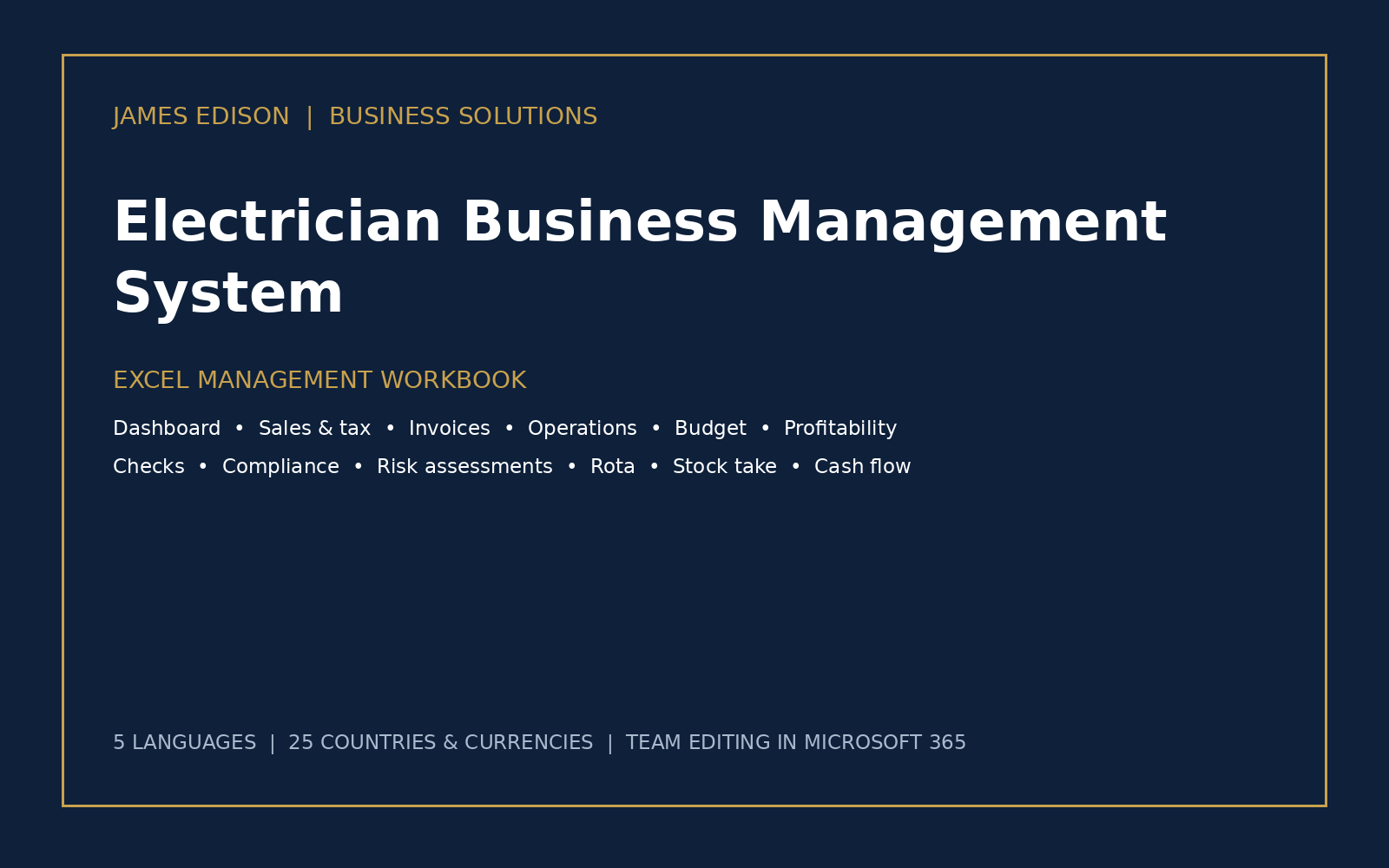
The Electrician Business Management System is an electrician business spreadsheet in Excel built around everything in this guide:
- Job tracker with labour hours, charge and cost per hour, materials, revenue, gross profit and a next inspection due reminder that turns amber 30 days ahead and red when overdue
- Sales and VAT, invoices and aged debtors with a "chase these first" list
- 12-week cash flow forecast with shortfall warnings
- Quarterly VAT summary, profit and loss, budget vs actual and a pricing calculator
- Daily and weekly checks including safe isolation, certificates issued, building control notifications, test kit and lock-off kit
- Compliance register pre-filled with competent person scheme membership, wiring regulations qualification, test instrument calibration, EV charger accreditation, insurance and waste carrier registration
- Risk assessments pre-filled for electric shock, asbestos, working at height and more
- Van stock take pre-loaded with cable, sockets, switches, MCBs and RCBOs, back boxes and connectors
- Staff rota with wage cost
- Dashboard with income, profit, margin, average job value, labour hours sold, materials billed, labour margin and a compliance score
It costs £15 once, with no subscription and no app. It works in Excel 2016 or later, Microsoft 365, Excel for Mac and Excel online, in 5 languages and 25 currencies.
**Get the electrician business spreadsheet →**
Your electrical business start-up checklist
1. Choose your niche: domestic, rewires, landlord inspections, EV chargers, commercial or call-outs. 2. Register as a sole trader or limited company and open a business account. 3. Confirm your wiring regulations qualification is current. 4. Join a competent person scheme and log the renewal date. 5. Get your test instruments calibrated and log the next date. 6. Arrange public liability, employers' liability, tools and van insurance. 7. Set fixed prices for standard jobs and work out your true hourly cost. 8. Build a van stock list with reorder levels. 9. Log every job with materials, hours and the next inspection due date. 10. Issue certificates and invoices the same day. 11. Track debtors, VAT and a 12-week cash flow forecast. 12. Write your risk assessments and daily safe isolation checks.
Frequently asked questions
How much does it cost to start an electrical business? The main costs are a van, tools and test equipment, initial stock, scheme membership, insurance and marketing. Many electricians start lean with a used van and add kit as work grows.
Do I need to join a competent person scheme? It is not compulsory, but in England and Wales it lets you self-certify notifiable domestic work instead of going through building control each time, which saves time and money. Rules differ in Scotland.
How much should an electrician charge per hour? Work out your true hourly cost from yearly overheads and billable hours, then add your profit target. Compare with local competitors and use fixed prices for standard jobs.
How do electricians get repeat work? Track the next inspection due date for every landlord and commercial customer and contact them before it is due. Periodic testing is reliable repeat income.
What software do self-employed electricians use? Many use a spreadsheet for jobs, invoices, stock, compliance and cash until they are big enough to justify a monthly app subscription.
Running an electrical business well is about paperwork as much as wiring. Get your schemes, certificates, pricing and cash flow organised and the profit follows. The electrician business spreadsheet puts it all in one Excel file for £15.