Most guides to becoming a content creator are about finding a niche, choosing a platform and buying a ring light. This one is about the part that decides whether creating content becomes a business: tax, advertising rules, pricing, costs and cash. Those are the parts that catch people out.
The UK creator economy is now big business: UK creator revenue is set to pass £1 billion for the first time, and Visa's research found 73% of UK creators see their content creation as a small business. The gap is in the running of it. A survey reported by IFA Magazine found that only 44% of people earning money from their content had filed a Self Assessment return.
This guide walks through setting up a content creator business properly, with worked numbers from our free start-up calculator.
1. Treat it as a business from your first paid post
HMRC doesn't have an "influencer tax". If you earn from content, it is self-employed trading income, the same as any sole trader.
The trigger is £1,000. Once your total trading income passes £1,000 in a tax year, measured before expenses, you must register for Self Assessment by 5 October after that tax year ends. It is one allowance across all your trading, not one per platform. So £600 from YouTube plus £500 from brand deals is £1,100, and you need to register.
What counts as income: - YouTube AdSense, TikTok and Meta creator payments - Brand deals and sponsored posts - UGC (user-generated content) fees from brands - Affiliate commission and discount-code payments - Patreon, memberships and subscriptions - Merch, presets, templates and courses - Gifted products given for promotion, which can count as income at their value
Platforms already report to HMRC. Under the digital platform reporting rules that began on 1 January 2024, UK platforms collect seller and creator information and report it to HMRC every year. Assuming small earnings go unnoticed is a bad bet.
Making Tax Digital for Income Tax started on 6 April 2026 for self-employed people above the income threshold. If you're in scope, you keep digital records and send quarterly updates through compatible software.
US income. YouTube AdSense is paid from the US. Submit a W-8BEN form so the UK–US tax treaty rate applies rather than the default withholding.
The habit that saves creators: move a fixed share of every payment into a separate tax account the day it arrives. Most creators who get into trouble with HMRC didn't plan to dodge tax. They spent the money and then faced one large bill.
2. Label every ad, every time
The ASA and CAP updated their *Influencers' guide to making clear that ads are ads* in October 2026. The rules are simple, and widely ignored:
- Anything you are paid for, gifted, given a trip for or earn commission on is likely to be an ad, whether or not the brand asked you to post.
- Label it upfront with "Ad" or "#ad", at the start of the caption or the video, before anything else.
- Labels such as "gifted", "sponsored", "spon" or "aff" on their own are not enough, because people don't understand them as ads.
- Use the platform's paid-partnership tools as well, but don't rely on them alone.
- The October 2026 guide also expects disclosure to continue for 12 months after a brand relationship ends.
Make the ad label a checklist item on every post, the same as spelling the brand's name right. It protects your reputation and the brand's, and brands increasingly put it in their contracts.
3. Choose your income mix
Relying on one platform is the biggest business risk a creator faces. An algorithm change or a policy decision can halve your income overnight. The strongest creator businesses mix:
1. Platform income: steady but small per view, and controlled by the platform. 2. Brand deals: usually the biggest earner, but lumpy. 3. UGC: videos made for brands to post on their own channels. It pays for your skill, not your audience size, so it's the fastest route to income for new creators. 4. Affiliate: passive once content is live. 5. Owned income: memberships, products, courses and email lists. This is the only income no platform can take away.
Track your income by stream every month. If one stream is more than half of your income, that's your biggest risk.
4. What it actually costs to start
Our free start-up calculator uses three scenarios. These are planning figures, not quotes:
| Item | Lean | Base | High |
|---|---|---|---|
| Camera or phone upgrade | £0 | £800 | £2,500 |
| Microphone and audio | £40 | £200 | £600 |
| Lighting | £30 | £150 | £600 |
| Editing computer and storage | £0 | £900 | £2,500 |
| Editing and design software (year 1) | £0 | £360 | £900 |
| Props, backdrops and set | £0 | £150 | £800 |
| Accountant, insurance and admin | £0 | £400 | £1,200 |
| Website, domain, email and media kit | £0 | £100 | £500 |
| Working capital reserve | £500 | £2,000 | £6,000 |
| Total | £570 | £5,060 | £15,600 |
The software line uses real 2026 UK prices: Adobe Premiere Pro at about £252 a year and Canva Pro at about £110 a year.
The lean column matters. You can start a creator business for a few hundred pounds with a phone you already own. Spend on audio before cameras, because audiences forgive average video far more than bad sound.
5. Work out your break-even
This is where most creators never look, and the reason so many quit within a year.
In the calculator's base example: - 8 paid deliverables a month (brand deals, UGC videos, sponsored posts) - £250 average fee per deliverable - £40 direct cost per deliverable (agency fees, props, travel) - £300 fixed costs a month (software, phone, insurance, accountant) - £1,500 owner pay target a month
Each deliverable contributes £210 (£250 − £40). Fixed costs plus pay are £1,800 a month. £1,800 ÷ £210 = about 8.6 paid deliverables a month to break even. At 8 deliverables, this creator is about £120 a month short of their target.
That one number changes decisions. Raising the average fee from £250 to £300 drops break-even to about 7 deliverables. Adding two UGC videos a month closes the gap entirely. Without the number, you're guessing.
6. Price brand deals properly
Underpricing is the most common creator mistake, and it's hard to undo. Build your rate from:
- Time: planning, scripting, filming, editing, revisions and approval rounds. A "30-second reel" can take a day.
- Usage rights: if the brand wants to run your video as a paid ad or on its own channels, charge for it, and limit it by time (for example 3 or 6 months).
- Exclusivity: if you can't work with competitors for a period, charge for the income you're giving up.
- Deliverables: price each format separately: video, story set, static post, link in bio.
- Audience quality: engagement and audience fit matter more to brands than raw follower counts.
Put every deal in writing: deliverables, deadlines, approval rounds, usage period, exclusivity, payment terms, kill fee and the ad label.
7. Get paid on time
Brands and agencies often pay 30 to 60 days after posting, and some pay late. Cash flow sinks creators the same way it sinks other small businesses.
- Invoice the day the content goes live.
- State payment terms on every invoice and chase on the due date.
- Track days to payment by brand. Slow payers should pay a deposit next time.
- Log gifted items at their value as they arrive.
8. Protect yourself and your channel
- Copyright: use only licensed music, images and fonts, and keep the licence records. Claims and takedowns can cut income from a video.
- Privacy: strip location data from photos and videos, delay posting from places you visit regularly, and use a business address for mail.
- Online abuse: use moderation tools, block and report, and keep evidence.
- Burnout: batch-film content, set posting limits and plan days off. Burnout is a business risk, not just a wellbeing one.
- Backups: keep raw footage and project files backed up in two places.
- Insurance: consider media liability or professional indemnity, equipment cover, and public liability for shoots and events.
- Data protection: if you hold fan or customer personal data (an email list or a shop), you may need to register with the ICO.
9. Run it from one place
A creator business has more moving parts than it looks: income streams, brand deals, invoices, gifted items, tax set-aside, compliance dates and a content calendar. Apps for each piece add up to monthly fees.
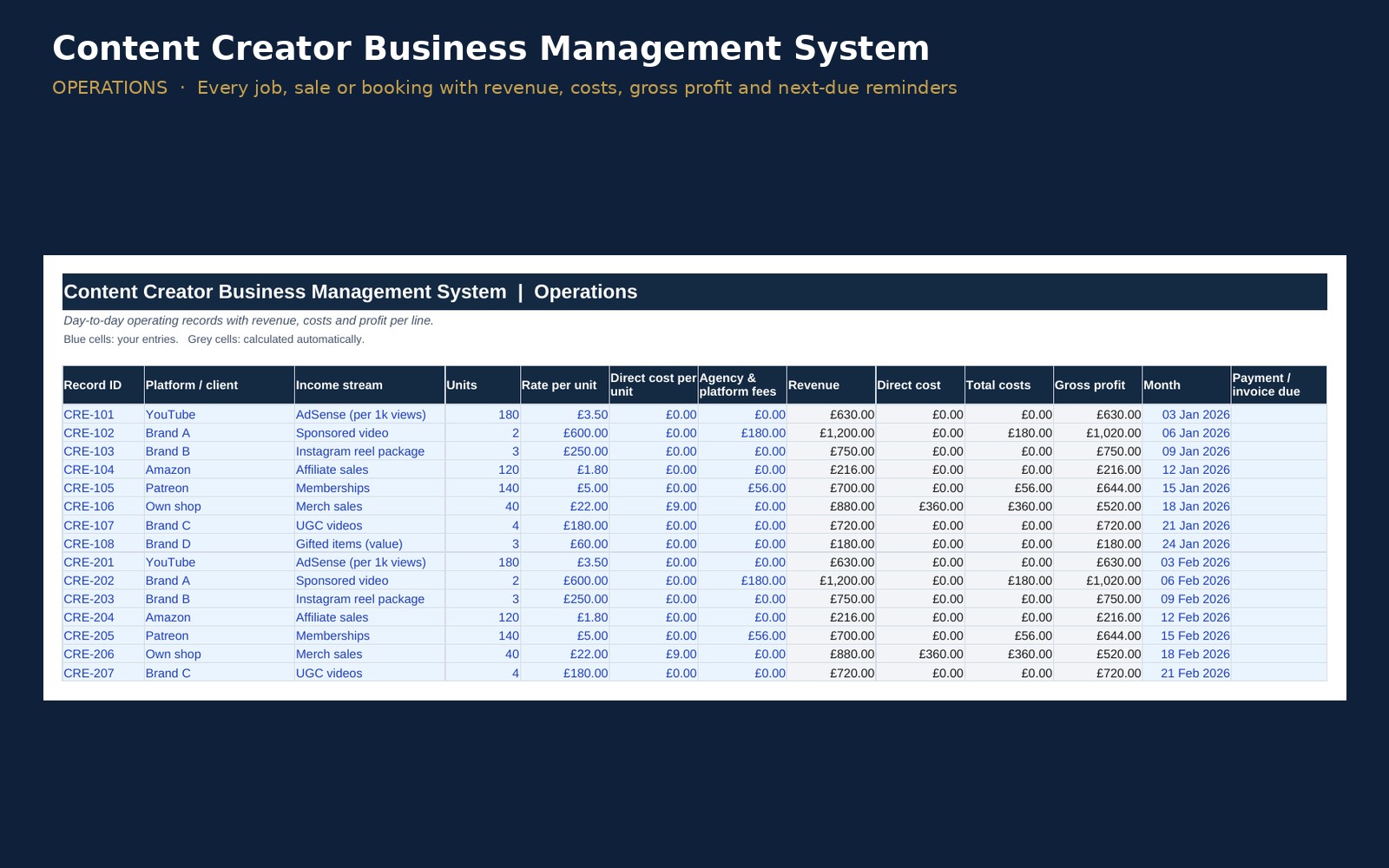
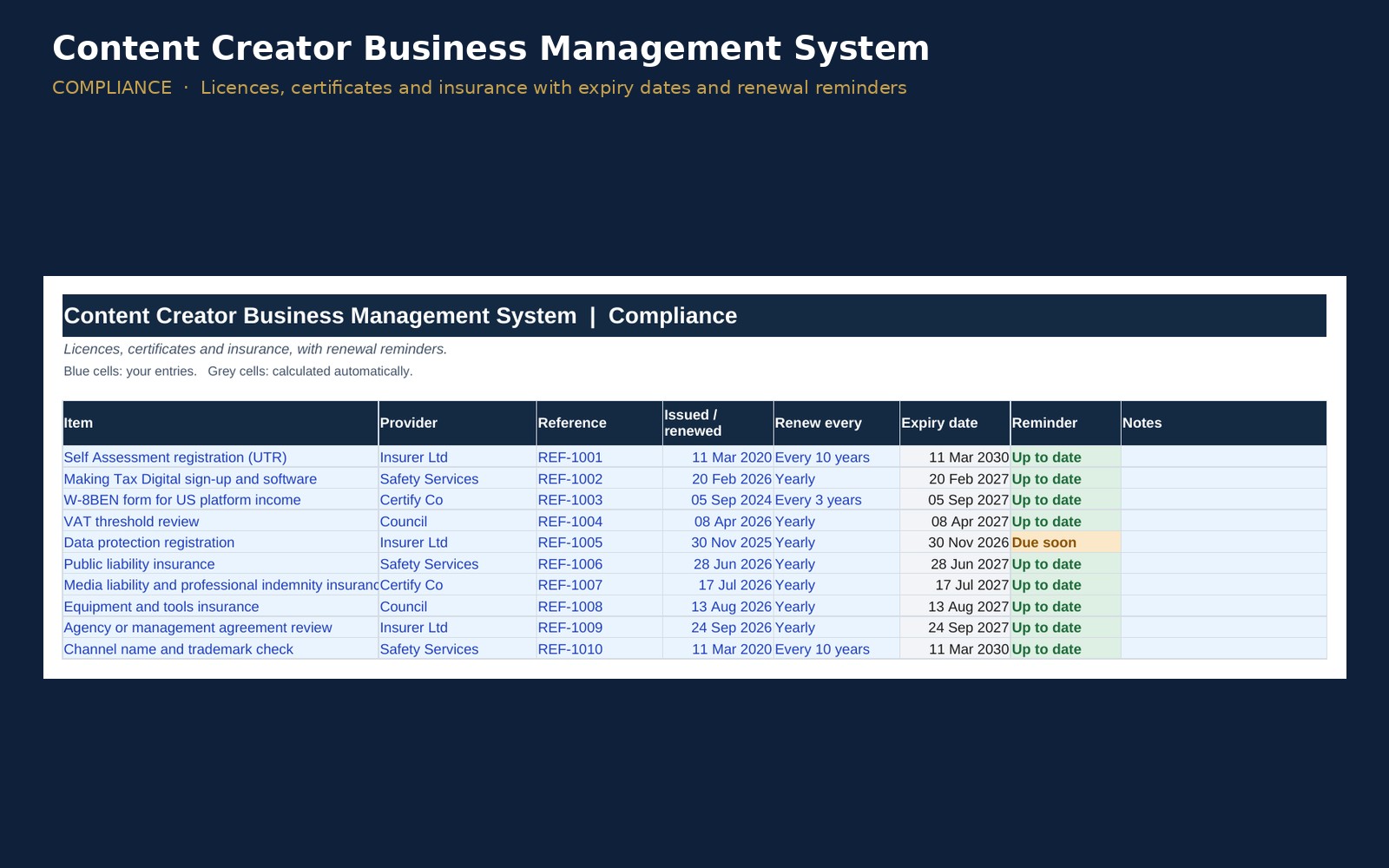
The **content creator business spreadsheet** keeps all of it in one Excel file for £15, with no subscription: - Income tracked by stream and client, with fees and gross profit on every line - Invoices, debtors and "chase these first" - Gifted items logged at value - A 12-week cash flow forecast and VAT summary - Daily, weekly and monthly checks: ad label on every post, licences, contracts, tax set-aside, quarterly updates - A compliance register for Self Assessment, MTD, W-8BEN, VAT, insurance and trademark dates - Risk assessments for burnout, abuse, privacy, copyright and undisclosed ads - A dashboard with paid deliverables, average fee, cost percentage and margin
Your content creator start-up checklist
1. Choose your income mix: platform, brand deals, UGC, affiliate and owned income. 2. Work out your start-up costs with the free content creator start-up calculator. 3. Find your break-even number of paid deliverables a month. 4. Register for Self Assessment once trading income passes £1,000. 5. Set up MTD-compatible records if you're in scope. 6. Submit a W-8BEN for US platform income. 7. Open a tax set-aside account and use it for every payment. 8. Put an "Ad" label upfront on every paid, gifted or affiliate post. 9. Build a rate card that charges for time, usage rights and exclusivity. 10. Use a written contract for every brand deal. 11. Invoice on posting and chase on the due date. 12. Write a plan with the content creator business plan template.
Want the full set? The Content Creator Full Business Pack includes the management system, the business plan template and all the free guides for £20.
Frequently asked questions
Do I need to register as self-employed as a content creator? Once your total trading income passes £1,000 in a tax year, before expenses, you must register for Self Assessment by 5 October after that tax year ends.
Are gifted products taxable? Gifted products given in return for promotion can count as income at their value. Log them as they arrive and speak to an accountant about your situation.
How do I label sponsored posts in the UK? Put "Ad" or "#ad" upfront, at the start of the post or video. Labels such as "gifted" or "sponsored" on their own aren't enough under ASA and CAP guidance.
How much should I charge for a brand deal? Charge for your time, the formats, usage rights and exclusivity, not just follower numbers. Work out your break-even so you know your minimum fee.
Can I be a content creator alongside a job? Yes. Your employer handles tax on your salary through PAYE, and your Self Assessment return covers your creator income.
Does Making Tax Digital apply to creators? Making Tax Digital for Income Tax started on 6 April 2026 for self-employed people above the income threshold. Check whether your income puts you in scope.
*Sources: GOV.UK Tax Help for Hustles; ASA/CAP Influencers' guide (October 2026); CMA social media endorsements guidance; Goforma 2026/27; LITRG digital platform reporting; Marketing Week; Visa Monetized Report; IFA Magazine; FluxNote 2026 software prices. This guide is general information, not tax advice.*