Micro-SaaS is one of the most talked-about business models of 2026: a small software product, often built by one person, that solves one problem for a niche audience and charges a subscription. AI coding tools have made building faster than ever. Application software is now the most common industry for new UK companies, with incorporations up 40% year on year in the first half of 2026, according to Beauhurst and NatWest.
Most micro-SaaS guides are written for an American audience. They cover ideas, code and launch, then skip the UK rules that can sink a subscription business. Two of them change in the next few months.
This guide covers the business side, with numbers from our free UK start-up calculator.
1. Start with a problem, not a product
The micro-SaaS products that work solve a narrow, painful problem for people who already spend money or time on it. "Invoice follow-ups for UK freelancers" beats "an AI productivity tool".
Validate before you build: - Talk to 10 to 20 potential users about the problem, not your idea. - Ask for commitment: a pre-order, a paid pilot or a waitlist sign-up with a real email address. - Check what they use now. If they're paying for a clumsy workaround, that's your opportunity.
2. The UK subscription rules that start on 1 January 2027
This is the most important change for any consumer subscription business in years, and most founders haven't heard of it.
The Digital Markets, Competition and Consumers Act 2024 introduces a new subscription contracts regime. After two delays it was brought forward, and the government has confirmed it applies from 1 January 2027. The rules follow the consumer, not the trader: if you market to UK consumers, accept UK orders or take UK payments, assume you're in scope wherever you're based.
What you'll need:
- Clear pre-contract information before someone subscribes: price, renewal terms, how to cancel.
- Reminder notices before a free or discounted trial ends, at regular intervals for rolling monthly contracts (guidance describes roughly every six months), and before annual contracts renew. They must be in writing, on a durable medium, and their purpose must be immediately clear.
- Easy online exit: if someone signed up online, they must be able to cancel online and switch off auto-renewal before the next renewal.
- Cooling-off rights: the existing 14-day initial cooling-off period stays, and a new 14-day renewal cooling-off period applies after a trial converts to full price or a 12-month-plus contract renews. For digital content, the initial cooling-off right can still be waived with express consent and acknowledgement. The renewal cooling-off period works differently, so plan your refund rules.
- Existing subscribers: transitional rules weren't finalised at the time of writing, so the safe assumption is that subscriptions renewing after January 2027 will need to comply.
The CMA can enforce consumer law directly, with fines of up to 10% of global turnover. Build reminders, cancellation and refund logic into your product now. It is far easier than retrofitting.
These rules apply to consumers. B2B-only products sit mostly outside this regime, but clear terms and easy cancellation are still good practice.
3. VAT: the UK threshold doesn't protect your EU sales
In the UK, the VAT registration threshold for 2026/27 remains £90,000 of UK taxable turnover. Below that, selling only to UK customers, you don't need to register.
For EU consumers, there is no threshold. Non-EU businesses selling digital services to EU consumers must register for VAT from the very first sale. VAT is charged at the customer's country rate. The practical route is the non-Union OSS scheme, which lets you file one quarterly return covering all your EU consumer sales from one registration.
You have three options: 1. Block EU consumer sales until you're ready. 2. Register for non-Union OSS in one EU country and file quarterly. 3. Use a merchant of record payment platform that acts as the seller and handles VAT for you, in exchange for a higher fee.
4. App store and payment fees
If you sell through Apple's App Store, the Small Business Program cuts commission from 30% to 15% for developers earning under $1 million a year, but enrolment isn't automatic. Apply before your first sale. Google Play and card processors also take a share, and lifetime deals, refunds and chargebacks all affect what you keep.
Model every fee. In our example operations data, platform and payment fees take about 4% of revenue across a mix of web and app-store subscriptions. That figure is far higher if most sales go through app stores.
5. What it costs to start
Our free calculator uses three scenarios. These are planning figures, not quotes:
| Item | Lean | Base | High |
|---|---|---|---|
| Development laptop | £0 | £1,200 | £2,500 |
| Domain, website and email | £10 | £100 | £400 |
| Hosting and database (year 1) | £0 | £300 | £1,500 |
| APIs and AI credits (year 1) | £0 | £400 | £2,000 |
| App store accounts | £0 | £100 | £100 |
| Design and branding | £0 | £300 | £2,000 |
| Terms, privacy, accountant and insurance | £0 | £600 | £2,000 |
| Launch marketing | £0 | £300 | £2,000 |
| Working capital reserve | £500 | £3,000 | £8,000 |
| Total | £510 | £6,300 | £20,500 |
The lean column is real: free hosting tiers and a laptop you already own mean many products launch for a few hundred pounds. The reserve is what most founders skip, and it's what keeps you going while subscribers build up.
6. Work out your break-even subscribers
In the calculator's base example: - £12 average revenue per subscriber per month - £1.50 per subscriber for hosting, APIs and payment fees - £350 a month of fixed costs (tools, software, insurance, accountant) - £1,500 a month owner-pay target
Each subscriber contributes £10.50. Fixed costs plus pay are £1,850. £1,850 ÷ £10.50 = about 176 paying subscribers to break even. With 150 subscribers, this founder is about £275 a month short.
That number tells you where to focus. Raising the price to £15 drops break-even to about 137 subscribers. Cutting churn means you need fewer new sign-ups to stand still. For deeper modelling of MRR, churn and runway, the SaaS Financial Model builds a full forecast, and the free SaaS Metrics Calculator handles the core subscription maths.
7. Price for profit, and watch churn from day one
- Price on the value of the problem, not your costs. Low prices attract customers who churn.
- Offer annual plans with a discount. They improve cash flow and cut churn, but they also trigger the new annual renewal reminders and renewal cooling-off rights from January 2027.
- Track why people cancel. Log every reason. Fixing the top one is usually your fastest growth.
- Watch per-user costs. API and AI usage grows with every user. If heavy users cost more than they pay, growth makes you poorer.
8. Data protection and security
- Pay the ICO data protection fee. Most businesses processing personal data must pay it.
- Publish a privacy notice that matches what your app actually collects, and review it when you add features.
- Secure API keys and admin access, and patch dependencies regularly.
- Test your backups by restoring them. A backup you've never restored is a hope, not a plan.
- Insurance: professional indemnity and cyber cover protect you if a bug or a breach costs a customer money.
9. Common mistakes that sink small software businesses
1. Building for months before anyone pays. Charge as early as the product reliably solves the core problem. Paying users give better feedback than free ones. 2. Free trials with no reminder. From January 2027, consumer trials need a reminder notice before they convert. Ending a trial without warning was already a quick way to collect chargebacks and angry reviews. 3. Making cancellation hard. Hidden cancel buttons and "call us to cancel" journeys won't survive the new rules, and they damage trust long before any regulator gets involved. 4. Ignoring EU VAT. A handful of EU consumer sales without a VAT plan creates a backlog of obligations in multiple countries. 5. Underpricing. A £3 a month product needs hundreds more subscribers than a £12 one to reach the same income, and cheaper customers often churn faster. 6. Not tracking per-user costs. AI-powered features can cost more per heavy user than the subscription brings in. Watch hosting and API cost per user every month. 7. No backup you've tested. Data loss is the one problem customers rarely forgive. 8. Mixing personal and business money. Use a separate account from day one. It makes VAT, Self Assessment and any future sale of the business far easier.
10. Run the business side in one place
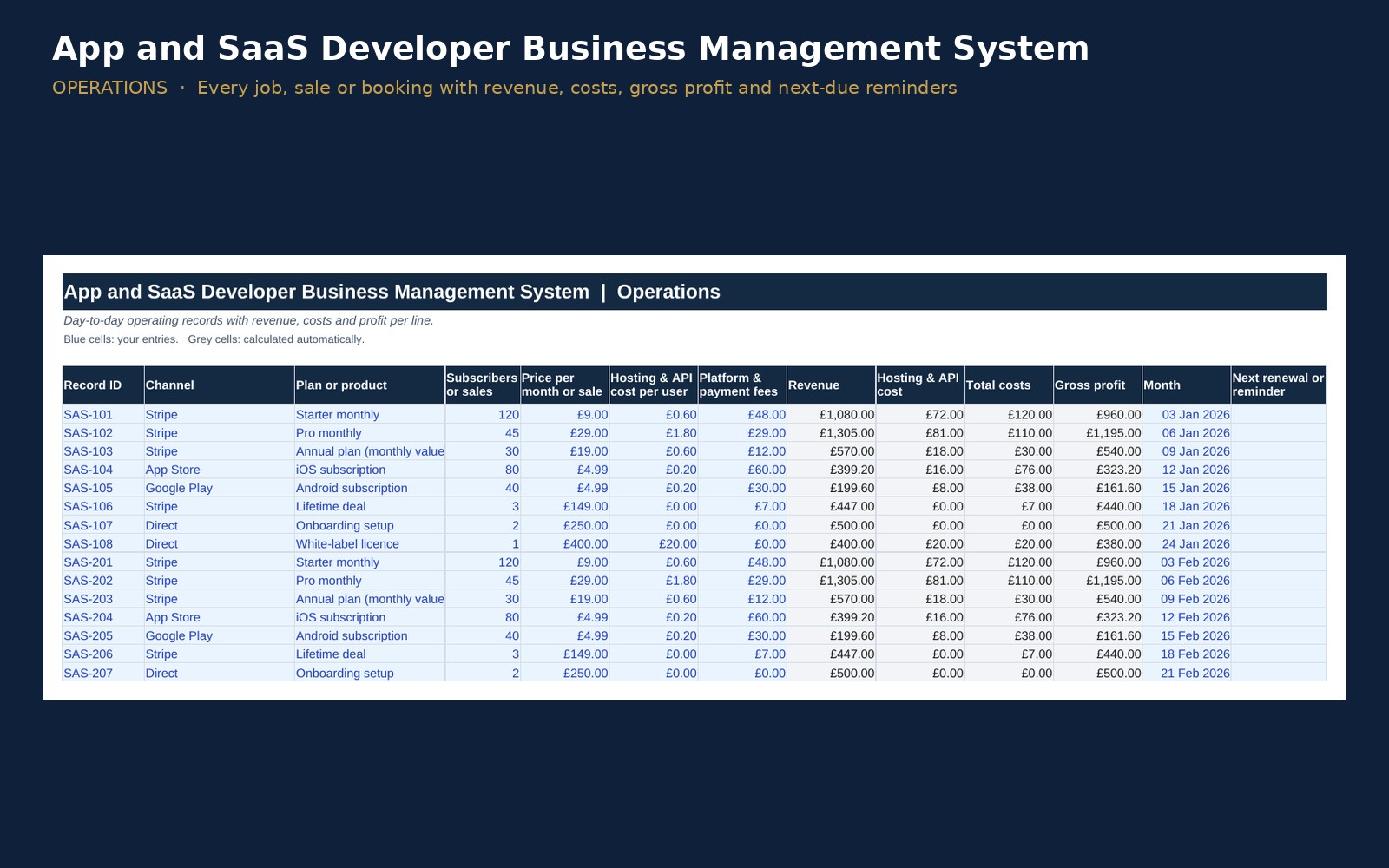
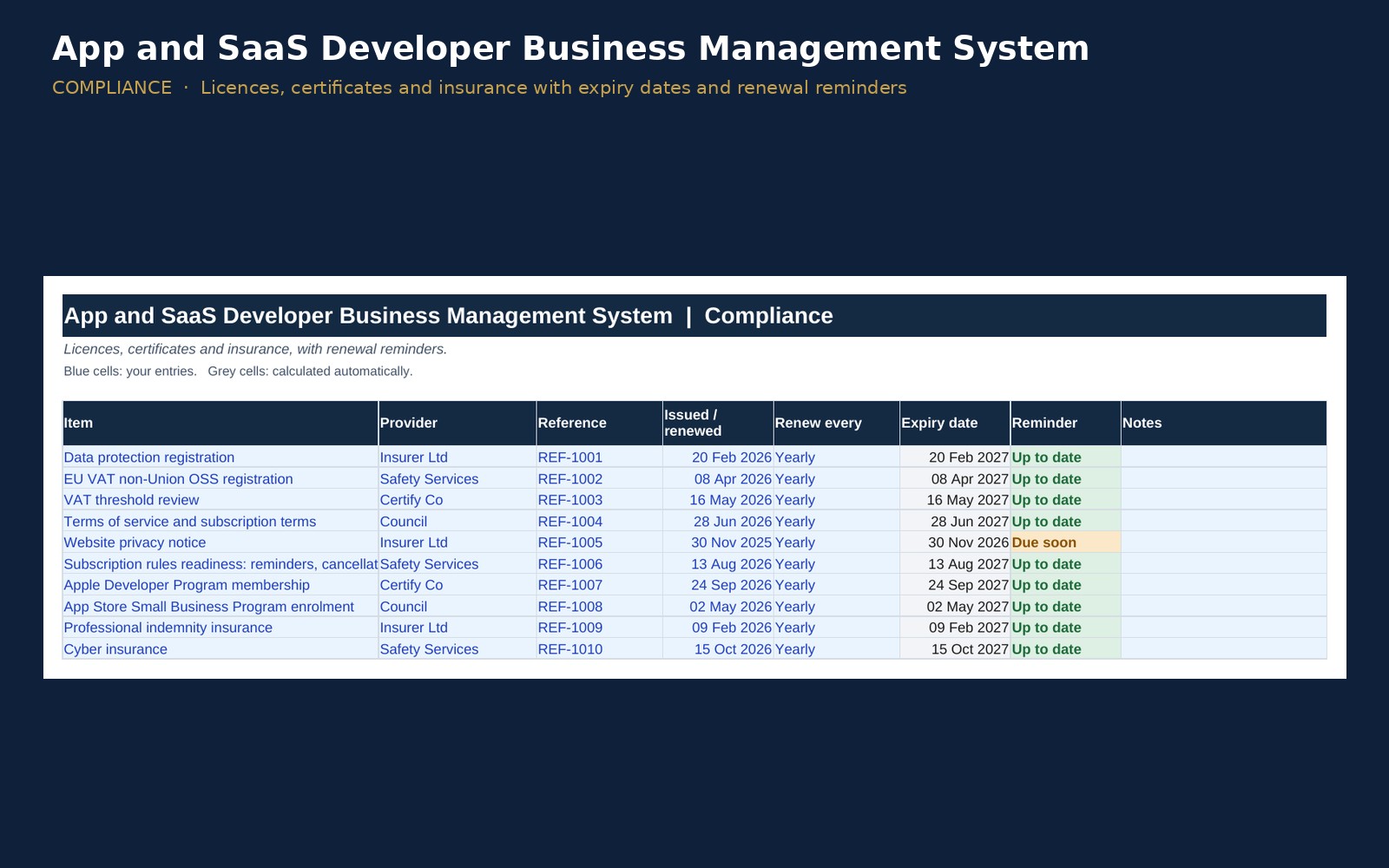
The **SaaS business spreadsheet** runs the business side in one Excel file for £15, with no subscription: - Subscribers and sales by plan and channel (Stripe, App Store, Google Play, direct) - Price, hosting and API cost per user, platform and payment fees, and gross profit on every line - Invoices, debtors, a 12-week cash flow forecast and VAT summary - Daily checks: uptime monitoring, support inbox, trial-end and renewal reminders - Weekly checks: backups, security patches, failed payments, cancellations, cost control - Monthly checks: online cancellation route tested end to end, VAT by customer country reconciled, API keys rotated - A compliance register: ICO fee, EU VAT OSS, UK VAT, terms, privacy notice, subscription rules readiness, Apple Developer and Small Business Program, insurance - Risk assessments: data breach, outages, breaching the January 2027 rules, payment freezes, app store rejection - A dashboard with paying subscribers, ARPU, platform fee percentage and gross margin
Your micro-SaaS start-up checklist
1. Validate the problem with committed users before you build. 2. Work out start-up costs and break-even subscribers with the free app and SaaS start-up calculator. 3. Build reminder notices, online cancellation and refund logic for the January 2027 rules. 4. Decide your EU VAT route: block, non-Union OSS or merchant of record. 5. Apply for the App Store Small Business Program if you're on iOS. 6. Pay the ICO fee and publish an accurate privacy notice. 7. Write clear subscription terms and a refund policy. 8. Set up monitoring, tested backups and security updates. 9. Price on value, offer annual plans and track every cancellation reason. 10. Write a plan with the app and SaaS business plan template.
Want everything at once? The App and SaaS Full Business Pack includes the management system, the business plan template and all the free guides for £20.
Frequently asked questions
When do the new UK subscription rules start? The government has confirmed 1 January 2027 for the subscription contracts regime under the Digital Markets, Competition and Consumers Act 2024.
Do I need to register for VAT to sell software to EU customers? For EU consumers, yes, from the first sale. The UK's £90,000 threshold doesn't apply to EU VAT. The non-Union OSS scheme lets you file one quarterly return, or a merchant of record platform can handle it for you.
How much does Apple take from app subscriptions? Standard commission is 30%. The App Store Small Business Program cuts it to 15% for developers earning under $1 million a year, if you enrol.
How many subscribers do I need to make a living? It depends on your price and costs. In our worked example, at £12 a month, you need about 176 paying subscribers to cover £350 of costs and £1,500 of pay.
Can I start a SaaS business alongside a job? Yes. Many founders do. Register for Self Assessment once your trading income passes £1,000 a year, and keep records from the start.
*Sources: Legal 500, TLT, Brodies and Mondaq commentary on the January 2027 subscription regime; HMRC VAT threshold 2026/27; Stripe and hellotax on EU non-Union OSS; Apple App Store Small Business Program; Beauhurst and NatWest New Startup Index H1 2026. This guide is general information, not legal or tax advice.*