
Home energy is one of the UK's biggest trade opportunities. Industry figures show 125,037 heat pumps were sold in the UK in 2025, up 27% on 2024, and solar PV installations hit record levels. The Warm Homes Plan commits around £13.2 billion over 2026 to 2030 to upgrade homes. For electricians and heating engineers, adding solar, batteries and heat pumps is one of the clearest routes to higher-value work.
This guide covers the business side: the VAT deadline that affects every quote this winter, what MCS certification really costs, how the Boiler Upgrade Scheme works for installers, start-up costs, and how many installs you need to break even.
*This guide is general information, not tax or legal advice.*
1. The deadline every installer needs to know: 31 March 2027
Installing qualifying energy-saving materials in homes (solar panels, battery storage and heat pumps, plus insulation and heating controls) is zero-rated for VAT until 31 March 2027.
- The Budget on 28 October 2026 did not extend it. The Treasury describes the return to the reduced rate as happening "as planned".
- From 1 April 2027, the same installations go back to 5% VAT.
- The zero rate covers the installed package: equipment plus labour, fitted by an installer. Materials bought on their own are standard-rated.
- Jobs that straddle the date: the tax point, normally the date of completion or payment, decides the rate. A job quoted at 0% that completes in April could be 5%.
- Part of a bigger job: where energy-saving materials sit inside a larger refurbishment or extension contract, the relief can fall away.
What to do now: update your quote templates to show the VAT rate and its expiry clearly, plan your installation calendar for January to March 2027, and expect demand to spike before the deadline. Book scaffold and stock early, because everyone else will be trying to finish jobs at the same time.
2. MCS certification: what it costs and why you need it
MCS (the Microgeneration Certification Scheme) is the quality mark for small-scale renewables. You don't legally need it to wire a solar system, but in practice you can't compete without it, because customers need it to:
- claim the Boiler Upgrade Scheme grant for heat pumps
- receive Smart Export Guarantee payments for solar electricity they export
Without MCS, an installer's heat pump quotes are effectively thousands of pounds dearer, because the customer loses the grant.
What it costs in 2026: - MCS puts the year-one cost for one technology at about £1,090, covering consumer code, certification body and licence fees, plus £30 for each installation certificate. - NICEIC's published fees: £114 application, £810 for 12 months' certification for one technology, and a £66 MCS licence fee (including VAT). - Certification is per technology. Solar PV, batteries and heat pumps are each assessed.
You'll also need consumer code membership (RECC or HIES), which sets rules on deposits, contracts and sales practices.
3. The Boiler Upgrade Scheme from the installer's side
In England and Wales, the Boiler Upgrade Scheme pays towards low-carbon heating. GOV.UK figures (September 2026): - £7,500 for an air source or ground source heat pump - £2,500 for an air-to-air heat pump - £5,000 for a biomass boiler - an extra £1,500 for eligible homes off the gas grid
Only MCS-certified installers can apply for and redeem vouchers, and the grant must be deducted from the customer's quote. Because you redeem the voucher after installation, grant money is a cash flow item. Track every voucher until it's paid.
4. The other qualifications and registrations
- Electrical competent person scheme membership, so you can self-certify notifiable electrical work.
- F-gas certification for heat pump work involving refrigerants.
- Heat pump and solar PV installation training to the standards your certification body expects.
- Grid notification: solar and battery systems need notifying to, or approval from, the network operator (G98 or G99).
- Working at height training and safe systems for roof work.
- Waste carrier registration for removing old equipment and packaging.
5. What installers earn
Industry guides for 2026 put employed heat pump engineers at about £38,000 to £48,000, dual-skilled gas and heat pump engineers at £48,000 to £62,000, and renewable specialists at £55,000 to £70,000, with London and the South East paying more. Business owners earn the margin on each job, so volume and pricing matter more than any salary figure.
6. What it costs to start
Our free start-up calculator uses three scenarios. These are planning figures, not quotes:
| Item | Lean | Base | High |
|---|---|---|---|
| MCS certification (year 1) | £0 | £1,090 | £2,200 |
| Training: solar PV, heat pumps, F-gas | £0 | £2,500 | £6,000 |
| Electrical competent person scheme | £0 | £500 | £700 |
| Insurance and workmanship warranty | £500 | £1,500 | £3,000 |
| Van, racking and signage | £0 | £3,000 | £15,000 |
| Tools and test equipment | £500 | £2,000 | £5,000 |
| Access equipment | £0 | £500 | £2,000 |
| Design software and job management | £0 | £400 | £1,200 |
| Launch marketing | £0 | £1,000 | £4,000 |
| Working capital reserve | £2,000 | £10,000 | £25,000 |
| Total | £3,000 | £22,490 | £64,100 |
The lean column assumes you're already a qualified electrician or heating engineer with a van. Working capital is the line people underestimate. You often buy panels, batteries and heat pumps before the customer's final payment or the grant voucher arrives. Customer deposits, protected under your consumer code, help.
7. Work out your break-even installs
In the calculator's base example: - £8,000 average job value including grants - £5,200 per job for equipment, materials, scaffold and certificates - £2,500 a month of fixed costs (van, insurance, memberships, software) - £2,500 a month owner-pay target
Each install contributes £2,800. Fixed costs plus pay are £5,000. £5,000 ÷ £2,800 = about 2 installs a month to break even. At 6 installs a month, the business has about £11,800 a month above target.
That makes installing look easy, but the margin per job is thin and fragile. An overrun day on scaffold, a missed component or a callback can wipe out a job's profit. Protect your margin per install more than you chase volume.
8. Price and sell honestly
- Price from a proper survey: a heat loss calculation for heat pumps, and a shading and roof assessment for solar.
- Show the grant and VAT clearly on every quote, and when the VAT rate changes.
- Use honest generation estimates. Misleading savings claims break consumer code rules and destroy trust.
- Add batteries and EV chargers where they genuinely suit the customer. They lift job value.
- Offer service plans for heat pumps. Recurring service income steadies cash flow.
- Charge for detailed design surveys, redeemable against the install, to filter out time-wasters.
9. Keep people safe
- Falls: scaffold with edge protection, trained installers and weather checks. Roof work is the biggest risk in the trade.
- Electric shock: isolation procedures, DC awareness and testing. Solar panels generate whenever there's light.
- Battery and inverter fires: follow manufacturer guidance on location and ventilation, and fit certified equipment only.
- Refrigerants: F-gas certified engineers, leak checks and records.
- Manual handling: two-person lifts and hoists for panels and heat pump units.
10. Common mistakes new installers make
1. Quoting 0% VAT on jobs that complete after 31 March 2027. Check the tax point. 2. Starting without MCS. Customers lose grants and export payments, and you lose the sale. 3. Underestimating working capital. Equipment is paid for long before grant vouchers are redeemed. 4. Skipping the survey. Undersized heat pumps and badly shaded arrays lead to complaints and callbacks. 5. Overpromising savings. Honest estimates protect your consumer code membership and reviews. 6. Losing track of paperwork. MCS certificates, grid notifications, F-gas records and warranties all have deadlines.
11. Run it like a business
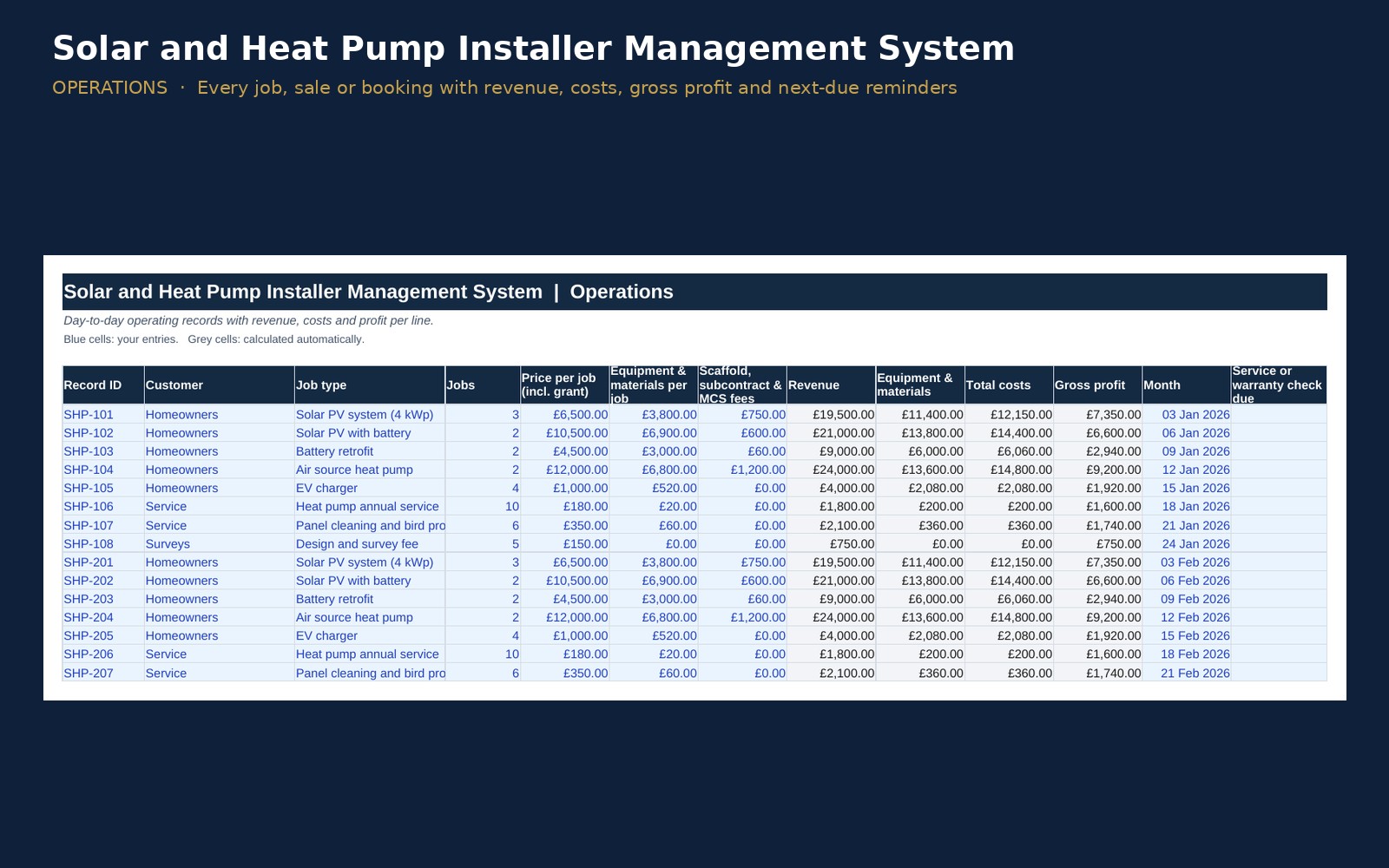
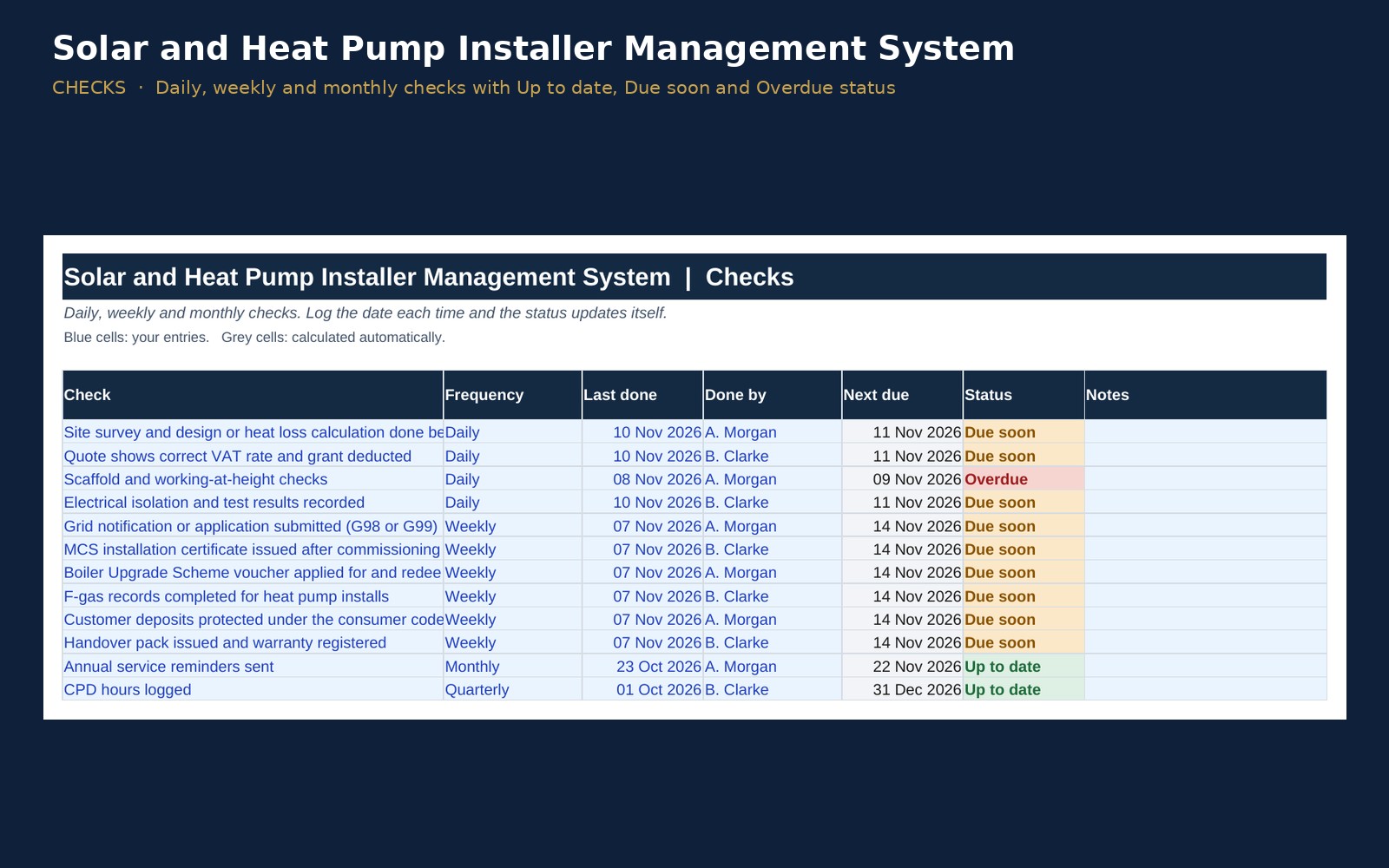
The **solar installer business spreadsheet** runs the business side in one Excel file for £15, with no subscription: - Jobs by type: solar PV, solar with battery, battery retrofit, air source heat pumps, EV chargers, servicing, cleaning and surveys - Price including grants, equipment and materials, scaffold, subcontract and MCS fees, with gross profit on every line - Invoices, debtors, a 12-week cash flow forecast and VAT summary - Daily checks: survey and design, correct VAT and grant on quotes, scaffold, electrical isolation - Weekly checks: grid notifications, MCS certificates, BUS vouchers, F-gas records, deposits, handover packs - A compliance register: MCS, consumer code, competent person scheme, F-gas, insurance, warranty, working at height, waste carrier, ICO fee, VAT - Risk assessments: falls, electric shock, battery fire, refrigerant leaks, manual handling, misleading claims and the VAT change - Stock: panels, inverters, batteries, mounting kits, cable, isolators, inhibitor and fittings
Already a plumbing and heating business? The Plumbing & Heating Business Management System covers boilers and general heating work. For larger projects, the Solar / Renewable Energy Project Finance Model forecasts returns.
Your installer start-up checklist
1. Get MCS certified for each technology you'll install. 2. Join RECC or HIES. 3. Join an electrical competent person scheme, and get F-gas certified for heat pumps. 4. Insure the business and offer insurance-backed workmanship warranties. 5. Update quote templates for the 31 March 2027 VAT change. 6. Set up your BUS installer account and a voucher tracking process. 7. Work out costs and break-even installs with the free solar and heat pump start-up calculator. 8. Plan working capital for equipment bought before payment. 9. Write a plan with the solar and heat pump installer business plan template.
Want everything at once? The Solar and Heat Pump Installer Full Business Pack includes the management system, the business plan template and all the free guides for £20.
Frequently asked questions
When does 0% VAT on solar panels and heat pumps end? On 31 March 2027. From 1 April 2027, installations in homes return to 5% VAT, and the October 2026 Budget did not extend the zero rate.
How much does MCS certification cost? MCS puts year one for one technology at about £1,090, plus £30 per installation certificate. NICEIC's fees include £114 to apply, £810 for 12 months for one technology and a £66 licence fee.
Do I need MCS to install solar panels? Not to do the electrical work, but customers need an MCS-certified installer to claim the Boiler Upgrade Scheme and the Smart Export Guarantee, so in practice you need it to compete.
How much is the Boiler Upgrade Scheme grant? £7,500 for an air or ground source heat pump, £2,500 for air-to-air and £5,000 for biomass, plus £1,500 extra for eligible off-gas-grid homes, in England and Wales.
How many installs do I need to break even? In our worked example, about 2 a month covers £2,500 of costs and £2,500 of pay. Protect the margin on each job, because one bad install can wipe out a month's profit.
Can a plumber or electrician add heat pumps or solar to an existing business? Yes, and many do. Add the training, MCS certification for each new technology, consumer code membership and F-gas certification for heat pumps. Then track renewable jobs separately so you can see whether they're earning their margin.
*Sources: GOV.UK VAT energy-saving materials relief; Selectra and SendWork on the Budget of 28 October 2026; GOV.UK Boiler Upgrade Scheme figures via Whito (September 2026); MCS 2026 costs via Reonic; NICEIC MCS fees; Payaca 2026 installer income guides. This guide is general information, not tax or legal advice.*