
Parents need childcare around the school day: before school, after school until 6pm, and through every holiday. The government's national wraparound programme aimed for every parent of a primary-age child in England to be able to access term-time care from 8am to 6pm, and holiday childcare is in constant demand.
2026 also brought a big change most guides haven't caught up with: free breakfast clubs in state primary schools. This guide explains what that means for the opportunity, then covers Ofsted registration, safeguarding, prices, start-up costs and how many child sessions you need to break even.
*This guide covers England. Rules differ in Scotland, Wales and Northern Ireland.*
1. The 2026 market: what free breakfast clubs change
The Department for Education is delivering a commitment to a free breakfast club in every state-funded primary school in England:
- 750 early adopter schools started in April 2025.
- The national rollout began in April 2026, with around 2,000 more schools joining between April 2026 and March 2027.
- By March 2027, around 2,750 schools will be delivering free breakfast clubs. There's no confirmed date yet for every school.
- Each free club offers at least 30 minutes of supervised care with food, free to every pupil, from reception to year 6.
What that means for your business: 1. Paid morning demand shifts earlier. Parents who start work before the free window still need early drop-off, from around 7.30am. 2. After-school and holiday demand is unaffected. The free offer is mornings only, so care from 3.15pm to 6pm and holiday clubs remain paid. 3. Schools need delivery partners. Schools can work with private, voluntary and independent providers, including childminders, to run their free breakfast clubs, funded by the government. That's a contract opportunity, not just competition, and it can give you a foot in the door for the school's after-school and holiday care too.
2. Childcare or activity club?
Decide which you're running, because it changes the rules:
- Childcare (after-school club, breakfast club, holiday club): care for 2 or more hours a day, usually 3.15pm to 6pm. Ofsted registration is usually required.
- Activity club (football, drama, coding): a single activity, often under 2 hours. Usually exempt from registration, though voluntary registration is possible.
3. Ofsted registration
The rules depend on the children's ages and how long they stay:
- Children aged 5 to 7 (from 1 September after their fifth birthday until their eighth birthday) cared for more than 2 hours a day must be on the compulsory part of the Childcare Register. This is a legal requirement.
- Reception-age children can bring Early Years Register rules into play.
- Children aged 8 and over: the voluntary part of the Childcare Register is optional, but it lets parents pay with Tax-Free Childcare and claim Universal Credit childcare support, so it's usually worth doing.
- Exemptions include care for less than 2 hours a day, settings running 14 days or fewer a year, and single-activity clubs.
- The fee: the 2026 Childcare Register registration fee is £114.
4. Safeguarding comes first
Ofsted, schools and parents judge you on safeguarding before anything else:
- Enhanced DBS checks for every adult working with children.
- A trained designated safeguarding lead and a clear reporting procedure.
- Safer recruitment: references, ID checks and an induction for every new staff member.
- Paediatric first aid on site at every session.
- Collection procedures: an authorised collector list, passwords and ID checks.
- Registers at every handover: from class, during the session and at collection.
- Allergies and medical needs: records, care plans, food labelling and staff trained to respond.
- Missing child, incident and complaints procedures, written down and practised.
5. What parents pay
Coram's 2026 surveys give the clearest benchmarks:
- After-school club: about £69 a week in England, around £14 a session.
- Holiday club: about £190 a week in England (£191 across Great Britain), and six weeks of summer holiday club averages £1,145 per child.
- Holiday club prices rose 5% in the last year.
Tax-Free Childcare adds £2 for every £8 parents pay, up to £2,000 a year per child. Registering as a provider makes your club cheaper for parents.
6. What it costs to start
Our free start-up calculator uses three scenarios. These are planning figures, not quotes:
| Item | Lean | Base | High |
|---|---|---|---|
| Ofsted registration | £114 | £114 | £300 |
| DBS checks and safeguarding training | £0 | £400 | £1,000 |
| Paediatric first aid and food hygiene | £0 | £300 | £800 |
| Insurance (year 1) | £300 | £600 | £1,200 |
| Equipment, games and sports kit | £200 | £1,000 | £3,000 |
| Hall hire: first half-term in advance | £0 | £1,500 | £4,000 |
| Booking, register and payments software | £0 | £300 | £800 |
| Launch marketing | £0 | £300 | £1,000 |
| Working capital reserve | £500 | £3,000 | £8,000 |
| Total | £1,114 | £7,514 | £20,100 |
7. Work out your break-even sessions
In the calculator's base example: - £15 average price per child session across early drop-off, after-school and holiday days - £1.50 per session for food, materials and booking fees - £6,000 a month of fixed costs (staff wages, hall hire, insurance, software) - £2,000 a month owner-pay target
Each session contributes £13.50. Fixed costs plus pay are £8,000. £8,000 ÷ £13.50 = about 593 child sessions a month to break even. That's roughly 30 children a day across a 20-day term month.
Staff are your biggest cost, and you need enough staff for the children booked whether the club is full or not. So occupancy is everything. A club running at 60% full can lose money; at 90% full it makes a good living.
8. Make the year work financially
- Run holiday clubs in every break. They earn far more per day than after-school sessions, and parents need them most.
- Use term bookings. Regular weekly bookings, paid in advance, fill places and steady cash flow.
- Bid for school contracts. Delivering a school's free breakfast club, or running its wraparound on site, gives guaranteed income.
- Add paid extras: sports, arts, coding or homework clubs within the session.
- Charge for late collection to protect staff time.
- Chase fees weekly. Staff are paid before parents' fees arrive.
9. Hire and keep good staff
Your staff are your club. Parents choose a club because their children are happy with the people who look after them, and Ofsted looks closely at staffing.
- Recruit safely: enhanced DBS checks, two references, ID checks and an interview that covers safeguarding.
- Look for split-shift workers: after-school work suits students, teaching assistants and parents whose own children are at school.
- Train from day one: safeguarding, your collection and allergy procedures, behaviour management and first aid.
- Plan cover: illness at 2pm can leave you short at 3.15pm. Keep a list of trained relief staff.
- Keep them: consistent hours, holiday club work in the breaks, and recognition go a long way in a sector with high staff turnover.
Staff costs are usually your biggest expense, so rota to the numbers booked, review staffing every week, and keep a written record of who was on shift each day.
10. Secure your venue
Most clubs run in a school hall or community building. Get a written lettings agreement covering: - times, including INSET days and term dates - storage for equipment - access, keys and lock-up responsibilities - cleaning and damage - fire procedures and evacuation points - the school handover process for collecting children from class
11. Common mistakes new clubs make
1. Not checking Ofsted rules first. Caring for 5 to 7-year-olds for more than 2 hours a day without registration is unlawful. 2. Ignoring the free breakfast rollout. Check whether your partner school is in the programme before planning a paid breakfast club. 3. Overstaffing quiet days. Use booking data to staff to numbers. 4. Underpricing holiday clubs. They cost more to run and parents expect to pay more. 5. Weak collection procedures. One wrong collection can end a club. 6. Not registering for Tax-Free Childcare. It makes you cheaper for parents at no cost to you.
12. Run it like a business
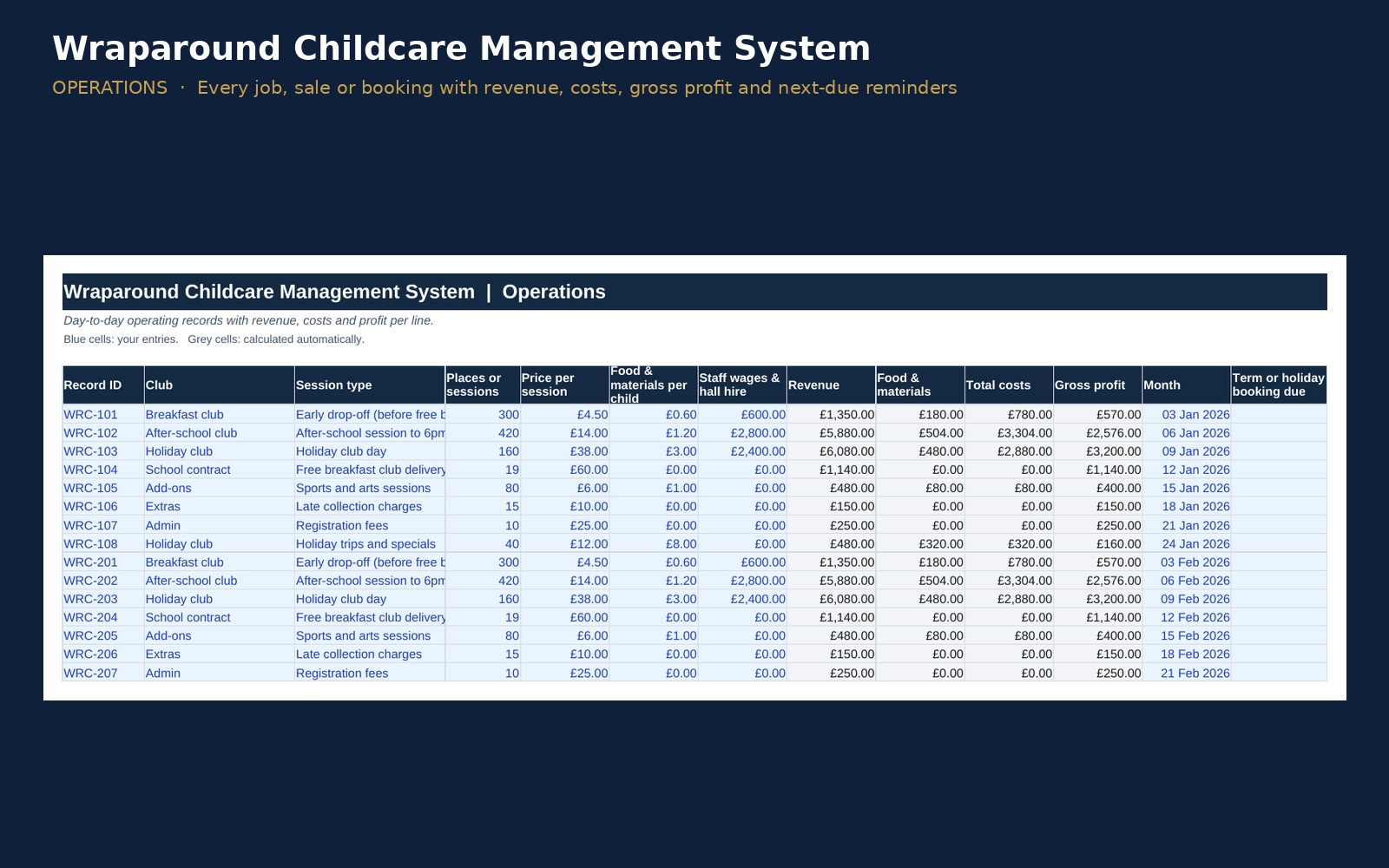
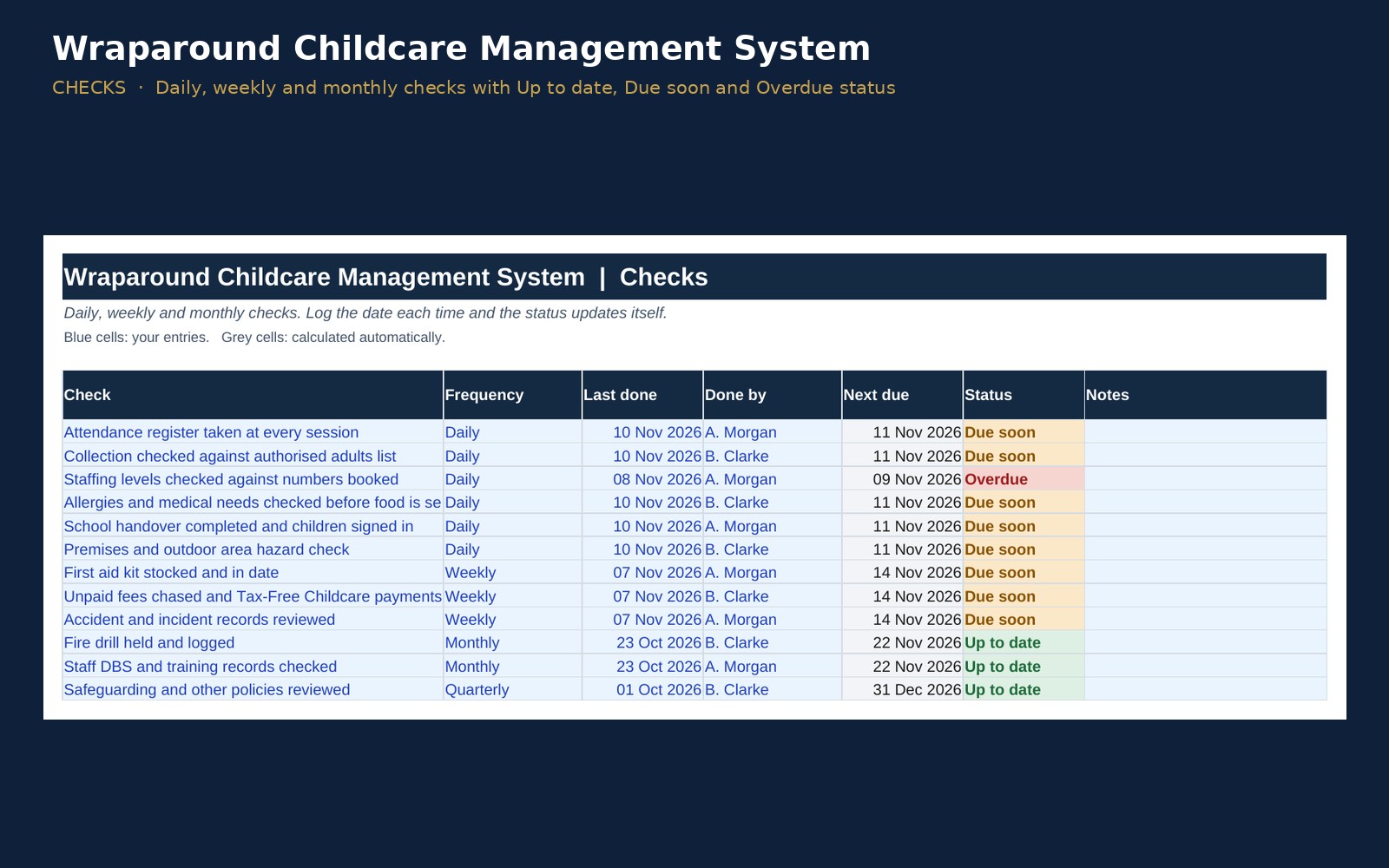
The **after school club management spreadsheet** runs the business side in one Excel file for £15, with no subscription: - Sessions by club: early drop-off, after-school to 6pm, holiday days, school contracts, add-ons, late collection and registration fees - Price, food and materials, staff wages and hall hire, with gross profit on every line - Invoices, debtors, a 12-week cash flow forecast and VAT summary - Daily checks: registers, collection against authorised adults, staffing levels, allergies, school handover, premises hazards - Weekly checks: first aid kit, unpaid fees and Tax-Free Childcare payments, incident records - Monthly and quarterly checks: fire drills, staff DBS and training records, safeguarding policies - A compliance register: Ofsted, safeguarding lead training, DBS, paediatric first aid, food hygiene, insurance, lettings, fire risk assessment, ICO fee, Tax-Free Childcare - Risk assessments: missing children, unauthorised collection, allergies, play injuries, safeguarding, evacuation, data
Thinking about home-based care instead? See the free childminder start-up calculator.
Your after-school club start-up checklist
1. Talk to local schools and parents to check demand, and whether the school runs a free breakfast club. 2. Decide on childcare or an activity club, and confirm your Ofsted route. 3. Get enhanced DBS checks, safeguarding lead training and paediatric first aid. 4. Write policies: safeguarding, collection, allergies, missing child, incidents, complaints. 5. Insure the business and sign a lettings agreement. 6. Register for Tax-Free Childcare. 7. Work out costs and break-even sessions with the free wraparound childcare start-up calculator. 8. Set prices for term-time and holiday sessions. 9. Write a plan with the wraparound childcare business plan template.
Want everything at once? The Wraparound Childcare Full Business Pack includes the management system, the business plan template and all the free guides for £20.
Frequently asked questions
Do I need Ofsted registration to run an after-school club? If you care for children aged 5 to 7 for more than 2 hours a day, yes: the compulsory part of the Childcare Register. For children 8 and over, registration is voluntary but lets parents use Tax-Free Childcare.
Will free breakfast clubs put paid breakfast clubs out of business? They change the morning market. Free clubs offer at least 30 minutes before school, so paid demand shifts to earlier drop-off. After-school and holiday care is unaffected, and schools can contract providers to deliver their free clubs.
How much do after-school clubs charge? Coram's 2026 survey puts the average at about £69 a week in England, around £14 a session. Holiday clubs average about £190 a week.
How many children do I need to break even? In our worked example, about 593 child sessions a month, roughly 30 children a day, covers £6,000 of costs and £2,000 of pay.
Can parents pay with Tax-Free Childcare? Yes, if you're registered with Ofsted (on either part of the Childcare Register) and signed up as a Tax-Free Childcare provider.
Can a childminder run a breakfast or after-school club? Yes. Childminders can offer before and after-school care from home, and schools can partner with childminders to deliver breakfast clubs. Check your registration covers the ages you care for.
*Sources: Department for Education free breakfast clubs guidance (April 2026) and summary business case (March 2026); Save the Children (2026); Coram Childcare Survey and Holiday Childcare Survey 2026; Surrey, Somerset and Southwark council guidance; Pembee (August 2026). This guide is general information, not legal advice.*