Retail and e-commerce sits in the top five sectors Brits say they'd most like to start a business in, according to a September 2026 Uswitch survey. It's easy to see why: you can launch an online shop from a spare room, sell through your own website and marketplaces at the same time, and grow without premises.
It's also never been more regulated. Since 2024 platforms report sellers to HMRC. Since 2025 the CMA can fine small sellers directly for hidden fees and fake reviews. Since June 2026 UK shops selling to EU customers need a new withdrawal button. This guide covers those rules, then the numbers: costs, fees per order and how many orders you need to break even.
*This guide is general information, not tax or legal advice.*
1. Treat it as a business from your first sale
HMRC trading allowance. Once your total trading income passes £1,000 in a tax year (before expenses), register for Self Assessment by 5 October after that tax year ends.
Platforms report you to HMRC. Under the digital platform reporting rules that began on 1 January 2024, UK platforms collect seller details and report them to HMRC every year. For goods sellers, the only carve-out is for those who make fewer than 30 sales and receive less than about £1,700 (€2,000) in a year. Above that, assume HMRC can see your sales.
Keep records by platform. Your own website, Amazon, eBay, TikTok Shop and markets each pay out differently, with different fees and timings. Reconcile them monthly so your tax return matches what platforms report.
VAT. Watch the £90,000 VAT registration threshold as you grow.
2. The consumer rules that catch small shops out
Cancellation and refunds. Under the Consumer Contracts Regulations, online customers can usually cancel within 14 days of receiving goods. You must refund within 14 days of getting the goods back (or proof of return).
Faulty goods. Under the Consumer Rights Act 2015, customers can reject faulty goods for a full refund within 30 days.
Drip pricing is banned. Since 6 April 2025, the Digital Markets, Competition and Consumers Act requires all mandatory charges to be included in the first price shown. Compulsory fees that only appear at checkout break the rules.
Fake reviews are banned. Since the same date, it's unlawful to buy, write or publish fake reviews, or to hide that reviews were incentivised. The CMA launched new fake review investigations in March 2026.
Small sellers are in scope. The CMA can now fine businesses directly, up to 10% of turnover. A legal review in October 2026 put it plainly: being small is no defence.
3. Selling to the EU from the UK
The EU is a big market, but it comes with its own rules:
- Withdrawal button: since 19 June 2026, online traders selling to EU consumers must provide a clearly labelled electronic withdrawal function. The test is where the customer is, not where you are, so a UK shop that ships to Ireland or France is in scope.
- EU VAT: EU consumer sales carry EU VAT. Low-value consignments usually go through the IOSS scheme.
- EU responsible person: under EU product safety rules, many products need a responsible person based in the EU.
Many new shops start UK-only, then add the EU once the systems are in place and they know which products sell.
4. Product safety
You're responsible for the safety of what you sell, whether you make it or buy it in:
- Buy from reputable suppliers and ask for test reports.
- Check the markings, labels, warnings and instructions your product type needs.
- Keep documents that prove compliance.
- Get product liability insurance.
- Have a plan for recalls if something goes wrong.
5. Choose your sales channels
Most successful small online shops sell in more than one place, but each channel works differently:
| Channel | Strengths | Watch out for |
|---|---|---|
| Your own website | Lower fees, you own the customer data, repeat sales | You have to bring the traffic |
| Large marketplaces | Huge built-in audience, trusted checkout | Higher fees, strict policies, price competition |
| Social commerce (TikTok Shop and similar) | Fast discovery through video | Trend-driven sales, platform fees, content demands |
| Wholesale and trade | Bigger orders, predictable volume | Lower margins, payment terms |
| Markets and pop-ups | Direct feedback, cash sales | Time-heavy, weather-dependent |
Start with one or two channels you can run well, then add more once your stock, fulfilment and records can cope. Track profit per channel, not just sales, because the channel with the most orders isn't always the one paying you.
6. What it costs to start
Our free start-up calculator uses three scenarios. These are planning figures, not quotes:
| Item | Lean | Base | High |
|---|---|---|---|
| Initial stock | £200 | £2,000 | £8,000 |
| Website or shop platform (year 1) | £0 | £400 | £1,500 |
| Product photography | £0 | £300 | £1,500 |
| Packaging and shipping supplies | £50 | £250 | £600 |
| Product testing and labelling | £0 | £300 | £1,500 |
| Product and public liability insurance | £100 | £300 | £800 |
| Trademark (one class) | £0 | £170 | £400 |
| Accounting software and accountant | £0 | £400 | £1,000 |
| Launch marketing | £0 | £800 | £3,000 |
| Working capital reserve | £500 | £3,000 | £8,000 |
| Total | £850 | £7,920 | £26,300 |
7. Know your numbers per order
Every order carries more costs than people expect: the product, packaging, postage, and platform or card fees. Then come returns, and the advertising it took to win the customer.
In the calculator's base example: - £28 average order value - £17 per order for product cost, platform fees and postage - £600 a month of fixed costs (software, insurance, storage, accountant) - £1,500 a month owner-pay target
Each order contributes £11. Fixed costs plus pay are £2,100. £2,100 ÷ £11 = about 191 orders a month to break even. At 400 orders, this shop is about £2,300 a month ahead of target.
Margin differs by channel. In our example operations data, the shop makes a gross margin of about 42% across all channels before overheads, but marketplace orders carry much higher fees than its own website. A busy channel isn't always a profitable one.
8. Grow profit, not just sales
- Raise average order value with bundles, add-ons and free-delivery thresholds.
- Move repeat customers to your own website, where fees are lower and you own the relationship.
- Watch stock turn. Cash stuck in slow stock can't buy best sellers. Our DTC inventory and working capital guide covers reorder points.
- Cut returns with better photos, sizing and descriptions.
- Know your customer acquisition cost. Ad spend per new customer must be well below the profit you'll make from them.
- Sell on more than one channel so one marketplace suspension can't stop your business.
9. Common mistakes new online shops make
1. Ignoring HMRC until January. Platforms report your sales, so keep records from day one. 2. Hidden fees at checkout. Drip pricing is banned, so show the full price upfront. 3. Buying or swapping reviews. It's unlawful, and marketplaces suspend accounts for it. 4. Overbuying stock. Start small, reorder what sells, and clear what doesn't. 5. Not counting fees per channel. Marketplace fees can wipe out the margin on cheap products. 6. Shipping to the EU without the rules in place. The withdrawal button, VAT and responsible person all apply. 7. No product safety documents. If a product causes harm, you'll need to show what you checked.
10. Run it like a business
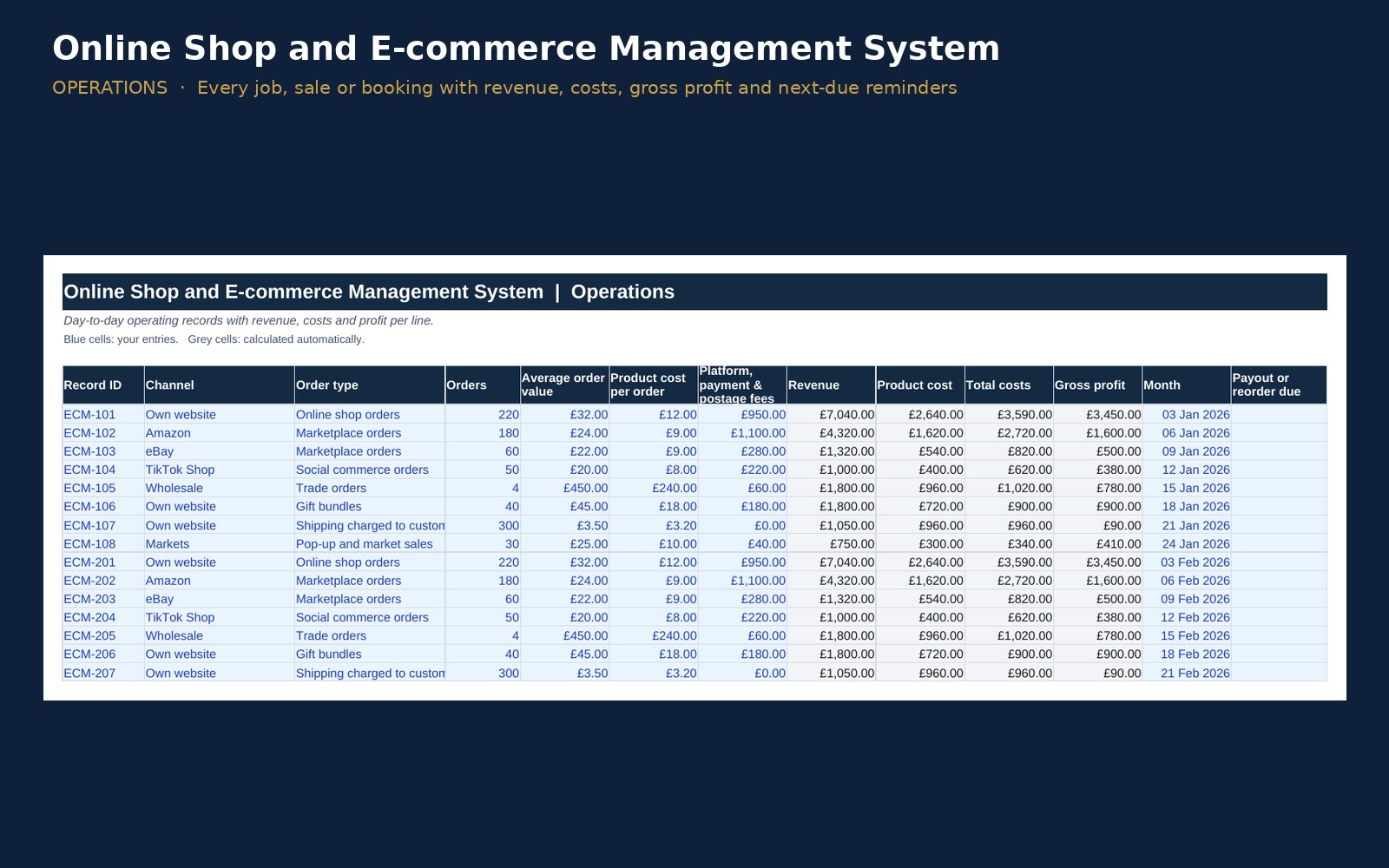
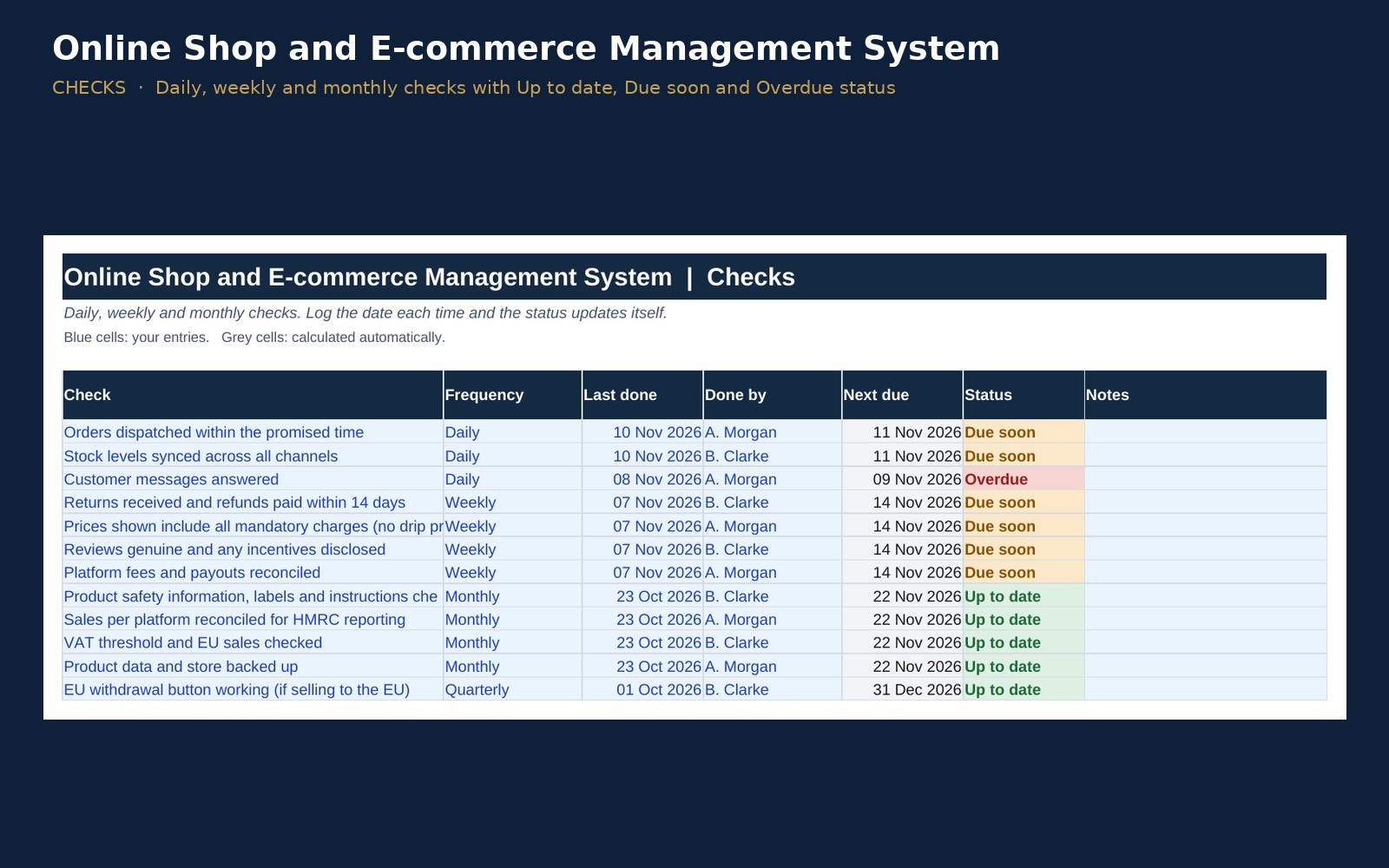
The **ecommerce business spreadsheet** runs the business side in one Excel file for £15, with no subscription: - Orders by channel (own website, Amazon, eBay, TikTok Shop, wholesale, markets) with average order value, product cost and fees - Gross profit per channel, invoices for trade customers, a 12-week cash flow forecast and VAT summary - Daily checks: dispatch times, stock sync across channels, customer messages - Weekly checks: 14-day returns and refunds, total prices shown, genuine reviews, platform fees and payouts - Monthly and quarterly checks: product safety information, HMRC platform reconciliation, VAT and EU sales, backups, EU withdrawal button - A compliance register: Self Assessment, VAT, ICO fee, website policies, insurance, EU responsible person, EU VAT, trademark, packaging and WEEE, marketplace account health - Risk assessments: unsafe products, drip pricing, fake reviews, account suspension, overselling, fraud, manual handling - A stock take for product lines and packaging, with reorder alerts
Selling mainly on Amazon? See the Amazon FBA Financial Model and the free Amazon FBA start-up calculator. Building your own brand? The E-Commerce / DTC Financial Model forecasts growth and cash.
Your online shop start-up checklist
1. Choose your products and check their safety requirements. 2. Work out costs and break-even orders with the free online shop start-up calculator. 3. Publish website terms, a returns policy and a privacy notice. 4. Show all mandatory charges in the first price. 5. Set up an honest review process. 6. Get product liability insurance. 7. Plan Self Assessment and keep records by platform. 8. Decide on EU selling: withdrawal button, VAT and responsible person. 9. Write a plan with the online shop business plan template.
Want everything at once? The Online Shop Full Business Pack includes the management system, the business plan template and all the free guides for £20.
Frequently asked questions
Do online platforms report my sales to HMRC? Yes. Since 1 January 2024, UK platforms collect seller information and report it to HMRC every year. Goods sellers are only excluded if they make fewer than 30 sales and receive less than about £1,700 (€2,000) in a year.
What is drip pricing and is it banned? Drip pricing is revealing mandatory charges late in the buying process. It has been banned in the UK since 6 April 2025: mandatory charges must be in the first price shown.
Do I need a withdrawal button if I sell to the EU? Since 19 June 2026, online traders selling to EU consumers must provide a clearly labelled electronic withdrawal function, including UK-based shops.
How long do customers have to return items bought online? Usually 14 days from receiving the goods to cancel, with refunds due within 14 days of getting the goods back. Faulty goods can be rejected for a full refund within 30 days.
How many orders do I need to break even? In our worked example, about 191 orders a month covers £600 of costs and £1,500 of pay. Check your fees per channel, because margins differ.
Should I start on a marketplace or my own website? Many sellers start on a marketplace for the built-in audience, then build their own website to keep more margin and own the customer relationship. Track fees and profit per channel to decide where to focus.
Do I need a licence to sell online? There's no general licence for selling goods online, but some products have their own rules (food, cosmetics, electrical items, toys and age-restricted goods, for example). Check the requirements for your product type before you list it.
*Sources: GOV.UK Tax Help for Hustles; HMRC digital platform reporting guidance; Consumer Contracts Regulations 2013; Consumer Rights Act 2015; CMA guidance and enforcement under the DMCC Act; Cooley (October 2026); Mondaq (2026); Directive (EU) 2023/2673; Uswitch September 2026. This guide is general information, not tax or legal advice.*