"How to start a clothing company" is the most-searched passion-led business idea in the UK, according to a 1st Formations study of Google searches. It's also one of the easiest businesses to start badly: brands buy too much stock in the wrong sizes, skip the legal labels and price without counting returns.
This guide covers the business side: which production model to start with, what samples and stock really cost, how to protect your name, the labelling law, and how many items you need to sell to break even.
1. Pick a niche you can describe in one sentence
Big brands win on price and reach. Small brands win on a clear customer: a sport, a community, a style or a value such as UK-made or organic. Write down who buys from you, what they wear now and why they'd switch. Test it before you spend: show designs to your target customers, run a pre-order or a small drop, and see who actually pays.
2. Choose print on demand or bulk production
- Print on demand: each item is made after a customer orders. There's almost nothing up front and no unsold stock, but less control over quality and a lower margin per item.
- Bulk (cut, make and trim, or blanks you decorate): much lower cost per item and full control, but minimum orders are often 50 to 1,000 units, paid up front (Tide).
A common route is to test designs on demand, then move proven best-sellers into bulk.
3. Budget for samples first
Before a production run you'll pay for pattern cutting and samples. Make it British's UK guide prices are about £50–£100 for a shirt pattern and £100–£300 for a dress, and £30–£100+ for a T-shirt sample or £80–£200+ for a hoodie. A manufacturer's prototype often costs at least double the production price. Expect two or three rounds before a design is right.
4. What it costs to start
Over half of Make it British members spent more than £15,000 before their product went on sale, but brands have launched on far less. Our free calculator puts a print-on-demand start at a few hundred pounds and a base launch with samples and a first run at around £7,700:
| Item | Lean | Base | High |
|---|---|---|---|
| Brand name checks, logo and design | £0 | £300 | £1,500 |
| UK trade mark (online) | £0 | £205 | £265 |
| Pattern cutting | £0 | £300 | £1,500 |
| Samples | £0 | £400 | £1,500 |
| First production run | £0 | £3,000 | £12,000 |
| Labels, swing tags and packaging | £50 | £300 | £1,000 |
| Online store and product photos | £0 | £400 | £2,000 |
| Launch marketing | £0 | £800 | £3,000 |
| Working capital reserve | £300 | £2,000 | £6,000 |
| Total | £350 | £7,705 | £28,765 |
Work through your own figures with the free clothing brand startup calculator.
5. Protect your brand name
Check the name is free at Companies House and on the UK trade mark register before you print anything. Since 1 April 2026 a UK trade mark costs £205 online for one class, plus £60 for each extra class. Clothing sits in class 25. A registration lasts 10 years, and it's what lets you stop copycats.
6. Get the labelling law right
Under the Textile Products (Labelling and Fibre Composition) Regulations 2012, every garment needs a fibre composition label in English, using approved fibre names. If a product can be ordered online, the fibre content must be shown on the product page too (Business Companion). Kidswear and nightwear carry extra safety rules on cords, drawstrings and flammability, so ask suppliers for test reports.
7. Price for profit, returns included
Start from the full landed cost of each item: making, labels, packaging, postage, payment fees and a share of your ad spend. Then set a retail price and a lower wholesale price if you plan to sell to shops. Online customers usually have a 14-day right to cancel after delivery, and clothing returns are common, so build a return allowance into your margin.
8. Work out your break-even
Our calculator's base example sells at £32 an item with £13 of costs per item, and has £350 of monthly fixed costs plus a £1,200 owner-pay target. That needs about 82 items a month to break even, roughly 19 a week. Change the numbers to yours: if break-even looks out of reach, cut fixed costs or raise your average price before you order stock.
9. Sell where your customers already are
- Your own online store: the highest margin and you own the customer list.
- Pop-up markets: instant feedback on fit, price and designs.
- Wholesale to boutiques: bigger orders at a lower price per item.
- Custom team and club merch: steady orders from local groups.
An email list for launches and restocks is the cheapest marketing you'll ever do.
10. Run it like a business
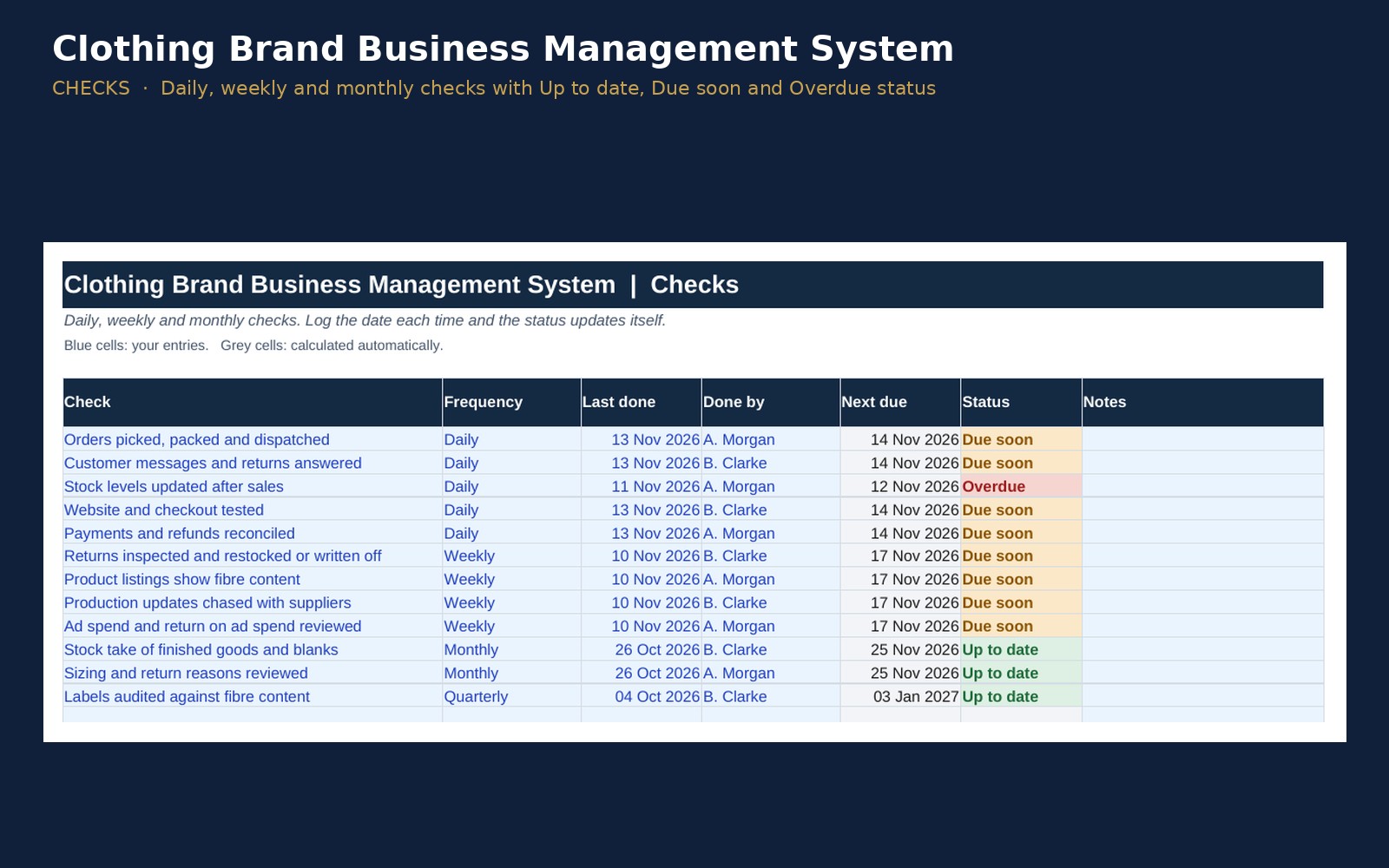
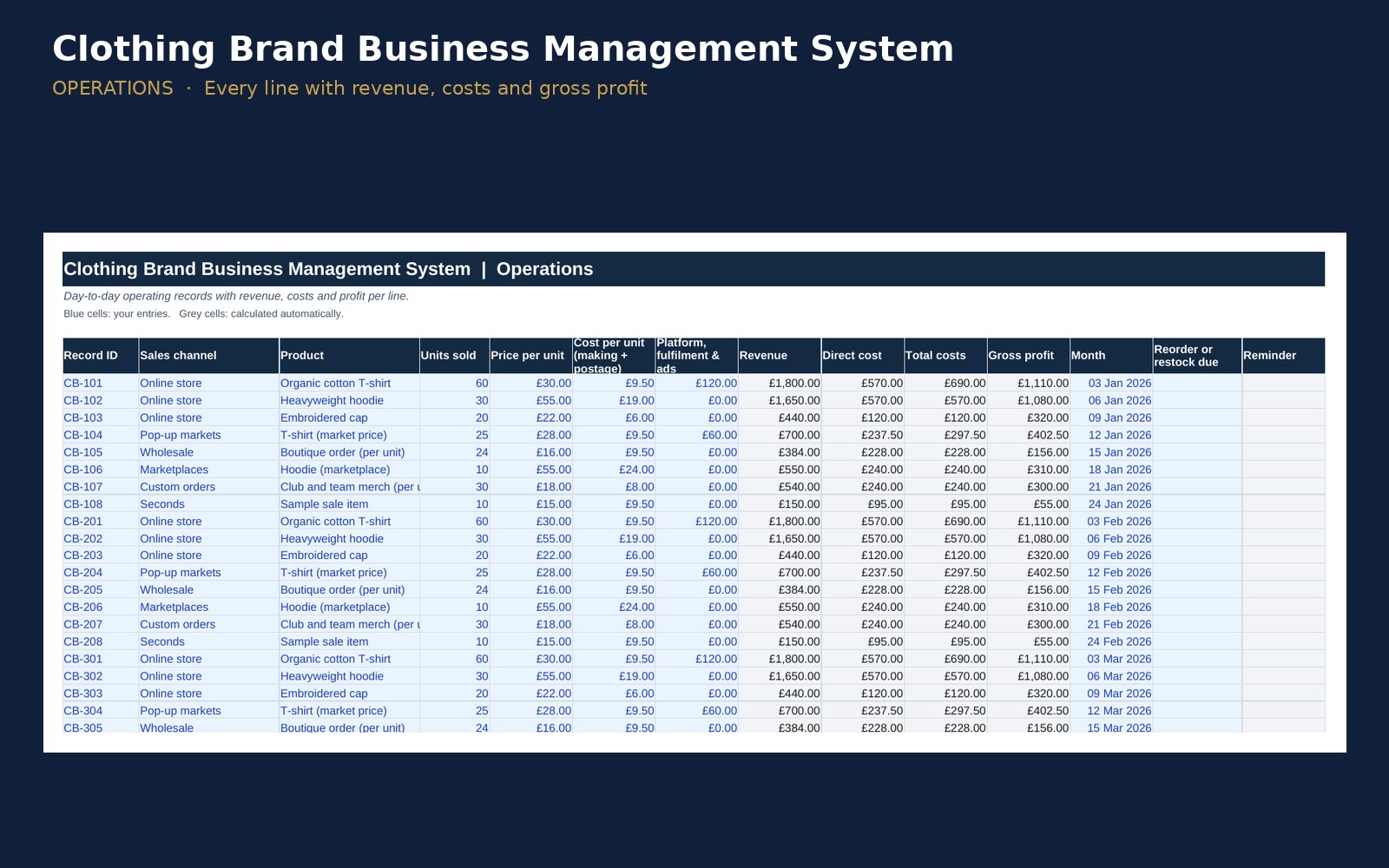
Track units sold, sell-through, return rate and gross margin every month. Sell-through tells you whether you ordered the right amount of each design, and it's the number that stops cash getting stuck in stock. Keep your trade mark, insurance, supplier test reports and label checks in one place with renewal dates.
Your clothing brand start-up checklist
- [ ] Niche and customer written down
- [ ] Demand tested (pre-orders or a small drop)
- [ ] Production model chosen
- [ ] Samples approved
- [ ] Name checked and trade mark filed
- [ ] Fibre content labels on every garment and product page
- [ ] Returns policy published
- [ ] Insurance in place
- [ ] Break-even units known
- [ ] Stock, returns and margin tracked monthly
Run it properly from day one
The **Clothing Brand Business Management System** is a clothing brand business spreadsheet that tracks every order, cost, invoice and VAT return, with checks, compliance dates, risks and stock in one Excel file. It costs £15 once, with no subscription. Planning to borrow? The Clothing Brand Business Plan Template (£10) is laid out the way lenders expect, or get both with every free guide in the Full Business Pack for £20.
Next, read how much a clothing brand owner earns and the KPIs to track.
Related: Online shop startup costs
Related: How to start an online shop
Frequently asked questions
How much does it cost to start a clothing brand in the UK? Print on demand can start for a few hundred pounds. A base launch with pattern cutting, samples, a first production run, a trade mark, labels and a store is around £7,700 in our free calculator. Over half of Make it British members spent more than £15,000 before launch.
Do I need a licence to sell clothes? No licence is needed to sell clothing, but every garment must have a fibre composition label, product pages must show fibre content, and kidswear and nightwear have extra safety rules.
Should I trade mark my clothing brand? If you plan to build a name, yes. A UK trade mark costs £205 online for one class (clothing is class 25) since 1 April 2026, and lasts 10 years.
Is print on demand worth it? It's the lowest-risk way to test designs because there's no stock, but margins are lower. Many brands start on demand and move best-sellers to bulk production.
Can I start a clothing brand from home? Yes. Many brands start from home with print on demand or a small first run. Check your home insurance and mortgage or tenancy terms if you store stock or have customers collect.